CRE Loan Memo Structure and What Lenders Actually Read
Lenders scan the first three pages for four key questions before voting on any CRE deal.

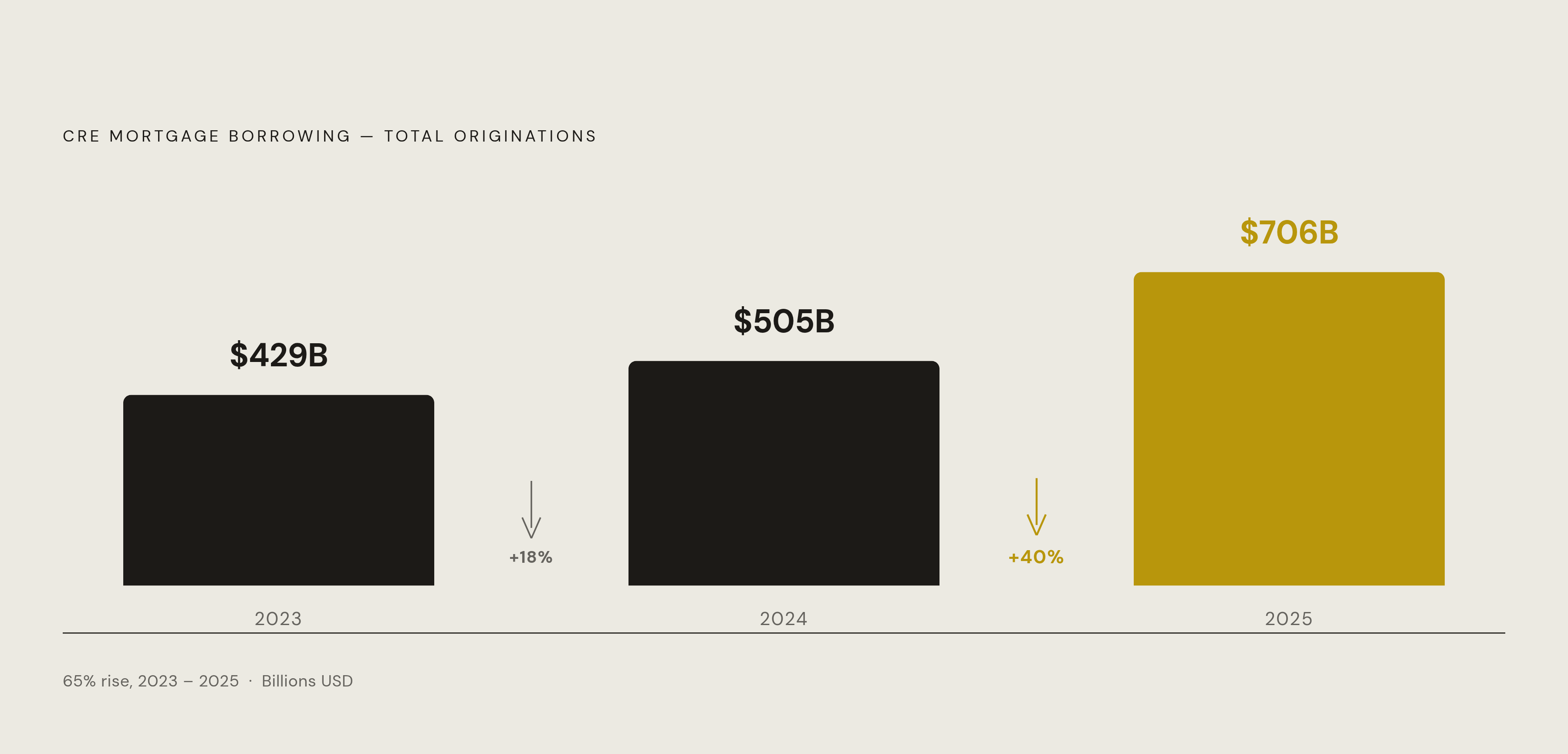
Total CRE mortgage borrowing hit an estimated $706 billion in 2025, up 40% from $505 billion in 2024 and 65% from $429 billion in 2023, according to a trade association that tracks mortgage lending. Volume is surging, but the bottleneck hasn't moved: it's still the loan memo, and specifically, whether the analyst reading it can find what committee needs in the first three pages. Deal flow is up. Bandwidth at the credit committee table is not. That mismatch is what makes memo quality, not just deal quality, a determinant of approval speed.
What the loan memo is, and what it is not
A commercial credit memo is the lender's written recommendation to approve, decline, renew, or modify a credit request. It is not a summary of the borrower's paperwork, and treating it as one is the most common mistake in a first-draft memo. Its job is to take financial statements, tax returns, collateral documentation, due diligence findings, and the lender's own policy, and turn all of it into a position the credit committee can act on.
That distinction matters because credit analysis and the credit memo serve different functions. The analysis is the work: spreading financials, checking debt yield, running comps, stress-testing cash flow. The memo is what packages that work into something committee can vote on and something the institution can point to later if a regulator or auditor asks why the loan was approved. One document exists to support a decision. The other exists to record it.
The financing memorandum a sponsor or broker submits is not the same thing as the credit memo the lender's analyst produces. The FM is the input. The credit memo is the output, built internally, often by an analyst who has never spoken to the borrower directly. A financing memorandum should not be confused with an offering memorandum, either, even though the two often look similar on the page. An OM targets equity investors and pitches upside. An FM targets lenders and pitches repayment certainty. Same format, nearly opposite argument.
Every credit memo, regardless of institution or asset type, is ultimately answering four questions before committee has to ask them out loud: can the borrower repay, will the borrower repay, what protects the lender if cash flow weakens, and does the proposed loan structure actually match the risk in front of it. Sponsors and brokers who understand that those four questions are the real target, not the borrower's own narrative about the deal, can build a submission package that makes the analyst's job faster instead of harder.
The standard sections of a lender-ready loan memo
Format varies by institution, but the underlying logic is close to universal. Most committee-ready memos vary in length depending on asset type and deal complexity, and organize into eight to ten sections that repeat across nearly every shop.
The sequence typically opens with an executive summary: borrower name, facility type, loan amount, purpose, term, pricing, and the recommendation itself. A credit officer should never need to dig through page three to find the ask. From there, the memo moves into borrower and ownership overview (legal entity, operating history, management team, guarantors, industry background), property description (asset type, location, condition, improvements), and market and submarket analysis (rent comps, sales comps, supply and demand data).
The financial analysis section follows: NOI, DSCR, debt yield, LTV, cash flow trends, and global cash flow where guarantors are involved. Then transaction structure, covering sources and uses, repayment source, collateral, guarantees, covenants, conditions precedent, and any policy exceptions. Risk identification and mitigants comes next, and the memo closes with an approval recommendation stated in exact decision language, not something a committee member has to infer.
The skeleton holds across property types, but the emphasis inside it shifts. A multifamily memo leads with unit mix, rent comps, and operating upside. Retail leads with tenancy, traffic counts, and trade-area demographics. Industrial leads with clear height, access, and tenant credit quality. Office has to balance lease rollover risk against location and amenities, which is a harder argument to make well right now. Development and land deals lead with entitlements, basis, and a credible path to stabilized value.
Knowing this structure gets a sponsor or broker in the room. It does not get the deal approved faster. The sections carry different weight, and most first-time submitters treat them as equal when committee does not.
The sections that drive approval, and why they carry more weight
Committee members do not read memos front to back. They skim, and they arrive at the table already holding questions from that skim. Six sections do most of the work in answering those questions, and each one carries disproportionate weight relative to its length.
The executive summary comes first, and it carries the recommendation itself. If it's vague, or if paragraphs of borrower background bury the ask, the reader's confidence in the rest of the package drops before they've reached page two. It needs to state borrower, facility type, amount, purpose, term, pricing, and recommendation without requiring the reader to hunt. A weak executive summary is itself a risk signal: it suggests the sponsor or the analyst couldn't articulate the deal clearly, and committees read that as sloppiness even when the underlying numbers are fine.
DSCR, LTV, and debt yield get checked next, immediately, often before anyone reads the narrative sections at all. Current market ranges for well-located, stable assets run at a moderate DSCR band, with LTV in the 65% to 75% range on strong deals, averaging closer to 63% according to CBRE. Riskier property types, office and retail especially, along with value-add plays, often need a meaningfully higher DSCR to build in a buffer. Many community banks underwrite primarily off these two metrics, approving credits that clear a modest DSCR threshold and stay under 75% LTV. LTV thresholds also vary meaningfully by asset class: multifamily tends to run higher, while office is typically in the 65% to 75% band.
DSCR and LTV are backward-looking, built off trailing 12-month data that can be stale by the time the loan closes. Lenders increasingly want a stress case sitting next to the base case, not instead of it, covering how rate movement affects debt service coverage and whether the borrower can actually refinance at maturity if rates or values move against them.
Internal consistency of the numbers is the single most common flag analysts raise. Every figure needs to reconcile across every section of the memo. The trailing-12 statement, the rent roll, and the OM's pro forma are usually produced by three different parties, using three different conventions, and reconciling them by hand is a significant time cost that can consume much of an analyst's early work on a deal. Inconsistencies, even small ones, read as either carelessness or an attempt to make the numbers look better than they are. Committees don't spend much time deciding which explanation applies; either one slows the file down.
Sponsor strength is its own line item. Net worth, liquidity, and CRE track record shape both approval odds and pricing, and guarantor support functions as a secondary repayment source that the memo has to show explicitly rather than assume the committee already knows. A strong sponsor can offset a marginal property. A thin sponsor raises the bar on every other section in the memo.
The market and comps section exists to prove the property's projected performance is realistic, not aspirational. Strong memos explain why each comp is actually comparable, rather than listing addresses and cap rates and moving on. Rent comps, recent sales with pricing and cap rates, and submarket supply-demand data all belong here, and a thin version of this section casts doubt on the entire pro forma. Projected rents that aren't anchored to something verifiable get discounted by underwriters almost automatically.
Finally, the loan request itself: amount, type, terms, timeline, spelled out, not implied. The easier it is for a lender to see exactly what's being asked for, the faster the file clears preliminary screening.
What credit committee scrutinizes that analysts often under-document
Committee arrives having already skimmed the package, which means it arrives with targeted questions rather than an open mind. Credit governance practice consistently surfaces three recurring areas of committee focus: whether the capacity argument survives a stress scenario, whether policy exceptions are disclosed and justified rather than discovered, and whether the officer's own recommendation is internally consistent with the risk section that precedes it.
This appears most in the financial analysis section. It should not read as a ratio dump. Committee wants to know what changed year over year, why it changed, and what that means for repayment capacity going forward. Spreading at least three periods of financials shows whether performance is stable, improving, or eroding, and non-recurring items have to be normalized before anyone draws a conclusion from the numbers. If a borrower shows a strong historical DSCR, but coverage drops to just above breakeven once a one-time income item is removed and a plausible rate increase is layered in, the memo has to state that. That gap changes what structure, covenant package, or guarantor support the loan actually needs, and it can change the approval level required.
The exception register gets more scrutiny than most first-time submitters expect. An empty exception register is, oddly, a red flag to an experienced committee member, because real loan files almost always carry at least one policy exception somewhere. Exceptions that are disclosed up front, with a justification attached, are defensible. Exceptions that the sponsor does not raise until the committee meeting are not disclosed up front, and they tend to stall the file regardless of how minor they actually are.
The risk and mitigants section gets read for honesty as much as content. Committee wants to see that risks were identified straight, and that the mitigants attached to them are credible rather than boilerplate. A memo that identifies no meaningful risk at all reads as either naive or as advocacy dressed up as analysis, and either read damages the analyst's credibility in the room. The recommendation itself then has to line up with whatever risk was disclosed: if the risk section describes something substantial, the loan structure and conditions attached to the recommendation need to visibly reflect that. A mismatch between the two is one of the fastest ways to get a memo kicked back.
Property type adds its own layer here. Office assets in particular are drawing more scrutiny industry-wide right now, given occupancy pressure, valuation uncertainty, and refinancing risk, and current lender guidance calls for deeper underwriting analysis on office specifically rather than the standard pass.
How the document preparation process creates problems before committee ever sees the memo
The trouble often starts well before the memo gets drafted. A typical CRE loan file includes business tax returns, accountant-prepared financials, interim statements, bank statements, AR and AP aging, debt schedules, projections, formation documents, and collateral support. In practice, these arrive as a mix of PDFs, Excel workbooks, scanned documents, and borrower-prepared schedules, often with different labels applied to the same line item across different documents.
Spreading is the process that turns that pile into comparable periods, standardizing revenue, expenses, debt, equity, and cash flow so an analyst can actually compare year over year and interim to interim. Before any of that can support a memo, it has to pass basic data quality checks: the balance sheet has to balance, tax schedules have to reconcile against each other, debt schedule balances have to align with reported interest expense, and interim periods have to be annualized with some care rather than just multiplied out.
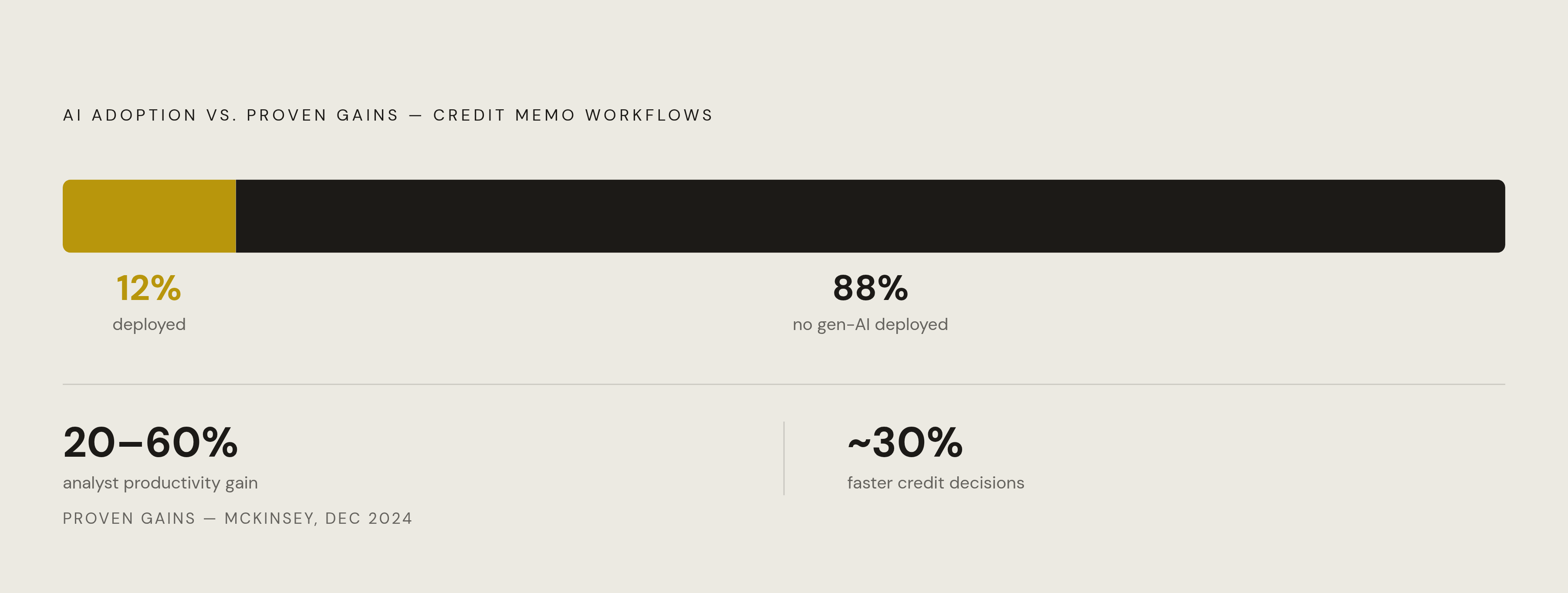
The reconciliation problem between the trailing-12, the rent roll, and the pro forma isn't only a consistency risk sitting inside the memo. It's a time cost that slows the entire credit process before the analyst even starts writing. Per McKinsey's December 2024 analysis of multiagent AI systems in banking, applying AI tools to credit memo workflows produced analyst productivity gains of 20% to 60%, along with roughly 30% faster credit decision turnaround, and it shifted the analyst's role away from manual drafting toward oversight and exception handling. That's a meaningful gain. Adoption hasn't caught up to it: McKinsey's July 2025 survey of North American banks found only 12% had deployed any generative AI use case at all, which leaves a fairly wide competitive opening for institutions and firms willing to move first.
Purpose-built CRE platforms that ingest offering memorandums, rent rolls, operating statements, and borrower financials, then surface structured data directly rather than requiring manual re-entry into spreadsheets, are the practical response to this problem. The effect isn't that analysts do less work. It's that the work shifts, away from data entry and toward judgment: reconciling assumptions, handling exceptions, and stress-testing repayment capacity, which is the part of the job that actually determines whether a deal gets approved.
What sponsors and brokers can do differently when they understand how the memo is read
The financing memorandum a sponsor submits is the raw material an analyst has to convert into a credit memo, and the quality of that raw material sets the ceiling on how fast the conversion happens. A sponsor who understands this can shape the submission accordingly, rather than treating it as a formality to get through before the "real" underwriting starts.
Front-load the information committee checks first. Loan request, DSCR and LTV at the requested amount, and sponsor strength belong in the first few pages, not somewhere past page ten where a skimming reader might miss them. Reconcile the trailing-12, the rent roll, and the pro forma to one consistent set of assumptions before submission, and label any adjustments explicitly rather than letting the analyst discover them mid-spread. Include a downside scenario alongside the base case. Lenders are going to run one regardless, and a sponsor who presents it first signals sophistication rather than optimism dressed up as analysis.
Disclose exceptions before committee finds them. A policy exception the sponsor names and addresses directly in the package does far less damage than the same exception raised cold in the meeting. Make the comps section argue its case rather than list it: explain why each comparable is actually comparable, not just similar in square footage. And adapt the whole package to asset type. A multifamily deal needs unit mix and rent comps up front. An office deal needs a credible, specific answer to lease rollover before committee has the chance to raise it as an objection.
Lending volume isn't slowing down, and lender bandwidth isn't expanding to match it. Against that backdrop, the packages that clear credit committee fastest aren't necessarily the ones behind the best deals. They're the ones that remove friction from the analyst's job before the analyst ever has to ask for it.