How Fannie Mae, Freddie Mac, and HUD Set Minimum DSCR by Product
Each agency sets different minimum DSCR floors by loan product, not one flat rule.

A single ratio decides what a multifamily loan can carry: net operating income divided by annual debt service. Fannie Mae, Freddie Mac, and HUD each set their own floor for that number, and the floor changes by product, not by any flat agency-wide rule. Sponsors who don't nail down which floor applies before they start underwriting are guessing, and guesswork produces deals that die in committee.
DSCR does two jobs at once. It gates risk (does the property clear the bar to get financed at all), and it sizes the loan (how much debt the NOI can actually support). A 1.25x floor and a 1.55x floor against the same $2 million NOI produce very different maximum loan amounts, and that gap sits at the center of the deal, moving proceeds up or down before anyone even pulls a rate quote.
Every document in a loan file eventually resolves into this ratio. Three years of tax returns, a T12 operating statement, the rent roll, bank statements, lease abstracts, the borrower's schedule of real estate owned, the appraisal's income approach: all of it feeds into two numbers, NOI and debt service, and collapses into a single decimal. The floor decides which decimal passes, and picking the wrong floor at the outset is the single most common way sponsors waste weeks of underwriting on a deal that was never going to size the way they hoped.
Fannie Mae's DUS Pricing Tiers as a Rate Lever, Not Just a Gating Test, for DSCR
Fannie Mae's Delegated Underwriting and Servicing (DUS) model lets approved lenders underwrite directly to Fannie Mae's parameters, mostly on a non-recourse basis outside the standard carve-outs. Inside that framework is a four-tier pricing structure, and DSCR and LTV move together to decide which tier a loan is in. Each tier shift carries a meaningful change in rate, which adds up to real money over the life of a 10-year loan.
On a purchase, Tier 2 covers 66% to 80% LTV (or up to 75% on a refinance), with a 1.25x minimum DSCR. Tier 3 tightens to 56% through 65% LTV and requires 1.35x. Tier 4, the most conservative tier, caps LTV at 55% and demands a 1.55x DSCR floor. Move down a tier and the rate improves, but only if the deal's DSCR and leverage both clear the higher bar.
Sponsors get this part wrong constantly: underestimating DSCR at underwriting rarely kills a loan. More often it just drops the deal into a higher-cost tier, since the loan still qualifies, just at worse pricing. Treat the floor as a simple pass or fail, and you'll miss the fact that it's really a graduated pricing input, and that misreading is how sponsors leave rate improvement on the table without realizing it. This four-tier grid is the baseline. Individual Fannie Mae products then deviate from it, some pushing floors lower for mission-aligned lending, others pushing higher for elevated operational risk, and that's where the real product-level detail lives.
Fannie Mae's core conventional products and their floor levels
The Standard DUS Fixed-Rate product, used for purchase or refinance of stabilized multifamily properties, sets an 80% max LTV on purchase (75% on refinance) and a 1.25x DSCR floor. That's the benchmark against which everything else in the Fannie Mae lineup gets measured.
The Small Loan Program, generally covering loan amounts from around $1 million up to roughly $9 million depending on market, matches that same 1.25x floor and 80% LTV ceiling, but strips out a lot of the paperwork: no tax returns required, and lighter physical needs and environmental assessment standards. Smaller loan, same DSCR discipline, less documentation to prove it.
Choice Refinance runs an 80% max LTV (75% if the borrower takes cash out), a 1.25x DSCR floor, and no minimum loan size, which makes it a flexible option for refinance-only sponsors. Supplemental Loans work differently: subordinate financing layered onto a property that's already carried a Fannie Mae loan for at least 12 months. Because subordinate debt adds risk, the DSCR floor steps up to 1.30x on a combined-debt-service basis, with combined LTV subject to Fannie Mae's supplemental loan guidelines.
The Structured ARM product is the real outlier in the conventional lineup. Minimum loan size is $25 million, max LTV 75%, and the DSCR floor drops to just 1.00x, calculated at the maximum note rate rather than the going-in rate. The underwriting already assumes the loan hits its rate cap, so 1.00x is measured against a worst-case rate scenario, making it a tighter test than it looks on paper. Affordable and Multifamily Affordable Housing (MAH) properties can use this product; substantial rehab deals can't.
Fannie Mae's Mission-Driven Products' Use of Lower DSCR Floors to Expand Affordable and Green Lending
The Affordable Housing Loan Program, built for properties with Section 8 HAP contracts or expiring LIHTC compliance periods, sets its DSCR floor at 1.20x, below the standard DUS benchmark, while still allowing 80% max LTV. That gap directly expands how much debt an affordable property's NOI can support compared to a market-rate deal with identical cash flow.
Green lending gets even more granular. Green Rewards and Green Building Certification on conventional properties run at 1.25x DSCR and 80% LTV, matching standard DUS. Apply the same green programs to an affordable property, and the floor drops to 1.20x. Green Preservation Plus goes furthest: 1.15x DSCR paired with an 85% max LTV, available specifically for affordable properties making qualifying green improvements. Green Rewards also lets borrowers count projected water and energy savings toward loan sizing, provided the improvements deliver a qualifying combined reduction in water and energy usage. That's real proceeds added to the loan based on efficiency projections, folded directly into the loan amount itself.
New York City has its own product: M-PIRE, covering first-lien and supplemental mortgages across all five boroughs for conventional, affordable, and cooperative properties making energy and water efficiency upgrades. It runs a 1.20x DSCR floor with 85% max LTV on purchase, 80% on refinance.
ROAR (Reduced Occupancy Affordable Rehab) is built for one specific situation: a property under active rehab that can't hit stabilized occupancy yet. During rehab, occupancy can run as low as 50% and DSCR as low as 1.00x. Once the property stabilizes, the DSCR requirement rises to 1.15x, and stabilized LTV can reach 90%. Renovation spend is capped at $120,000 per unit. That two-phase floor is the mechanism that makes ROAR work for properties that would otherwise fail a conventional DSCR test; it starts rock-bottom during construction and tightens once the asset stabilizes.
None of this is Fannie Mae going soft on weak assets. Lower floors here are the price the agency pays, deliberately, for mission alignment. Affordable and green designations are the consideration it accepts in exchange for opening up more capital, and sponsors who dismiss these products as consolation prizes for deals that can't hit conventional terms are simply wrong about where the real proceeds advantage sits.
Fannie Mae's Senior Housing Floors Well Above the Standard DUS Benchmark
Senior housing runs in the opposite direction, and for good reason. Fannie Mae's Senior Housing Loan Program ties its DSCR floor directly to care acuity. A property with lower care acuity carries a lower floor. Cross the threshold into 50% or more assisted living or Alzheimer's/dementia care, and the floor jumps to 1.40x. A property that's entirely memory care needs 1.45x.
The logic tracks the underlying income. Assisted living and memory care revenue depends on staffing intensity and census levels in a way conventional multifamily rent rolls simply don't, and that operational exposure makes the income stream more volatile. The elevated floor is Fannie Mae's underwriting response to that volatility, not an arbitrary penalty.
As of December 31, 2024, Fannie Mae's seniors housing book carried a weighted-average DSCR of just 1.5x, the lowest of any segment in its multifamily portfolio, and 26% of seniors housing loans sat below a 1.0x DSCR, against 5% for the overall multifamily book. Sponsors who underwrite a seniors housing deal off standard DUS assumptions will systematically over-lever the transaction. The elevated floor here reflects realized credit performance in that asset class rather than an arbitrary agency preference, and the portfolio numbers back up the calibration.
Freddie Mac's conventional and small-balance floors by market designation
Freddie Mac's Conventional Fixed-Rate large-balance product mirrors Fannie Mae's standard: 80% max LTV, 1.25x minimum DSCR. Repeat Freddie Mac sponsors on select 10-year-plus transactions can qualify for a 1.20x floor, though max LTV drops to 70% to compensate. Full-term interest-only structures don't offer a shortcut around DSCR either. Freddie Mac applies higher DSCR requirements to full-term IO structures, as reflected in the product's tiered floors.
Conventional Small, the product formerly known as the Small Balance Loan (renamed in April 2026), covers loans from $2 million to $10 million, and here the floor moves entirely on market designation. Top Markets need 1.20x on amortizing or hybrid ARM structures (1.35x for full-term IO), with 80% max LTV. Standard Markets step up to 1.25x amortizing (1.40x IO). Small Markets require 1.30x amortizing (1.40x IO) with LTV capped at 75% purchase, 70% refinance. Very Small Markets carry the tightest terms in the whole product: 1.40x amortizing, 1.50x IO, with LTV caps consistent with the elevated risk of thin markets.
There's a carve-out for loans between $6 million and $7.5 million: they have to sit in a Top or Standard Market, cap out around 100 units, and clear a 1.25x floor regardless of the broader market-tier grid.
Smaller markets carry more liquidity risk, less certainty around exit pricing, and more volatile property values, and Freddie Mac's tiered floor is how it prices that risk instead of simply declining loans in thin markets. The gap is not trivial: a stabilized asset in a Very Small Market faces a 1.40x amortizing floor, 20 basis points above what the identical asset would need in a Top Market. On a real NOI, that spread often decides whether a deal clears underwriting or doesn't.
Freddie Mac's Affordable and Workforce Programs Pushing Floors Below the Conventional Baseline
Affordable housing gets meaningfully more room under Freddie Mac's guidelines, and this is where the program actually rewards sponsors for taking on affordability restrictions rather than penalizing them for it. LIHTC properties can qualify with a DSCR as low as 1.15x and LTV up to 90%. Non-LIHTC affordable deals, Section 8 properties without the tax credit overlay, can go as low as 1.20x DSCR with LTV up to 80%.
The Tax-Exempt Loan (TEL) product under the Targeted Affordable Housing program uses an extended loan term with longer amortization, and sets a DSCR floor of 1.15x. The extended amortization schedule paired with the low floor is what makes TEL proceeds competitive for affordable sponsors: a longer amortization spreads debt service thinner and lets the same NOI support more debt, even before the DSCR floor comes into play.
The Workforce Housing Mezzanine Loan goes lower still, and it's the most aggressive proceeds tool in the entire Freddie Mac lineup. Originated alongside a 10-year Freddie Mac Conventional Loan, the combined structure allows elevated combined LTV and a combined DSCR well below the conventional baseline, among the most aggressive terms in Freddie Mac's product set. Borrowers commit to affordability restrictions on a meaningful share of units in exchange. The mezzanine layer itself is what makes 1.05x possible: splitting the capital stack into senior and mezzanine pieces lets the blended DSCR sit lower than either tranche would tolerate on its own.
Student housing gets no such break. It's underwritten as straight conventional multifamily, generally at a 1.30x DSCR floor, with no affordability offset, because the lease structure itself (parental co-signs, revenue concentrated around the academic year) carries a risk profile the higher floor is meant to address.
The Green Advantage Program rewards borrowers who commit to cutting water and sewage usage past a set threshold with higher LTV allowances, a lower DSCR requirement, and reimbursement at closing for the energy assessment. The exact size of the DSCR reduction depends on the deal, so confirm it with the lender directly rather than assuming a fixed number.
Revolving Credit Facilities sit outside this whole framework. They're non-recourse, cross-collateralized, and cross-defaulted across a portfolio, with no per-property LTV or DSCR test, since underwriting happens at the facility level. That structure only works for large-scale portfolio investors, not single-asset sponsors.
Reading the floor matrix: what the spread between the lowest and highest agency minimums means for deal sizing
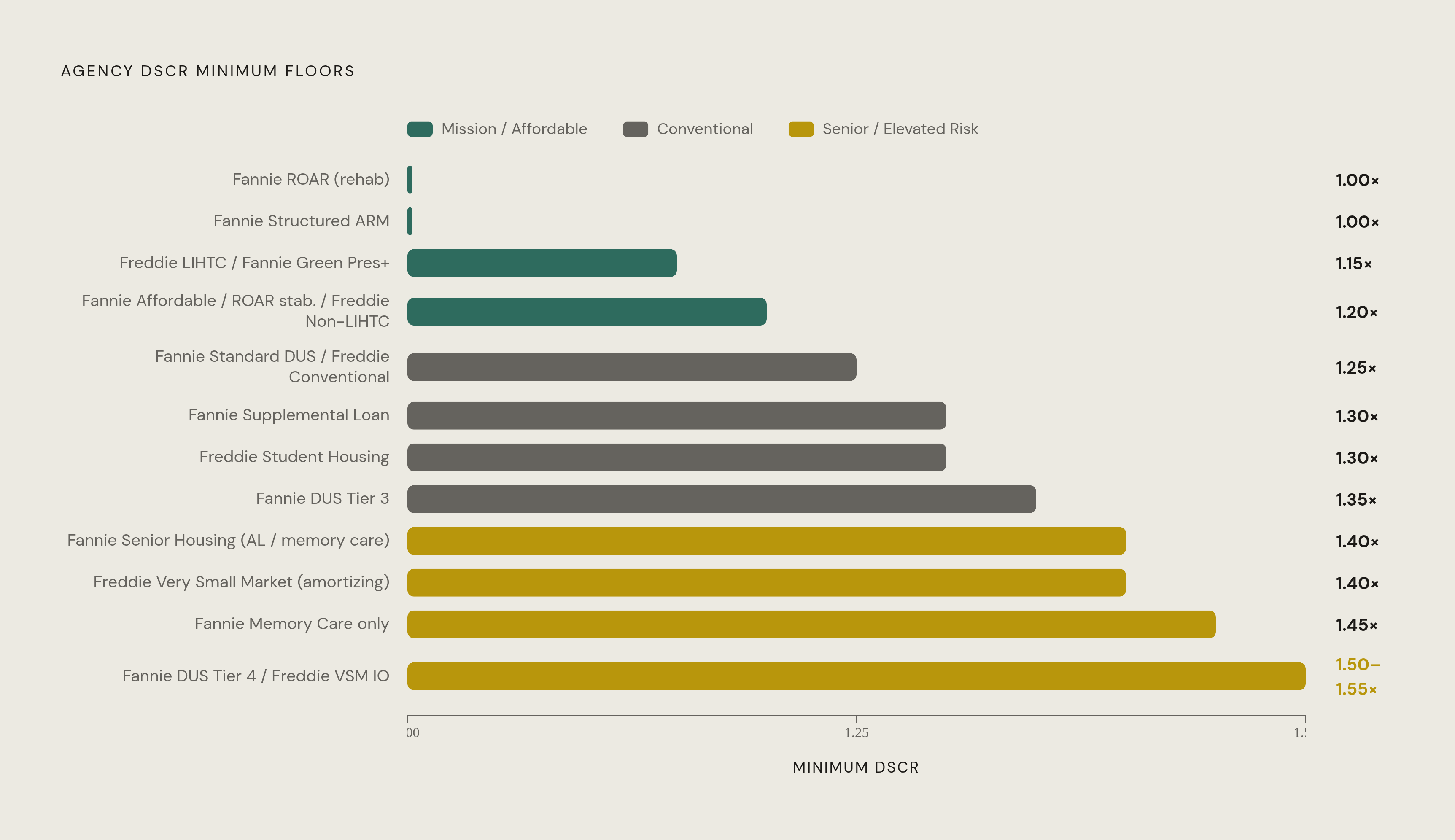
Line up every product covered here and the range runs from 1.00x (Fannie Mae's Structured ARM at its stressed note rate, and ROAR during active rehab) up to 1.50x (Freddie Mac Conventional Small in Very Small Markets on a full-term IO structure). That's a 50 basis point spread, and against a given NOI, it can be the entire difference between a loan that gets approved and one that gets declined.
Three variables actually decide which floor applies. Property type and care acuity separate conventional multifamily from assisted living from memory care. Affordability and mission designation, LIHTC, Section 8, workforce commitments, green certification, pull floors down. Loan structure and market geography, fixed versus ARM, amortizing versus interest-only, Top Market versus Very Small Market, push floors in either direction depending on the specific combination.
Most sponsor miscalibration happens at the assumption stage, and it's an avoidable mistake, not a market condition. A sponsor defaults to the familiar 1.25x standard DUS or conventional Freddie Mac floor, only to discover partway through underwriting that the actual product, a supplemental loan, a senior housing deal, a small-balance loan in a thin market, carries a different number. By the time that becomes visible in underwriting, the deal is already sized wrong, and reworking the numbers late in the process costs time sponsors usually don't have.
The upside runs the other direction too, and sponsors leave it on the table more often than they should. For a property that actually qualifies, the gap between a 1.25x conventional floor and a 1.15x affordable or green floor is a direct expansion of maximum proceeds on identical NOI, not a rounding error. Sponsors who can plausibly qualify for an affordable or green designation should run both scenarios side by side before picking a path, because the math often favors the mission-aligned product by a wide margin, not a narrow one.
Matching a property's specific attributes, unit count, affordability status, care level, market size, loan structure, to the correct agency product and its exact DSCR floor is the first computational step in sizing any loan correctly. That match belongs at the front of deal analysis, applied before a lender ever has the chance to kick the file back for missing a floor nobody checked. Agency DSCR floors are the actual architecture of the capital stack, and sponsors who work the full matrix, rather than the single number they assumed applied, are the ones who size deals right the first time.