What Triggers a Lender Credit Committee Rejection
Committees reject deals that fail downside stress tests, not upside stories.

Credit committee rejections almost never trace back to one bad number or one missing document. They follow a logic that's consistent across institutions: the sponsor is pitching upside (appreciation, rental growth, a redevelopment story that pencils out nicely on a spreadsheet), while the committee is running a downside stress test, asking what happens to this loan when something goes wrong.
That gap has widened lately, not narrowed. Federal Reserve Senior Loan Officer Opinion Survey data showed sustained tightening in commercial real estate lending running through 2025, and the April 2026 survey found standards broadly unchanged at the headline level, but large banks reported some easing while smaller and regional banks kept tightening, especially on construction, land development, and multifamily hallmarkabsservice.substack.com. A deal that clears one institution's screen can fail another's outright, so sponsors who treat "the credit market" as one undifferentiated thing are working from the wrong map hallmarkabsservice.substack.com.
Timing compounds the problem. The $2.5 trillion maturity wall approaching in 2026 and 2027 means a large volume of loan packages is arriving in front of committees at precisely the moment when risk appetite among many lenders is at its lowest hallmarkabsservice.substack.com. Add to that the sheer scale of existing exposure sitting on bank balance sheets, roughly $909 billion of CRE loans at domestically chartered banks per Federal Reserve H.8 data, and it becomes clear why committees are cautious about adding to the pile rather than eager to hallmarkabsservice.substack.com. None of this means good deals can't get funded. It means the deals that get funded are the ones built to survive a downside test, and the rest of this piece is about what that test checks.
How a credit committee reads a loan package
A credit committee exists to approve loans above a certain size threshold, to approve exceptions to policy, and to oversee the institution's overall commercial credit risk, with the largest exposures sometimes escalating to a board-level committee. Everything the committee sees comes filtered through the credit memo, the document that condenses the underwriting work into financial analysis, stress testing, qualitative judgment, and a list of key risks paired with proposed mitigants. Whatever doesn't show up clearly in that memo doesn't get credit for existing, no matter how solid it is in reality.
The approval path scales with the size and complexity of the deal. Smaller loans might clear with sign-off from a senior credit officer, while larger or more complicated requests go in front of a full committee of senior executives, sometimes with outside board members in the room. Even after a positive decision, the loan isn't done: conditions still have to be satisfied, including satisfactory third-party reports (appraisal, environmental, property condition), title insurance, adequate insurance coverage, final lease reviews, and verification that the sponsor's equity is actually in the deal.
The point worth sitting with is that the committee isn't hunting for reasons to say yes. It's testing every line of the package against one question: does this loan survive if conditions get worse? Once that frame is clear, the specific rejection triggers stop looking like a random list of pitfalls and start looking like what they are, each one a place where the downside test returns an answer the committee can't accept.
Debt yield as the first filter: why it displaced LTV at institutional lenders
Loan-to-value made sense as the dominant metric in a rising market, where collateral values reinforce themselves and a lender foreclosing on a property can reasonably expect to recover more than the loan balance. That logic breaks down when values are uncertain and transaction volume is thin, because a 70 percent LTV appraisal is really just a record of what a comparable building sold for at some point in the past, and it says nothing about what the same asset would fetch in a forced sale with few buyers and cap rates moving against the seller. Committees have adjusted accordingly. Appraisals still get ordered, but they function as a documentation requirement more than a forward-looking protection, and the real underwriting has shifted to income-based measures.
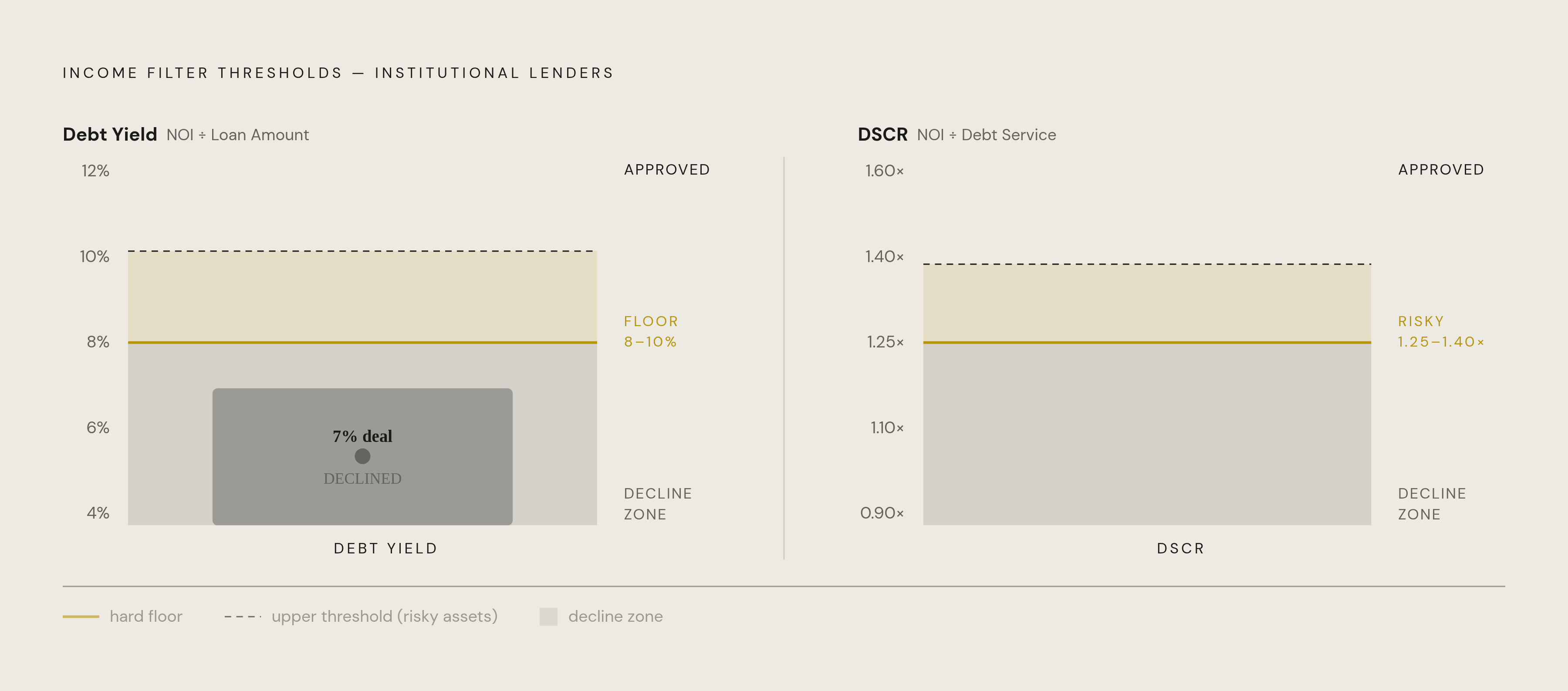
Debt yield is the metric that took over: net operating income divided by the total loan amount loanbase.com. According to KBRA's commercial real estate credit analysis, debt yield now functions as the primary filter at institutional lenders, with floors typically running from 8 to 10 percent depending on asset class and market, and transitional assets in secondary markets held to the tougher end of that range.
The floor isn't a starting point for negotiation, it's a routing signal. A bridge loan request underwritten at a 7 percent debt yield doesn't get talked down to an approval by adjusting the rate, it gets declined outright or handed off to a capital source whose pricing already accounts for that income level.
DSCR hasn't disappeared, it works alongside debt yield rather than in place of it. Minimum DSCR thresholds for most CRE loans in 2026 are in a range, with stronger assets and stronger sponsors clearing at the lower end and riskier property types (office, retail, value-add plays) pushed higher to build in a cushion; one top-tier lender reportedly raised its minimum for stabilized assets in a January 2026 underwriting memo hallmarkabsservice.substack.com. Insurance premium spikes in states like Florida, Louisiana, and California push operating costs up, HOA fees and property tax exposures never make it into the model, and vacancy assumptions on the rent roll don't match what the trailing actuals show, and these are what quietly wreck these numbers before they ever reach a calculation. Each of these inflates NOI on paper while leaving the real cash flow untouched, and committees catch it loanbase.com.
Capital reserves and sponsor liquidity: the two screens most sponsors fail
Every commercial property carries deferred maintenance, upcoming lease expirations, and capital needs that were easy to put off when rates were low and refinancing was cheap. Committees want to see that money sitting in a verified account at closing. A projection that it will appear later from operating cash flow doesn't satisfy the requirement, no matter how reasonable the projection sounds.
A sponsor who plans to cover tenant improvement costs out of cash flow six months down the road is effectively asking the lender to treat a forecast as if it were collateral, and most institutional lenders won't make that trade. A funded reserve is a fact. A cash flow projection is a bet, and committees don't underwrite bets. A package built to pass this screen includes a detailed schedule of capital needs over the next 24 months, roof replacements, HVAC systems, tenant improvement budgets, lease commissions, each with a real timeline and a real dollar figure, alongside clear documentation of where that money sits today hallmarkabsservice.substack.com.
Sponsor liquidity gets tested with the same rigor, and it trips up more sponsors than almost any other screen. Committees aren't asking about net worth, they're asking for verified, unencumbered, liquid cash, and most institutional lenders apply a threshold somewhere between 12 and 18 months of debt service held in accounts that can be confirmed MBA. The gap this exposes is easy to illustrate: a sponsor with the equivalent of $20 million in net worth but only $200,000 in liquid cash isn't well positioned to absorb a vacancy or a gap in operating income, because that net worth is tied up in real estate, partnership stakes, and positions that can't be converted to cash quickly hallmarkabsservice.substack.com loanbase.com. The documentation has to be specific too, account statements, confirmation the funds aren't encumbered, and clarity on whether any of that cash sits in a partnership account the sponsor doesn't individually control.
This is the screen that catches sponsors most off guard, arriving with a strong net worth statement and getting pushed back because the liquid cash position doesn't hold up. And it connects directly to the debt yield discussion: a deal can clear the income floor and still die here, because the committee tests the property and the sponsor in parallel, not one after the other.
Document contradictions that signal a package the committee cannot trust
The documentation problem that actually kills deals isn't missing paperwork, it's paperwork that contradicts itself MBA. The rent roll shows in-place rent. The appraisal assumes a stabilized occupancy that doesn't match either one MBA. When those numbers won't reconcile, every calculation built on top of them, DSCR, LTV, the internal risk grade, expected credit loss, and the committee memo itself, inherits the same gap and can't be trusted.
A lender-ready package needs, at minimum, current rent rolls, trailing operating statements, a forward budget, lease abstracts, a clear accounting of capital expenditure needs, existing debt terms, ownership structure, sponsor financials, and a use-of-funds schedule that's actually sourced. All of it has to tell one coherent story about the property's economics.
What the committee reads into a package full of contradictions isn't generous. It suggests either the sponsor doesn't actually control the numbers, or the numbers don't hold together on their own, and both readings are disqualifying. The fix isn't complicated, but it has to happen before the package goes to market: reconcile the documents against each other, not in response to committee questions after the fact.
Sponsor profile and exit strategy: what committees read when the numbers are marginal
When the financial metrics land close to the floor rather than comfortably above it, the sponsor's own profile starts to carry the decision, and committees evaluate that profile against specific, documentable criteria rather than reputation or referral. Track record on comparable assets matters, lenders look at past performance on similar properties and past repayment behavior, and for specialized properties or ground-up development, relevant hands-on experience is expected rather than assumed.
Lease quality functions as a proxy for how stable that income really is. Short-term leases, tenants with credit problems, and a wall of upcoming expirations all raise flags, because they introduce uncertainty into the exact NOI figure that debt yield and DSCR are built on. And every lender needs a straight answer on how the loan gets repaid, through sale, refinance, stabilization into long-term tenancy, or portfolio restructuring; a weak or vague answer here is treated as a major red flag on its own.
The committee's concern was the exit cap rate in a high-rate environment occ.gov hallmarkabsservice.substack.com. Approval came, but only with a mandatory interest reserve held in escrow for 24 months and a reduction in the LTV, which forced the sponsor to rework the capital stack occ.gov hallmarkabsservice.substack.com. Experience didn't make the concern disappear, it shifted where the negotiation landed occ.gov hallmarkabsservice.substack.com. Compensating factors that actually move a committee are concrete, a stronger credit score, more verified liquidity, an experienced team, additional collateral or guarantees, not a narrative about how much upside the deal has if everything goes right.
Property type flags and portfolio concentration limits that have nothing to do with deal quality
Two nearly identical properties can get two entirely different answers from two different lenders, and often the reason has nothing to do with either deal's fundamentals. Hotels, care homes, mixed-use buildings, vacant commercial space, and office product are treated as elevated risk by many banks, sometimes triggering an automatic decline and sometimes just a much tighter threshold on everything else. Environmental findings during due diligence carry similar weight: banks work hard to avoid liability tied to contamination, and a finding that affects long-term property performance can stop a deal cold regardless of how strong the financial metrics look. An appraisal that comes in below expectations creates a related but different problem, the deal isn't rejected on credit grounds, it fails on structuring grounds because the resulting loan amount no longer covers what the borrower needs.
Portfolio concentration limits are the cleanest example of a rejection that has nothing to do with the individual deal's quality. Once a bank's CRE loan portfolio crosses 300 percent of its total risk-based capital, the institution moves into heightened supervisory attention, and regulators start paying closer notice to every subsequent addition. For a lot of regional and smaller institutions, CRE lending already makes up a large share of total credit exposure, in some cases well past what regulators consider a comfortable range. A well-run concentration policy sets limits by sub-segment, office, multifamily, industrial, retail, hotel, and construction or land development, and once a proposed loan would push a sub-segment over its limit, the committee is stuck choosing between granting a formal exception or declining. A perfectly clean deal in a saturated sub-segment gets routed away for that reason alone, and originators bringing the deal in the door don't always know which sub-segments are already full when they submit it. Sometimes the honest explanation for a rejection is that another department inside the same institution simply won the internal fight for capital that quarter. Sponsors and brokers who check a lender's existing exposure and sub-segment appetite before submitting save themselves a rejection that was never really about the deal.
The pre-submission checklist that maps directly to the committee's downside screen
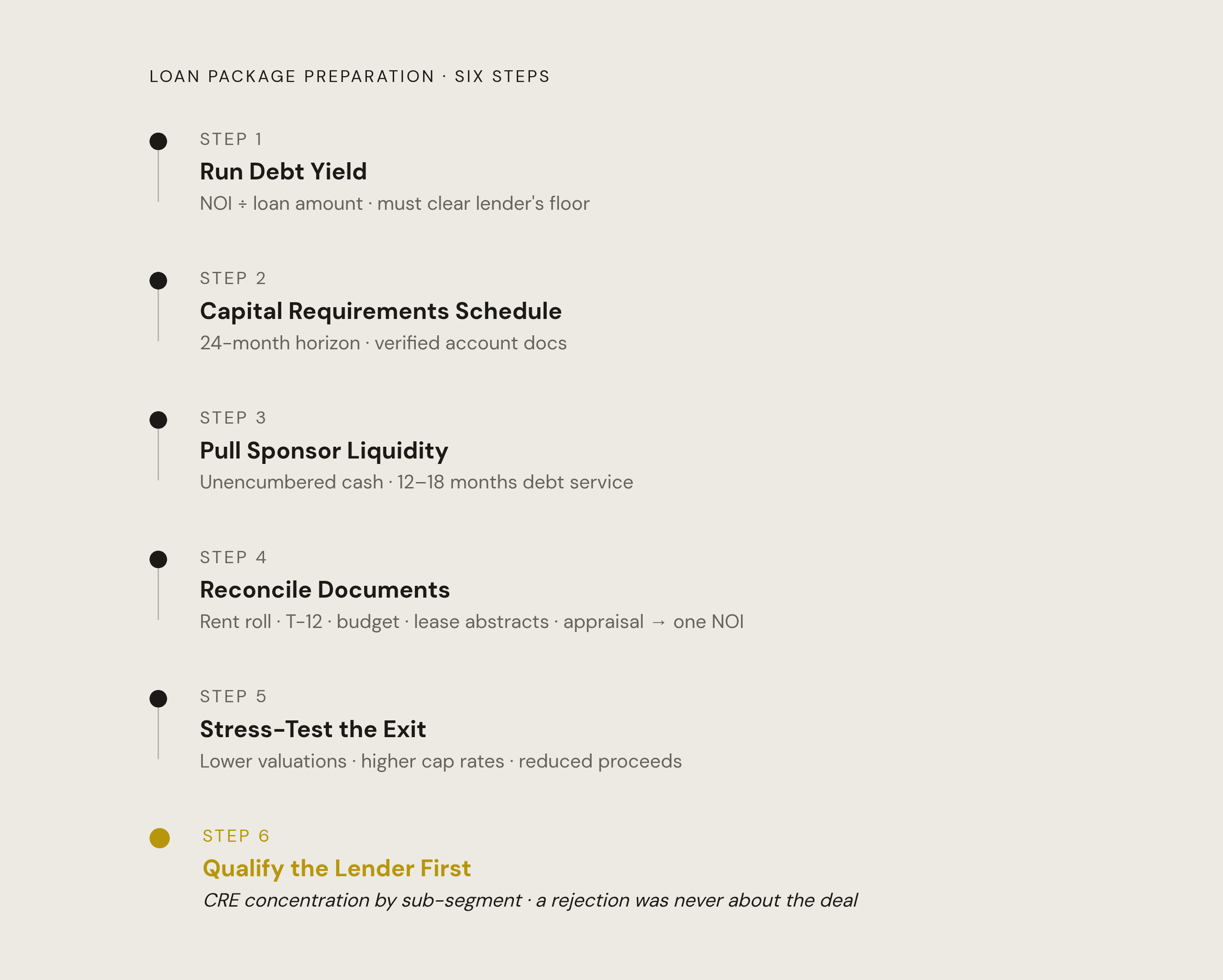
Every trigger covered so far answers the same underlying question the committee is asking: what happens to this loan when something goes wrong? A pre-submission checklist is organized around that question, and a folder of documents being technically complete isn't the organizing principle.
Start by running the debt yield calculation before anything else gets built, NOI divided by loan amount, and if it doesn't clear the lender's floor for that asset class and market, the deal needs a different loan amount or a different capital source before the rest of the package gets assembled. Next, build out a 24-month capital requirements schedule covering tenant improvements, lease expirations, and mechanical deferred maintenance, backed by verified account documentation showing exactly where that cash sits today hallmarkabsservice.substack.com. Pull and verify sponsor liquidity directly, not net worth, but unencumbered, verifiable cash covering 12 to 18 months of debt service, supported by account statements and confirmation the funds aren't tied up elsewhere MBA. Reconcile every document into a single coherent economic story, rent roll, T-12, forward budget, lease abstracts, and the appraisal's rent schedule all need to produce the same NOI, and any gap needs to be found and explained before submission, not discovered by the committee MBA.
Stress-test the exit under multiple scenarios, lower valuations, higher cap rates, reduced proceeds, additional required capital work, not to predict what the market will do, but to show how much room exists before the capital structure depends on everything breaking favorably. Qualify the lender before submitting anything, checking existing CRE concentration by asset type and market, preferred property types, and current sub-segment capacity, because a deal that's wrong for a specific institution's portfolio isn't a credit rejection at all, it's a routing mistake. And build the sponsor profile as a credit document rather than a marketing one: track record on comparable assets, repayment history, verified liquidity, contingent liabilities, and an exit strategy with timelines that hold up.
The institutional divide running through the market right now is itself something sponsors can use strategically. The January and April 2026 Senior Loan Officer Opinion Surveys showed banks broadly reporting tighter standards for commercial and industrial loans across firm sizes, reflecting a general tightening rather than something specific to any one lender or deal hallmarkabsservice.substack.com. A deal that fails at a cautious regional bank may be exactly right for a larger institution reporting some easing, or for a non-bank lender with a different risk appetite entirely hallmarkabsservice.substack.com. Matching the deal to the right capital source, rather than assuming one rejection means the deal is unfundable everywhere, is its own professional skill, and increasingly the one that separates sponsors who get financed from those who don't hallmarkabsservice.substack.com.
Automated underwriting approach and sponsor preparation before committee
The checklist above describes work that used to take an analyst days to assemble by hand, cross-checking a rent roll against a T-12, running debt yield and DSCR across several loan amount scenarios, flagging which sub-segment limits a given lender might already be brushing up against MBA. Tools built for underwriting workflows now compress much of that reconciliation into hours rather than days, catching the exact contradictions, an occupancy assumption that doesn't match trailing actuals, a reserve schedule that's thin against the deferred maintenance list, before a human reader on the committee ever has to find them manually.
What that shift changes for sponsors isn't the substance of what committees demand. The downside test still asks the same questions it always has, about debt yield, reserves, liquidity, and exit risk. What changes is how much of that testing can happen before the package ever reaches a committee table. The sponsors who get ahead of it, running their own debt yield math, reconciling their own documents, stress-testing their own exit, are the ones showing up with packages built to survive scrutiny rather than packages hoping to avoid it.
Sources
- The 2026 Commercial Real Estate Credit Squeeze: Why Banks Are Saying “No”
- Commercial Real Estate Loan Underwriting: What Bank Credit Conditions Mean in 2026 - Primior Group
- Version 2.0 Comptroller’s Handbook i Commercial Real Estate Lending
- Interagency Guidance on Concentrations in Commercial Real Estate Lending; Sound Risk-Management Practices