Loan Assumption Mechanics in Agency and CMBS Deals
How property value declines derail CMBS loan assumptions.

Roughly $957 billion in commercial mortgage debt came due in 2025. Another $875 billion matures in 2026, and together the two years account for close to 17% of all outstanding commercial mortgage debt. That wall is made up largely of two loan vintages: 10-year CMBS paper originated in 2016, before anyone had heard of a pandemic, and 5-year loans from 2021, when rates sat near zero. Both are now colliding with a rate environment that makes refinancing painful and assumption, quietly, the more rational path.
Multifamily maturities are forecast to grow 56% from 2025 into 2026, and office-backed CRE debt accounts for roughly $148 billion of next year's maturities. Both property types run heavily through agency and CMBS pools. The maturity wall and the assumption market are, functionally, the same story told from two angles. Lenders are also less willing to grant extensions without real concessions attached. The extend-and-pretend period that carried the market through recent years is closing, and that alone is pushing more deal structures toward assumption instead of refinance or extension.
None of that matters much, though, if the sponsor or broker doesn't understand how these assumptions actually get approved, because the CMBS and agency paths are built on entirely different logic, and mistaking one for the other is how deals die in month three instead of week one.
How CMBS loan structure controls the assumption process
A CMBS loan doesn't sit on a bank's balance sheet waiting for someone with authority to say yes. Once it's securitized, it's inside a trust, typically a New York common law trust organized to qualify as a REMIC for tax purposes, and every decision about that loan afterward is governed by the Pooling and Servicing Agreement that created the trust. There's no loan officer to call. There's a document, negotiated years earlier by parties who are no longer necessarily in the room, and that document decides what's possible.
That REMIC structure isn't a technicality. It exists because of IRS rules that limit how much a securitized loan pool can be modified after the fact without triggering tax consequences for the trust itself. Combined with the PSA's own restrictions, this means loan assumption is permitted, but the path is narrow, pre-set, and not subject to negotiation the way it might be with a balance-sheet lender. Nobody at the special servicer is going to cut a borrower a break because the deal makes sense. They're going to follow the PSA, because deviating from it exposes the trust to REMIC violation risk, and that risk lands on people with far more at stake than the transaction in front of them.
It also matters what kind of CMBS loan is being assumed. Conduit loans, generally in a broad mid-sized range, get pooled with dozens of other loans from unrelated borrowers and use standardized documentation, so the assumption language tends to be uniform across a given shelf. Single-asset, single-borrower (SASB) deals are a different animal entirely: one loan, one asset, heavily negotiated at origination, with bespoke transfer provisions that may bear no resemblance to the conduit standard. SASB volume actually eclipsed conduit issuance as the most active CMBS subsegment in 2025, so a growing share of the market may not follow the "standard" playbook. The mechanics described here apply most cleanly to conduit deals. For SASB, the loan documents need deal-specific legal review before anyone assumes the standard process applies, because it very well might not.
The step-by-step CMBS assumption process, from initial request to closing
The process starts when the buyer submits a formal assumption request to the master servicer. That submission is what triggers the servicer's review obligations under the PSA, and until it happens, nothing else moves.
From there, if the special servicer approves the assumption, often with conditions attached, the master servicer sends requests for "no downgrade" letters to the rating agencies covering the securitization. The master servicer and special servicer both operate under a servicing standard, a defined duty that constrains their discretion, an asymmetry that trips up a lot of sponsors. The junior bondholder is not held to that same standard. That party can object, delay, or simply decline to engage without the same accountability the servicers carry, and that asymmetry is a real source of unpredictability in how long this stage takes.
While that's happening, the master servicer's counsel is running parallel diligence and preparing the closing package: the assumption agreement itself, replacement guarantees from the new sponsor, and the opinion letters required to satisfy the trust's legal requirements. None of this happens in isolation from the special servicer track. It's meant to run alongside it, so that once approval clears, the documents are ready rather than starting from scratch.
Then there's 17g-5. Servicers are required to post relevant documents and communications to a website operated by a designated "17g-5 information provider," a rule that exists for rating agency transparency purposes. It's a compliance step, not a negotiation, and one of the most overlooked sources of delay in the entire assumption timeline. Sponsors budgeting a tight closing window rarely account for the fact that a required posting, a required waiting period, or a documentation gap at this stage can quietly add weeks.
The LTV reserve requirement, why property value declines are the most common reason CMBS assumptions collapse
To assume a CMBS loan, the servicer can require that the loan-to-value ratio match what it was at origination. To assume a CMBS loan, the servicer can require that the loan-to-value ratio match what it was at origination. If the property's value has fallen since then, the buyer has to deposit the difference into a reserve account held by the servicer for the remainder of the loan term.
That reserve isn't a security deposit that reduces the loan balance over time. CMBS loans generally can't be paid down outside of scheduled amortization, so the reserve funds simply sit in an account, untouched, until the loan is paid off in full. From the buyer's perspective, this is dead capital: money committed to the deal that earns no return, reduces no principal, and isn't accessible again until payoff or maturity.
The reason this matters so acutely right now comes down to where values sit relative to where they were when many of these loans were written. Available data show property values remain roughly 28% below their mid-2022 peak. A loan originated in 2016 or 2021 was underwritten against a value that, in a lot of cases, no longer exists. Walk through the mechanics with a simple illustration: a loan originated at 65% LTV against a property valued at some baseline. If that property has since dropped in value by close to a third, the same dollar loan balance now represents a far higher percentage of current value than the 65% ceiling the servicer wants preserved. Closing that gap requires a reserve deposit, and depending on how far values have fallen, that deposit can represent a meaningful share of the total purchase price, capital that has to be found and parked before the servicer will let the assumption proceed. A deal that penciled out at the LOI stage can become uneconomical the moment the servicer completes its LTV analysis and states the reserve number in dollars.
Agency loan assumptions through Fannie Mae and Freddie Mac, and where the paths diverge from CMBS
The scale of the agency market alone explains why its assumption mechanics matter. FHFA set 2026 multifamily loan purchase caps at $88 billion each for Fannie Mae and Freddie Mac, a combined $176 billion, up roughly 20% from the $146 billion combined cap set for 2025. Combined multifamily activity from both GSEs has grown substantially alongside the expanded caps. This is one of the largest engines in the CRE debt market, not a niche corner of it. It's one of its largest engines.
FHFA also requires that at least 50% of each Enterprise's multifamily business qualify as mission-driven affordable housing, and workforce housing loans are excluded from the 2026 caps. That policy detail isn't just regulatory trivia. It shapes which assets are most likely to carry Fannie or Freddie paper in the first place, and by extension, which assets are most likely to come up for assumption under agency rules rather than CMBS rules.
Freddie Mac's assumption terms are comparatively simple: loans are fully assumable subject to lender approval, Freddie Mac charges a 1% assumption fee, and a separate lender underwriting fee may apply on top of that. There's no LTV reserve mechanism analogous to CMBS. The lender re-underwrites the buyer and the property, but it isn't trying to reconstruct an origination-era value ratio through a cash deposit.
Freddie Mac retired its Small Balance Loan program on April 15, 2026, folding it into the Conventional Small program, which covers loans from $2 million to $10 million. Freddie no longer originates loans below that $2 million floor. That narrows the small-balance assumption market for loans backed by a government-sponsored mortgage enterprise, and any broker holding legacy small-balance paper of that kind needs to verify current program applicability before assuming the old rules still govern the transfer.
Comparing the two approval structures side by side, where each loan type creates leverage, delay, and irreversible risk
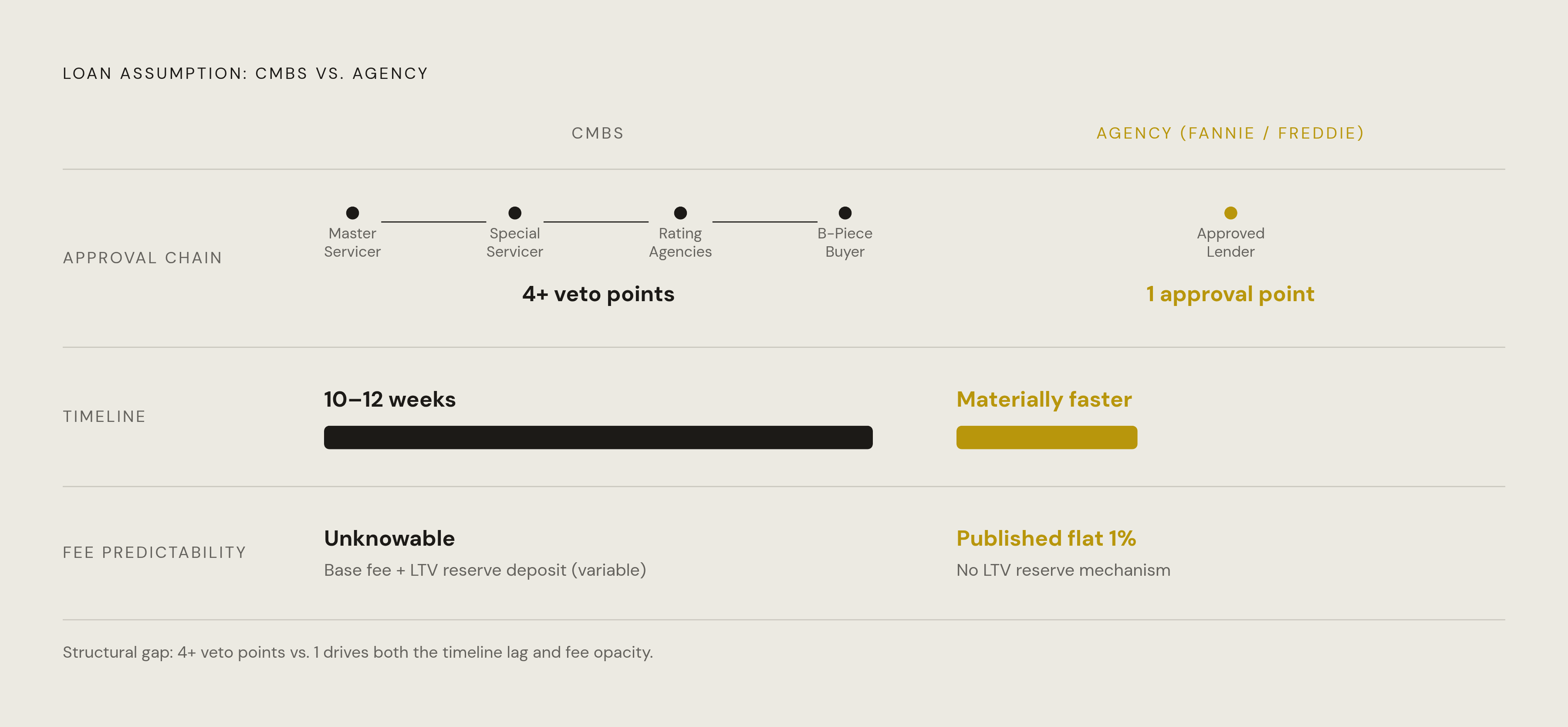
Lining up the approval chains next to each other shows the difference in complexity is stark. CMBS assumption runs through the master servicer, then the special servicer, then the rating agencies, and sometimes the B-piece buyer as well. Agency assumption runs through a single approved lender. Every additional party in the CMBS chain is a separate veto point, with its own timeline, its own incentive structure, and, in the case of the junior bondholder, no servicing standard obligating it to move quickly or ever.
That structural gap appears directly in how long each process takes. CMBS assumptions typically run somewhere in the 10 to 12 week range, with real variance depending on PSA terms and how complicated the deal is. Agency assumptions move materially faster, a direct consequence of having far fewer approval parties than the CMBS chain. For a transaction with a tight closing deadline, tied to a like-kind exchange window or a rate lock, that gap in timeline isn't a minor inconvenience. It can decide whether the deal closes.
Fee predictability follows the same pattern. Freddie Mac's 1% assumption fee is published and consistent, so a sponsor can underwrite it before signing anything. CMBS fees include a base assumption fee, but the real budget risk is the LTV reserve deposit, a number that isn't knowable until the servicer completes its analysis, and that can swing from negligible to deal-breaking depending on how far the asset's value has drifted from its origination-era number. Agency offers budget certainty. CMBS, structurally, cannot, at least not until the process is well underway.
Valuation risk is where the two paths diverge most sharply. CMBS imposes a hard LTV reserve requirement that can lock up capital for years with no return. Agency lenders re-underwrite the borrower and the property under a different framework than CMBS servicers. In a market where property values are roughly 28% below their mid-2022 peak, that distinction isn't academic. A clean assumption requires no such deposit, while one with a value shortfall requires the buyer to park a large, illiquid sum of capital for the balance of the loan term.
Steps sponsors and brokers must take before the purchase agreement is signed to avoid assumption deal killers
Pull the loan documents before the LOI gets signed, not after. A PSA or an agency loan agreement will state whether the loan is assumable, lay out the fee structure, and indicate whether cash management provisions are already in effect. Reading this after a purchase agreement is executed is how sponsors discover, too late, that the deal they've committed to can't close on the terms they assumed.
For CMBS deals specifically, request a full accounting of reserves, escrows, and any active cash management provisions. This information isn't volunteered. It has to be asked for directly, and the earlier it's requested, the more time there is to react if something in it changes the deal's economics.
Run the LTV stress test before committing to a purchase price. Compare the property's current value against the origination-era LTV baseline, and if there's a gap, assess the potential reserve obligation before the buyer is locked into a number. A deal that looks attractive on a rent roll and a cap rate can turn uneconomical fast once dead-capital reserve obligations get layered on top of the purchase price.
Confirm buyer eligibility early, particularly for foreign investors. CMBS assumption rules can impose eligibility requirements that create obstacles for certain buyer profiles, including foreign investors. Discovering that disqualification after the PSA is executed doesn't just kill the deal. It burns months of diligence, legal fees, and servicer coordination that can't be recovered, all because a threshold eligibility question got answered too late to matter.