Recourse vs Non-Recourse Debt Negotiation in Commercial Loans
Understand the hidden recourse clauses buried in your loan documents.

Recourse and non-recourse aren't two boxes a lender hands a borrower. They sit on a spectrum, and where a given loan lands on that spectrum depends on the property, the sponsor, the loan program, and a set of carve-out clauses most borrowers skim past on their way to the signature page. Sponsors who treat recourse as a fixed feature of the product they're buying give up leverage they didn't know they had. The real question isn't recourse or not: it's how much personal liability, triggered by what conduct, capped at what amount, and for how long.
What recourse and non-recourse mean in practice, and where the line gets blurry
Recourse debt lets a lender go after a borrower's other assets, savings, other properties, anything on the personal balance sheet, if a foreclosure sale doesn't cover the loan balance. Non-recourse debt limits the lender's remedy to the collateral itself. No deficiency judgment, no chasing the guarantor's other holdings.
Between those two poles sits limited recourse, where liability attaches only to specific assets named in the loan documents, not the borrower's entire net worth. And within limited recourse there's a further wrinkle: partial recourse structures like a limited payment guaranty, a burn-off guaranty, or a completion guaranty, where the guarantor's exposure actually shrinks as the project clears defined milestones.
Then there's the category that trips up most borrowers: conditionally non-recourse debt. A loan gets marketed and underwritten as non-recourse, but it converts to full recourse the moment the borrower crosses a defined trigger, one of the carve-outs buried in the guaranty. According to Kelley Clarke PC, most bridge and agency debt is in this conditional bucket. That means a lot of sponsors are carrying more exposure than the label on their term sheet suggests.
Non-recourse also isn't free. Lenders offset the reduced remedy by demanding a bigger equity cushion up front. Fident Capital notes that non-recourse deals typically come with lower loan-to-value ratios, often in the 50-60% range, functioning as a form of overcollateralization. The lender takes less recourse against the person and more comfort from the asset itself.
Which loan programs offer non-recourse by default and which require recourse as a condition
Some programs build non-recourse into the product from the start. Conduit and CMBS loans are structured non-recourse with standard bad-boy carve-outs, since the collateral and its income stream are the lender's primary remedy by design. Agency multifamily debt, Fannie Mae, Freddie Mac, and HUD/FHA, offers non-recourse execution for stabilized properties, and that capacity just grew: JP Morgan reports GSE multifamily lending caps rose 20.5% in 2026. Insurance company mortgages on stabilized, institutional-quality assets often follow the same pattern, as do select FHA/HUD executions.
Other categories default to recourse as a matter of convention, not just risk math. Construction loans are the clearest case: non-recourse construction financing barely exists outside HUD/FHA programs and a handful of institutional lenders, because no lender wants to end up foreclosing on a half-built structure. Bridge and transitional loans often stay recourse, or conditionally non-recourse, until the property hits stabilization milestones, though fully non-recourse bridge structures are available from debt funds and institutional lenders for sponsors who qualify. Smaller balance loans, community and local bank programs, and higher-leverage deals with thin operating history round out the recourse-by-default list.
The burn-off bridge is a recourse bridge loan that converts to non-recourse once occupancy hits 90% and holds there for 90 days. That turns personal liability into something finite and defined, rather than open-ended.
Private credit has become a real force in this market, now accounting for 24% of all U.S. commercial real estate lending according to commerciallendingusa.com. These lenders move fast and flex on structure, but they typically want demonstrably strong assets in return, and will impose recourse in situations where an agency lender wouldn't blink. CBRE reports that alternative lenders broadly, debt funds and credit companies, captured 38% of non-agency loan closings in the second quarter of 2026, up from 34% a year earlier. More lenders in the market means more variation in the recourse terms sponsors will run into, not less.
The CRE CLO market deserves particular attention here. It's the fastest-growing vehicle for transitional, floating-rate, non-recourse bridge execution, with issuance through May 2026 hitting $21.6 billion, up 32.2% year-over-year. Plenty of value-add sponsors default to a recourse bridge lender out of habit without ever pricing out an alternative funded through another vehicle that might get them non-recourse terms on the same asset.
How property type and deal stage shape whether non-recourse is even on the table
Stabilized multifamily is the strongest sector for non-recourse access, full stop. Vacancy has held around 8% per NAR data, resilient enough that agency execution stays attainable for sponsors who qualify. Office is the opposite story: lenders are staying cautious on office exposure through 2026, and recourse structures appear even on assets that look stabilized on paper but carry real rollover risk. Retail, industrial, and mixed-use fall in between, non-recourse for institutional-quality assets with dependable income, murkier for anything facing lease-up or re-tenanting risk.
Ground-up construction and major renovation are, practically speaking, recourse by default. No lender wants to inherit an unfinished building. Value-add and lease-up deals often start on recourse terms with a defined path to non-recourse once cash flow stabilizes, and Fident Capital says a completion guaranty should expire at certificate of occupancy rather than dragging on through the full stabilization period.
The asset's current condition sets the ceiling here, not the borrower's preference. A sponsor who wants non-recourse on a transitional property either waits for stabilization or negotiates a documented conversion mechanism into the loan up front. There's no way around that sequencing.
The equity cushion lenders demand has been widening. CBRE reports commercial LTVs averaged 59.6% in the second quarter of 2026, down from 60.8% a year earlier, and multifamily LTVs averaged 63.3%, down from 65.8%. Tightening LTVs are a signal in themselves: lenders want more skin in the game before they'll hand over non-recourse terms.
How sponsor strength, equity contribution, and track record affect what a borrower can demand
Non-recourse lending only works for a lender if it trusts the operator, because reduced remedy means the lender is leaning harder on sponsor judgment than on the ability to chase personal assets later. That's why non-recourse deals get more scrutiny on operating history than recourse deals do, not less.
Equity contribution functions as leverage at the negotiating table. Sponsors who put a large equity check into a deal can generally push harder on carve-out language, because that equity cushion is already absorbing much of the lender's downside. Guarantor net worth and liquidity matter too, though in a slightly counterintuitive way: underwriting on non-recourse deals leans on property cash flow and asset quality, while recourse underwriting adds guarantor financial strength into the mix. A strong personal balance sheet opens up recourse deals a weaker sponsor couldn't get, but it also gives that same sponsor room to negotiate lighter recourse terms once inside the deal.
Track record acts almost like collateral in its own right. Lenders read a clean operating history as evidence that bad-boy triggers are unlikely to get tripped, and price that belief into the terms they'll offer an experienced sponsor versus a first-timer.
There's a longer-game version of this too. Experienced sponsors often treat guarantor capacity as a finite resource, something to be rationed across a career rather than spent freely on any one deal. That's pushed some sponsors toward non-recourse execution even when the pricing is slightly worse, just to keep the personal balance sheet available for the next acquisition.
Multi-guarantor deals add another layer entirely. Joint and several liability means one guarantor's misconduct can expose every other guarantor on the loan, regardless of who actually caused the problem. The guidance here is straightforward: sponsors should negotiate allocation and indemnification agreements among co-guarantors before closing, not after a default has already happened and the finger-pointing has started.
The specific carve-out triggers that convert non-recourse loans to full personal liability
The term "bad boy carve-out" comes from an era when these clauses covered outright fraud. That's no longer where the boundary sits; the scope has expanded well past misconduct into ordinary operational missteps.
Some triggers are full-recourse "springing" events, so the entire loan balance becomes personal liability the moment they occur. Voluntary bankruptcy filing tops the list, and Kelley Clarke PC calls it thermonuclear rather than a reset button: even an uncontested involuntary petition can spring full recourse. Unauthorized transfer of the property or an ownership interest without lender consent is another, along with fraud or intentional misrepresentation to the lender.
Other triggers are loss-only, meaning liability caps at whatever actual damages the lender can document. Misapplying rents, insurance proceeds, or escrow funds falls here. So does failing to maintain required insurance, which can trigger significant lender claims depending on how the carve-out language is drafted. Environmental violations and waste, meaning physical deterioration of the asset, are additional carve-out triggers, and waste claims become common when a value-add renovation plan stalls out.
Administrative carve-outs are creeping into loan documents where they used to be informal expectations. Late financial reporting, delayed tax payments, and insufficient insurance documentation have appeared in loan documents as administrative carve-out triggers. SPE violations round things out: commingled books, an entity doing anything beyond owning the single asset it was formed to own, personal expenses run through the property.
Kelley Clarke PC identifies the most underappreciated risk in multi-sponsor deals, where joint and several exposure means another control party's bad act can land squarely on a guarantor who had nothing to do with it. A slower-building risk is that a rate reset that pushes DSCR below the covenant threshold doesn't itself trigger a carve-out. It triggers cash management and chokes off operating cash flow. But that pressure is exactly what pushes sponsors toward the kind of moves, member loans, ownership restructurings, that do end up tripping one.
What borrowers can negotiate in carve-out language and how to approach each lever
Lenders present carve-out language as boilerplate, standard, non-negotiable. It reflects that particular lender's risk appetite instead, and sponsors with equity, a track record, and competent counsel have real room to push back on it. It's a reflection of that particular lender's risk appetite, and sponsors with equity, a track record, and competent counsel have real room to push back on it.
Start by narrowing what actually triggers full-balance recourse. Reserve springing recourse for the handful of things that genuinely warrant it: voluntary bankruptcy, fraud, intentional misapplication of funds, willful unauthorized transfer, and environmental indemnity breaches rooted in willful misconduct. Everything else should be loss-only, capped at documented, actual damages with a clear causal link. The goal is straightforward: stop a lender from turning a technical default into a full-balance personal liability event.
Imprecise drafting can let a lender expand a carve-out well beyond what the sponsor intended. "Misrepresentation" should read "intentional and material misrepresentation," per LoanBase. "Waste" needs a specific definition tied to documented neglect, not to market conditions causing an asset to underperform. Vague language gives a lender room to interpret aggressively at exactly the moment a sponsor is least able to fight back.
Cure rights matter just as much, especially given how administrative carve-outs have expanded. A 10- to 30-day cure period after notice, for nonmonetary breaches, gives an operations team room to fix a late report or a lapsed insurance certificate without the whole loan flipping to recourse.
Burn-off structures deserve attention on any recourse or payment guaranty. Liability should shrink as the project clears real milestones, occupancy, DSCR, debt paydown, and payment guarantees should carry a percentage cap rather than sitting open-ended. Fident Capital says that on construction deals specifically, the completion guaranty should terminate at certificate of occupancy, not linger through full stabilization.
For deals with more than one guarantor, allocation has to get settled before closing, not during a workout. That means indemnification agreements among the guarantors and clarity on which control party's conduct actually creates exposure for the others. Kelley Clarke PC points out that agency carve-out language, Freddie, Fannie, HUD, is publicly available online, so borrowers can read exactly what they're agreeing to before a term sheet ever lands on the desk.
None of this replaces good recordkeeping. Waste and misrepresentation claims are defensible when a sponsor can show a shortfall came from market conditions rather than neglect, but that defense only works with a contemporaneous paper trail, not a story reconstructed after a default has already happened. Regular, accurate lender reporting does double duty: it satisfies the administrative carve-outs directly, and it builds the record that beats back an overreaching claim later.
Why the 2026 maturity wall raises the stakes on carve-out exposure for sponsors already in loans
Kelley Clarke PC reports that roughly $875 billion in commercial and multifamily mortgages come due in 2026, about 17% of all outstanding CRE debt. Agora puts the number at $936 billion, a gap that likely reflects differences in how each source counts the universe of loans. Either way, the scale is enormous.
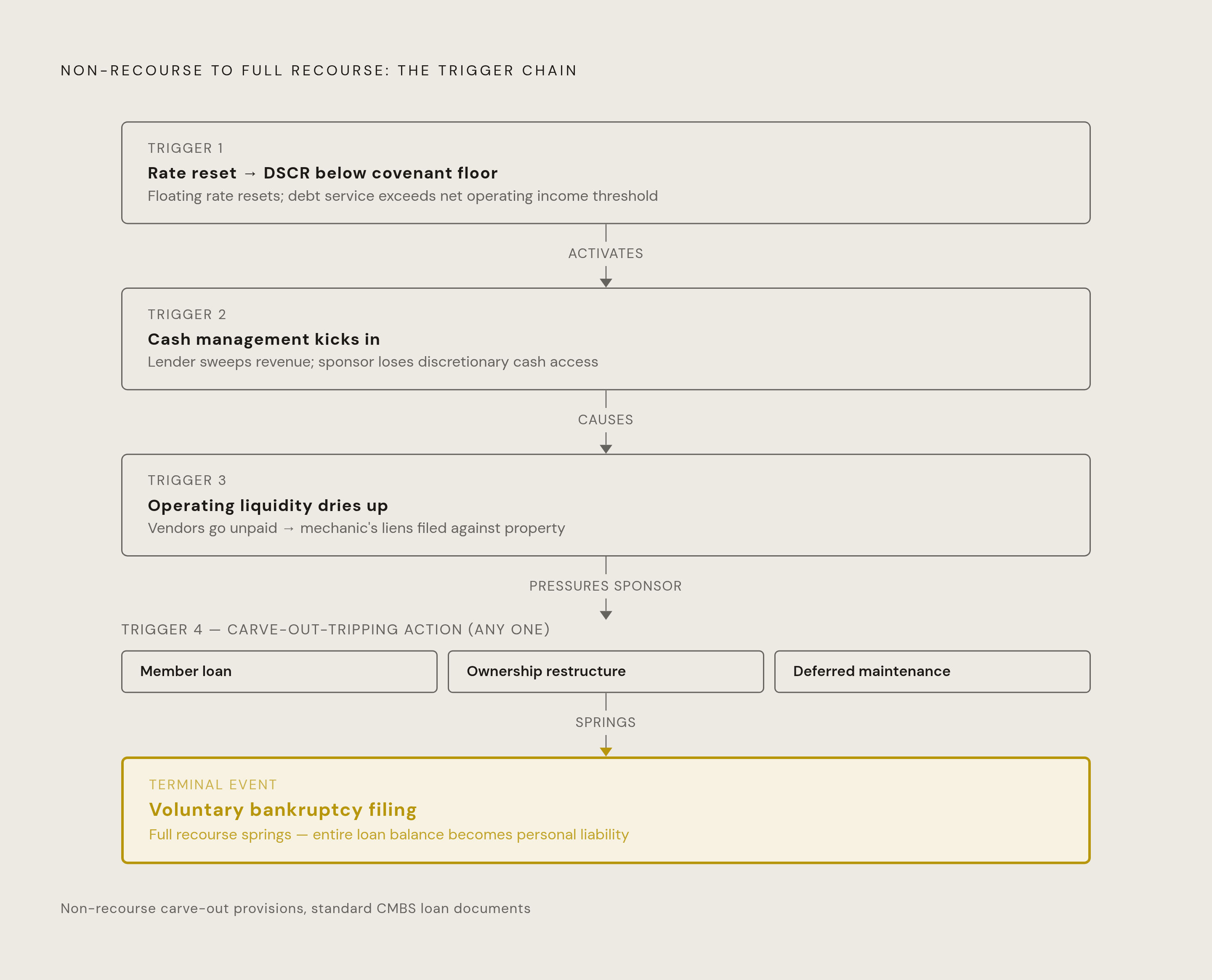
The deals under the most pressure are floating-rate bridge loans closed between 2019 and 2023 on two- to three-year interest-only terms, underwritten on the assumption of a permanent agency takeout that rate increases have since made unreachable. That sets off a fairly mechanical chain: a rate reset pushes DSCR below the covenant floor, cash management kicks in, operating liquidity dries up, vendors go unpaid, liens get filed. Each step down that path raises the odds a sponsor takes an action, a member loan, an ownership restructuring, deferred maintenance, that happens to trip a carve-out.
The bankruptcy trap sits at the far end of that chain. Sponsors under real capital pressure sometimes look at bankruptcy as a restructuring tool, a way to buy time and reorganize. Kelley Clarke PC notes that a voluntary filing is, in most non-recourse loan documents, a full-recourse springing event the instant it's filed. That's not a technicality. It's the exact moment a non-recourse loan stops being non-recourse.
Agora reports CMBS delinquencies stood at 6.59% in the third quarter of 2025, concentrated in specific property types rather than spread evenly across the market. But the direction is clear enough: as more loans hit maturity without a clean refinance path, the carve-out provisions sponsors treated as boilerplate at closing are the same clauses that will decide how much of the loss lands on the collateral, and how much follows the guarantor home.
Sources
- Understanding Recourse and Guarantees in Commercial Real Estate: What Every Borrower Needs to Know - Fident Capital | Commercial Real Estate Debt and Equity Solutions
- Commercial Real Estate Distress in 2026: Market Cycles & Lender Relations
- Non Recourse Commercial Loan Requirements 2026 | Lenders & Eligibility