Preferred Equity vs Mezzanine Debt in CRE Capital Stacks
Ownership versus debt determines enforcement speed and balance sheet treatment.

Preferred equity and mezzanine debt sit in the same slot in a capital stack, the gap between senior debt and common equity, but they are not the same thing. One makes an investor an owner. The other makes an investor a creditor. That single distinction, ownership versus obligation, determines how each instrument gets enforced when a deal breaks, how it shows up on a balance sheet, and whether it's allowed on the loan.
Both instruments exist because senior lenders won't stretch into that gap and common equity alone rarely covers it. Sponsors sometimes treat the two as interchangeable, partly because the headline numbers overlap: total returns in the 11% to 18% range appear for both. But pricing similarity masks structural difference, and that difference only becomes visible once a deal is under stress, at exit, or under a balance sheet audit.
The stakes are higher than usual right now. Commercial real estate investment volume climbed 19% year-over-year in the first quarter of 2026, hitting $117 billion, and a substantial volume of commercial mortgages come due sometime in 2026. That maturity wall is pushing sponsors toward subordinate capital in volume. The CBRE Lending Momentum Index backs this up: it rose to 1.5 in Q1 2026, up from 1.2 in the prior quarter and just 0.3 a year earlier, the highest reading since 2021. Subordinate capital is getting put to work at a pace the market hasn't seen in years, which makes getting the mezz-versus-pref decision right a live, practical question rather than an academic one.
The ownership-versus-obligation divide: what each instrument is
Mezzanine debt is a loan, full stop. It creates a creditor-debtor relationship with a fixed rate, a set payment schedule, and a maturity date. The borrower owes principal back regardless of how the property performs. Some mezz loans carry equity kickers, warrants or conversion rights bolted on to juice the return, but those features don't change what the instrument is under the law. It's still debt. The kicker just makes the debt pay like equity in the good scenario.
Preferred equity works the other way. Holders get membership interests or ownership units in the entity that owns the property, not a note. They sit ahead of common equity for distributions and for whatever's left in a liquidation, but they sit behind every layer of debt, including mezz. Preferred equity can carry cumulative distribution features, a cut of the upside, and sometimes a right to convert into common equity down the line.
A deal from the BMO 2025 CMBS trust shows how this plays out in practice. Strategic Value Partners put in a $50,000,000 preferred equity investment at a 16.0% preferred rate, compounded annually, with 6.0% of that paid monthly so long as cash flow and certain trigger conditions held up. That's not a coupon on a loan. It's a negotiated equity return with conditions attached to how much of it gets paid out in cash versus accrued.
The distinction here is a difference in kind, not a matter of degree, more risk against less risk. It's a difference in kind. Debt and equity get treated differently by contract law, by the IRS, and by whoever's reading the balance sheet on the other side of the table. Everything downstream of this section follows from that one fact.
How enforcement works when a deal goes wrong
This is where the difference stops being theoretical. When a deal goes sideways, the two instruments diverge sharply in how fast, and how certainly, a lender or investor can act.
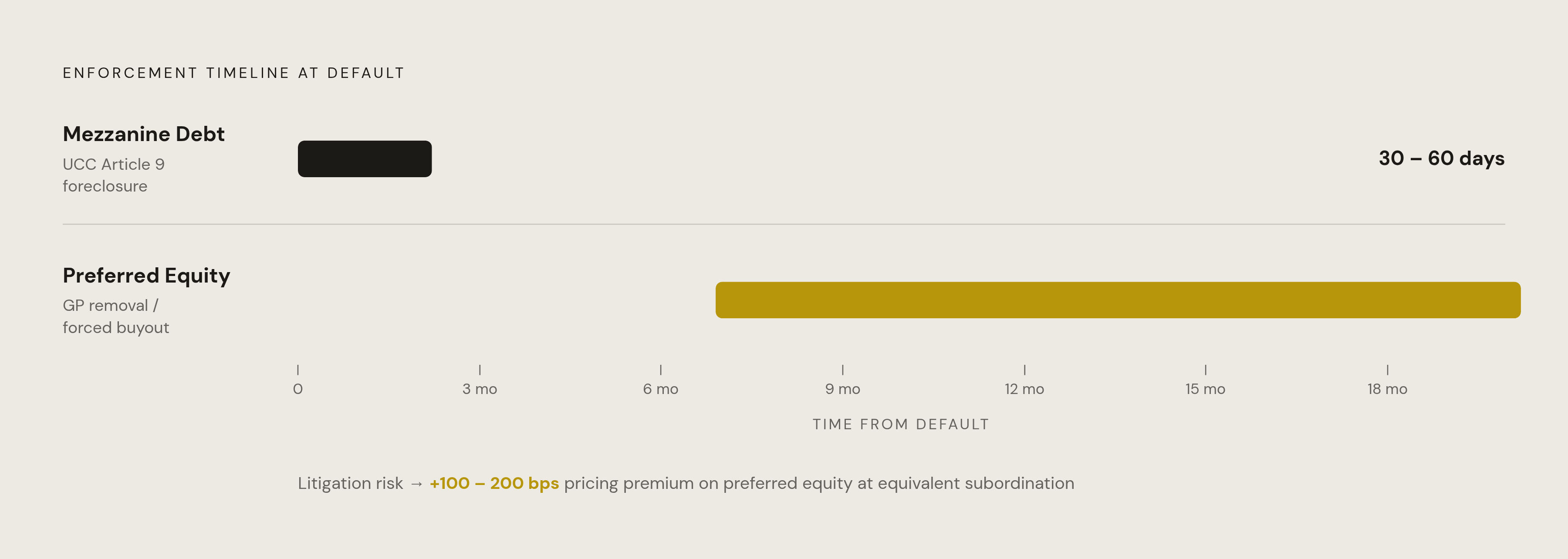
Mezzanine debt gets enforced through a UCC Article 9 foreclosure on the pledged equity interest in the borrowing entity. That process typically wraps up in 30 to 60 days. The mezz lender ends up owning the LLC that owns the building, not the building itself, but the mechanism is statutory, well-worn, and hard for a sponsor to challenge successfully.
Preferred equity has no lien and no pledge to foreclose on. Remedies live inside the operating agreement, usually structured as GP removal rights or a forced buyout provision. When a sponsor contests that removal, and sponsors often do, the dispute turns into litigation that can run six to eighteen months at minimum, sometimes longer. There's no statutory shortcut waiting on the other side.
That speed gap raises pricing directly. The mezz lender's faster, more certain remedy justifies a tighter spread, while preferred equity investors typically demand 100 to 200 basis points more at an equivalent level of subordination, largely to compensate for a slower and less predictable enforcement path. Recent market cycles have made this concrete rather than theoretical, as the enforcement speed difference plays out in real deal timelines when sponsors contest remedies. Subordinate capital investors in 2026 price that enforcement difference into how they underwrite the two instruments.
Mezz carries one more structural wrinkle preferred equity avoids entirely: the intercreditor agreement. The senior lender has to approve the mezzanine financing up front, and the resulting agreement spells out standstill periods, cure rights, and purchase options between the two lenders. It's an added negotiation, and an added constraint, that doesn't exist on the preferred equity side.
Balance sheet and tax treatment: what lenders and investors see
Preferred equity lives in the equity section of the balance sheet. It increases total shareholders' equity, and its distributions reduce retained earnings without ever touching the income statement. Reported profitability, on paper, looks stronger with pref equity in the stack than with mezz doing the same economic job.
A wrinkle for sponsors running more complex structures: certain redeemable preferred equity structures may need to be classified outside permanent equity. That changes how the balance sheet reads to anyone outside the deal looking in; a lender's underwriter can catch this detail if the sponsor misses it.
Mezzanine debt sits as a liability, and its interest, even when deferred or paid in kind rather than paid in cash, still has to be recognized as an expense in the period it's incurred. That expense drags down net income and feeds directly into DSCR math. Preferred equity distributions generally don't touch DSCR at all, which means the exact same dollar amount of subordinate capital can produce a meaningfully stronger coverage ratio in the eyes of a senior lender, purely based on which instrument carries it.
Leverage ratios follow the same logic. Senior lenders frequently fold mezzanine debt into covenant calculations, which can tighten a sponsor's room to borrow later in the deal's life. Preferred equity generally escapes that constraint.
Tax treatment adds another layer. Mezz interest is generally deductible by the borrower, subject to the limits under IRC Section 163(j), while preferred distributions get no such deduction. The 2025 One Big Beautiful Bill Act restored the EBITDA-based 163(j) calculation and brought capitalized interest across businesses under the same cap, while leaving mandatory capitalization rules under Sections 263(g) and 263A(f) untouched. On highly leveraged stacks in 2026, that makes the after-tax cost comparison between mezz and pref equity a genuinely live question rather than a footnote.
Preferred equity holders get K-1 forms and share in the entity's income allocations, which shapes how the sponsor has to present and explain financial statements to those investors over the life of the deal.
Agency debt eligibility: the constraint that decides the instrument before anything else does
Before any of the pricing or enforcement questions matter, there's a gating question that settles the choice outright on a large share of deals: is the senior loan agency debt?
Fannie Mae and Freddie Mac prohibit mezzanine debt pledges on agency-backed multifamily loans. A mezz pledge creates a third-party UCC claim over the borrowing entity, and agency lenders won't accept that claim sitting alongside their loan; that is the structural reason. On any deal financed with agency debt, which covers a large portion of the market in that country. apartment market, mezzanine debt simply isn't available. Preferred equity is the only gap-fill option on the table.
Preferred equity clears this bar because it functions as an internal change to the entity's equity structure rather than a loan. It's an internal change to the entity's equity structure, and most agency intercreditor frameworks permit that kind of change because it doesn't create a subordinate lender relationship requiring its own intercreditor agreement. CMBS trusts and senior lenders more broadly lean the same direction for the same reason: loan documents often prohibit subordinate financing outright, which catches mezz, but say nothing about changes to the equity cap table, which lets preferred equity through.
For multifamily sponsors working with agency financing, this isn't a secondary factor to weigh against pricing. Whether mezz is permitted has to be settled first. Everything else in this comparison only becomes relevant once the answer here comes back "mezz is permitted."
Pricing ranges as of mid-2026, and what drives the spread between the two instruments
Senior CRE debt priced around 6.75% to 9.0% as of June 2026, depending on loan type and property class. That's the baseline everything subordinate gets measured against.
Mezzanine debt pricing varies by deal size. Smaller deals, in the low-single-digit millions to low double-digit millions range, run 13% to 15% current-pay plus 1% to 3% paid-in-kind from middle-market specialty funds. Move up to the next tier of deal size, in the low double-digit millions to mid double-digit millions range, and pricing drops to 12% to 14% current-pay plus 1% to 2% PIK. At the next tier up, roughly double the previous range's upper bound, it's 11% to 13% plus 0% to 2% PIK. Above that tier and into much larger deal sizes, large institutional funds price mezz at 10.5% to 12.5% plus 0% to 1% PIK. Property type moves the number further: stabilized multifamily mezz can price as low as 10% to 13%, while ground-up development mezz can run 15% to 20% or higher, given the added construction and lease-up risk.
Spreads have come in roughly 75 to 100 basis points from their 2023 peak, as senior banks have loosened leverage constraints and reduced the scarcity premium that once sat on subordinate capital.
Preferred equity's total return band runs 11% to 18%, against mezz's 11% to 15% current-pay range. The two overlap, but preferred equity typically prices 100 to 200 basis points wider than mezz at an equivalent level of subordination. On stabilized deals, the 300 to 500 basis point gap between senior debt and preferred equity reflects three things stacked on top of each other: the subordinate position itself, the enforcement delay covered above, and an illiquidity premium on top of both.
The gap between mezz and pref narrows to somewhere around 100 to 300 basis points at the stabilized end of the market. It widens considerably at the transitional and development end, where mezz stays a current-pay product and preferred equity leans harder on accrual and a share of the upside. Oaktree-backed Formida Capital's launch in November 2024, targeting mezzanine, preferred equity, and participating debt on deals spanning a wide range from the smaller end to well into the larger end of the market, is a fair signal that institutional capital takes the risk-return math at this layer of the stack seriously.
Choosing the right instrument: what the decision turns on
Start with agency debt. If the senior loan is Fannie or Freddie, preferred equity is the only instrument on the table, and the sponsor can skip straight to negotiating terms.
Mezzanine debt has the edge in a handful of situations. Interest deductibility matters most on highly leveraged deals: mezz interest lowers taxable income, preferred distributions don't, and that after-tax gap is real money under the 2026 163(j) rules. Enforcement certainty matters to lenders building out a portfolio of subordinate positions, where the 30-to-60-day UCC remedy gets underwritten as part of the deal itself. And when combined loan-to-cost is 80% to 85% or below, that's mezz's natural range, the level most mezz lenders stop at, and within it mezz tends to be the tighter-priced, more clearly defined option. Sponsors who aren't wrestling with lender covenants triggered by added debt also have less reason to care about the liability classification on the balance sheet.
Preferred equity takes over once leverage pushes past that range. Combined LTC above 85% is where mezz lenders generally step back, and preferred equity will go to 90% or higher, charging a higher return to compensate for the extra risk. It's also the answer when the senior loan document flatly prohibits subordinate debt but says nothing about changes to the equity structure, and when balance sheet optics matter enough that the DSCR and leverage-ratio benefits are worth the tradeoff. That tradeoff only makes sense if the sponsor and the pref equity investor can negotiate real contractual protections into the operating agreement, since the enforcement path, if things go wrong, is going to be slower no matter what.
Stacking both is rare but not unheard of. A deal can run mezz behind the senior mortgage and preferred equity between the mezz and the common equity, producing a four-layer stack with two separate intercreditor arrangements, layered enforcement priorities, and a payment waterfall that takes real work to model correctly. That structure appears mostly on large transactions where the subordinate capital need is bigger than any single provider wants to underwrite alone.
The instruments can look almost identical on a term sheet, similar headline cost, similar-sounding subordination language, and still behave completely differently once a payment gets missed, a timeline slips, or an investor decides to enforce its rights. The decision has to rest on structure, not just on the rate printed at the top of the sheet.
Market conditions for sponsors in 2026
The $936 billion in commercial mortgages maturing in 2026, a figure from S&P Global, is doing a lot of the work behind current demand for both instruments. Sponsors refinancing older loans into a higher-rate environment are reaching for creative capital structures more often, a dynamic Akin Gump Strauss Hauer & Feld has flagged as well.
Alternative debt sources, preferred equity and mezz among them, made up 24% of national lending volume in 2025, well above the roughly decade-average of 14%, according to Northspyre's PropTech Outlook citing Deloitte figures. Debt funds drove most of that non-agency lending growth, with volume surging sharply year over year in the first quarter of 2026. Those are the same funds writing mezz and preferred equity checks, so there's more capital chasing this layer of the stack than in prior cycles, not less.
Underneath all that growth, private credit's headline default rate has stayed below 2%, but once selective defaults and liability management exercises get counted in, the effective rate climbs closer to 5%, and PIK usage has risen noticeably alongside it. Anyone underwriting subordinate capital in 2026 needs to build that gap into their enforcement scenarios rather than taking the headline number at face value.
Deal volume is recovering, $124.5 billion in the second quarter of 2026, up 15% year over year, which means more transactions are closing. But the market is pricing risk with more care than it did before 2022, and picking the wrong subordinate instrument at closing doesn't always become a problem right away. Sometimes it becomes visible eighteen months later, when a refinancing stalls or a distribution gets contested. Sponsors who understand the enforcement mechanics, the accounting consequences, and the agency eligibility rules before they go to market end up structuring cleaner deals, presenting stronger financials to senior lenders, and negotiating from a position of actual knowledge with whoever's sitting across the table on the subordinate capital side.
Sources
- Understanding Preferred Equity and Mezzanine Debt in Commercial Real Estate Capital Stacks
- Preferred Equity vs. Mezzanine Debt: Which Works Best in 2025
- Mezzanine Debt vs. Preferred Equity: Key Differences
- apers.app
- withintelligence.com
- Preferred Equity: Comparing Alternatives and Managing Legal Risks | Insights | Mayer Brown
- Preferred Equity or Mezzanine Debt: What's Right for You? | Gower Crowd
- lev.com