How Regional Bank CRE Lending Policies Shift During Rate Tightening Cycles
Banks shifted from projected to actual income and cut loan-to-value ratios during rate hikes.

When regional banks tighten during a rate cycle, the criteria change more than the coupon does. The Fed's rapid rate hikes beginning in 2022 didn't just make loans cost more; they exposed underwriting habits that had built up over a decade of low rates and forced credit shops to re-examine every number that goes into an approval. A sponsor who reads tightening as "the same deal at a higher rate" has misread the mechanism. Loan-to-value thresholds fell, the treatment of income changed, entire sectors were quietly fenced off, and covenant packages grew heavier. Sponsors who understood only that banks were "tighter" got blindsided by the actual reasons specific deals died: a pro forma rent growth assumption that would have cleared in 2021, a debt service coverage ratio built on projected rather than in-place income, an office asset sitting in a bank portfolio that had already hit its internal sector limit. None of those failures appear as a pricing problem. Each is a criteria problem, and the rest of this piece maps the specific levers behind it.
The regulatory pressure that forced banks to treat CRE underwriting as a balance-sheet problem
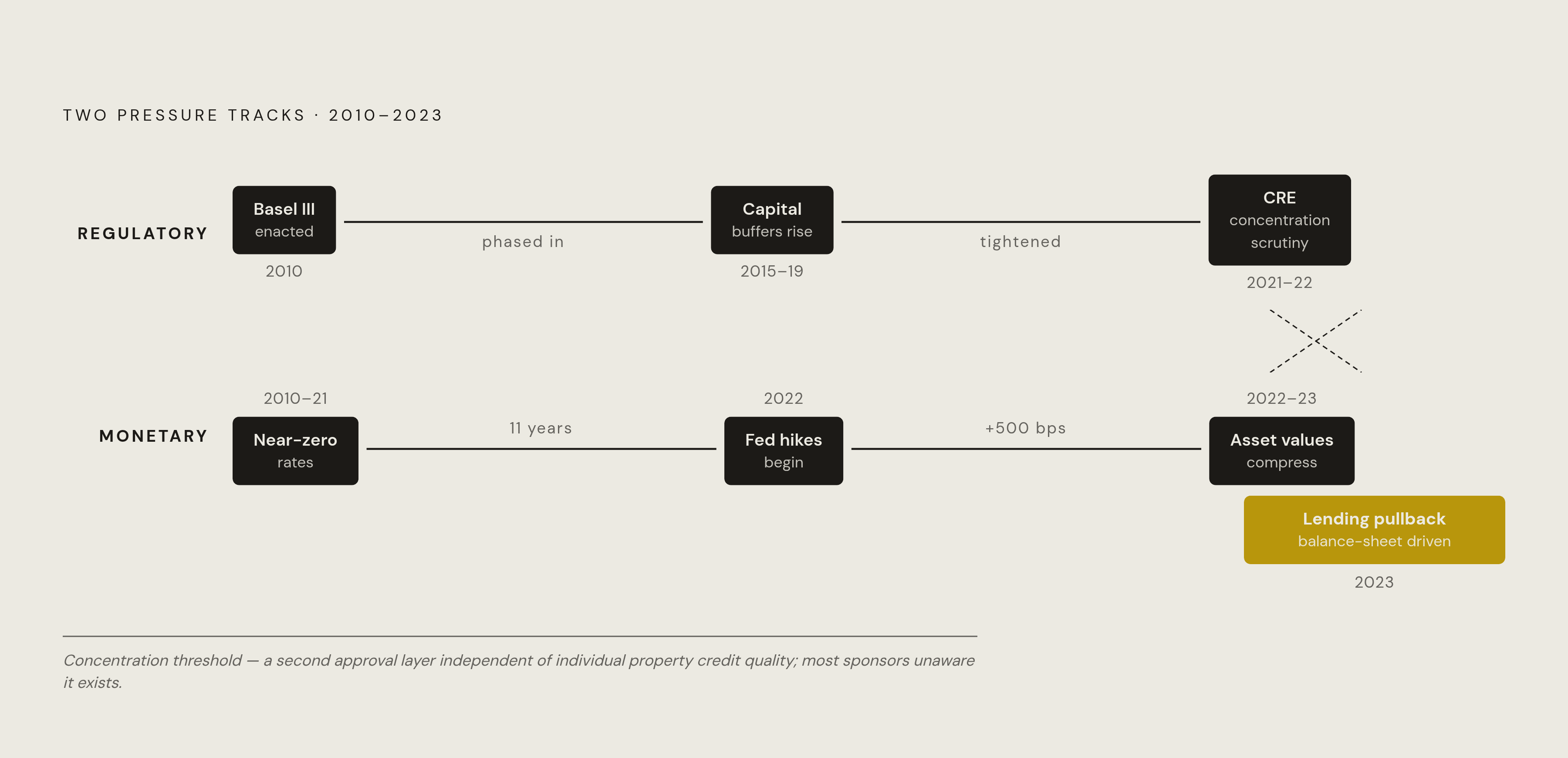
The tightening of 2022 and 2023 didn't arrive alone. Basel III implementation, new attention to commercial real estate concentration, and balance-sheet stress all landed on regional banks at the same time as the rate hikes, giving them a second reason to pull back that had nothing to do with any individual borrower's credit quality. Banks entered 2023 already facing proposed Basel III capital requirements, on top of rising rates and thinning liquidity. Those pressures didn't offset each other. They stacked, compounding rather than offsetting each other.
The FDIC's 2026 Risk Review shows that a large number of banks still carry CRE exposure above the regulatory threshold that triggers heightened supervisory scrutiny. Concentration risk, not credit quality alone, is shaping lending decisions at a large share of community and regional institutions. That changes how an underwriter has to think about any single loan. A bank sitting above its CRE concentration threshold can't approve a deal purely on the asset's own merits; it has to weigh what that loan adds to the bank's total exposure, which functions as a second approval layer sitting on top of the usual credit analysis and having nothing to do with the property itself. That's the structural piece of the story: the retrenchment wasn't a temporary reaction to a bad quarter, it was the output of banks actively managing their balance sheets. In those cases, the sponsor pitched on asset quality, but the bank was asking a different question.
From Pro Forma to In-Place Income as the Controlling Underwriting Standard
The single change that mattered most during tightening wasn't where banks set the DSCR hurdle. It was what income they'd count toward clearing it.
Under the looser standards that prevailed through the low-rate years, a property could clear underwriting on a fully leased pro forma: projected rent growth, anticipated lease-up, optimistic expense assumptions, all baked into the number that determined whether the loan qualified. Tightening ended that practice at most regional banks. Underwriting shifted to start from in-place leases: collected rent, recurring operating expenses, concessions already on the books, scheduled tenant rollover, and realistic vacancy downtime. When income depends on future leasing, aggressive rent growth assumptions, or unusually low expense ratios, the bank credits it at a steep discount against documented operating history.
Consider a multifamily property still in lease-up, at partial occupancy, with a pro forma built around stabilized rents that the sponsor expects to hit within 18 months. Under the pre-tightening standard, the bank sizes the loan against the stabilized number and the deal clears comfortably. Under the in-place standard, the same property, with the same unit mix and the same market rents, gets sized against its current partial occupancy and its current collected rent, and the DSCR comes up short. Nothing about the asset changed between those two outcomes. The income definition did. That's the mechanism behind a pattern that confused a lot of sponsors in 2023 and 2024: the same deal, same numbers, same sponsor, failing underwriting that would have passed two years earlier, for assets in lease-up, value-add repositioning plays that depend on future NOI, and properties with near-term rollover exposure. Those deals had to qualify on where they stood, not on where they were headed, or they failed to qualify.
The sector-level sorting that concentrated capital in some asset classes and cut it off in others
Tightening didn't land evenly across property types. Regional banks ran internal policy changes at the sector level, so entire asset classes froze regardless of how strong any individual deal looked, and even a property with solid in-place income could fail for reasons that had nothing to do with its own numbers.
Office is the clearest case. Vacancy rose, valuations fell, and regulators paid more attention to office concentration, so many banks set internal exposure caps on office lending, and some stopped originating new office loans. A sponsor with a performing office asset, strong in-place occupancy, and clean financials could still get turned down because the bank's policy wouldn't allow a new office commitment, regardless of how the deal underwrote. U.S. Bancorp CFO John Stern has noted that the bank's office exposure dropped materially over three years as the institution deliberately shed holdings and avoided new office commitments, which confirms that the sector exit was a chosen policy, not an accident of deal flow drying up.
Multifamily and industrial sat on the other side of that sort. Both asset classes kept attracting bank capital even at the peak of tightening, because their income profiles were steadier and their vacancy dynamics held up better than office's. Commercial real estate now runs as a two-tier market: some property types move through underwriting largely on their merits, while others meet a closed door before a single financial metric gets reviewed. For a sponsor, that means knowing a bank's internal sector policy before submitting a deal is the first filter the deal has to clear, ahead of DSCR, ahead of LTV, ahead of everything else the credit memo will eventually cover.
LTV compression and the equity gap that restructured deal capitalization
Income treatment and sector policy explain which deals get looked at. LTV compression explains what it costs to get one closed. When regional banks cut their maximum loan-to-value ratios at the same time they tightened the income definition driving the loan amount, the two changes didn't just add together. They multiplied.
The compounding mechanic is this: a property that would have qualified for a higher LTV under pro forma income now has to qualify for a lower LTV calculated against in-place income instead. Debt sizing takes a hit from both directions at once, the appraised value itself shrinks as cap rates rise (the numerator), while the maximum LTV a bank will allow shrinks as well (the denominator). A deal that once supported a substantial share of leverage on a pro forma valuation can end up supporting a noticeably smaller share of leverage on a lower in-place valuation, and the gap between those two numbers raises an equity requirement, not a rate. This equity gap appears when the debt the deal can carry as senior debt falls short of what it actually needs to close.
That gap has to come from somewhere, and the options, equity raises, mezzanine debt, preferred equity, all cost more and take longer to arrange than a bank's senior loan would have. If a deal couldn't source that gap, it didn't get a renegotiated term sheet. It was a dead deal or a forced extended hold, and that failure to refinance at the new, higher equity requirement is a direct contributor to the maturity wall problem that regional banks are now working through.
Covenant packages and reporting requirements that changed the ongoing cost of holding bank debt
Tightening didn't stop at the closing table. Regional banks expanded covenant packages, so sponsors carried the real monitoring burden and operational risk for the life of the loan, not just at origination.
During the tightening cycle, banks added more frequent financial reporting requirements, moved DSCR maintenance covenants from annual to quarterly testing, layered in cash management controls, and required larger reserve balances that limited how freely a sponsor could move cash out of a property. If you cleared underwriting and closed a loan under these terms, you still carry an ongoing compliance load that didn't exist under the looser terms of the prior cycle. A missed reporting deadline, a covenant trip caused by a temporary dip in income, or a reserve balance that falls short can trigger a default provision or loan acceleration, even on an asset that performs in every practical sense.
That pressure is documented at scale. The FDIC's 2026 Risk Review shows banks, often larger institutions, using loan modifications to give CRE borrowers relief as high operating costs, elevated interest rates, and vacancy pressure made it harder for some borrowers to refinance and repay. For a sponsor weighing bank debt against alternative capital, covenant intensity is a cost that never appears in the interest rate quoted at closing. You need staff time to manage reporting cadence, keep reserve balances funded, and track compliance thresholds, and that is a real carrying cost of bank debt that grew meaningfully heavier through the tightening cycle.
The Size Divide Between Large and Regional Banks
Everything described so far treats "banks" as a single actor, but the tightening cycle split large institutions and regional or community lenders in opposite directions on some of the policies that matter most.
The Federal Reserve's Senior Loan Officer Opinion Survey shows the divergence directly: during tightening, large banks reported easing standards across CRE loan types at the same time other banks, the regional and community institutions, reported tightening standards specifically on nonfarm nonresidential and construction loans. The same split carried into the easing phase that followed. The Built analysis found that large banks eased their standards first, while regional and community banks stayed more cautious, particularly on construction, land development, and multifamily lending. It is a persistent structural feature of how this cycle runs, not a temporary misalignment between two groups of banks catching up to each other on a lag.
For a sponsor, the practical consequence is that the credit environment depends heavily on which tier of bank sits across the table. If a sponsor had relationships at large, money-center institutions, the path through the same period was meaningfully easier than for a sponsor whose primary lending relationships sat with regional banks, where tighter standards and slower policy adjustment compounded each other. Reading "banks are easing" in a Fed survey headline and assuming that applies to a regional relationship bank is a mistake with real consequences for deal timing.
The permanent market share shift that tightening handed to alternative lenders
Regional bank retrenchment didn't leave behind a temporary vacuum that waited patiently for banks to come back. It handed market share to alternative lenders, debt funds, mortgage REITs, private credit, and that share has not fully reverted even as banks re-entered the market.
Alternative lenders' share of CRE lending nearly doubled from pre-pandemic levels to a substantial portion of the market in 2025, with the shift sharpest in construction financing, where these lenders held the top originator position for consecutive years. The fact that both bank and non-bank lending grew at the same time tells the real story: the market expanded rather than simply redistributing a fixed pool of loans. Banks originated substantially more CRE loans in the first quarter of 2026 than in the first quarter of 2025, and private market lending surged over that same stretch. The overall pie grew, and alternative lenders kept the larger slice they'd already carved out.
Atlantic Union Bank's completed sale of a $2 billion performing CRE loan portfolio to Blackstone shows how that mechanism works in practice. Loan sales and synthetic risk transfers let banks shrink their balance-sheet exposure and free up capital for new origination, so the long-term holding of that risk goes to alternative capital while the bank keeps the origination relationship with the borrower. CMBS issuance reached its highest level in nearly two decades in 2025, which reflects the same underlying shift: institutional capital markets stepped into the space regional banks vacated, and that infrastructure, the funds, the conduits, the securitization pipelines, is now built out and operating regardless of what regional banks choose to do next. For sponsors, the capital stack now has structurally more paths through it and more complexity than it did before the tightening cycle began, which makes knowing where a given deal fits in that stack, and which lender type is the right first call, a basic requirement for sourcing capital efficiently.
The maturity wall as the unresolved residue of tightened underwriting hitting loans written under looser standards
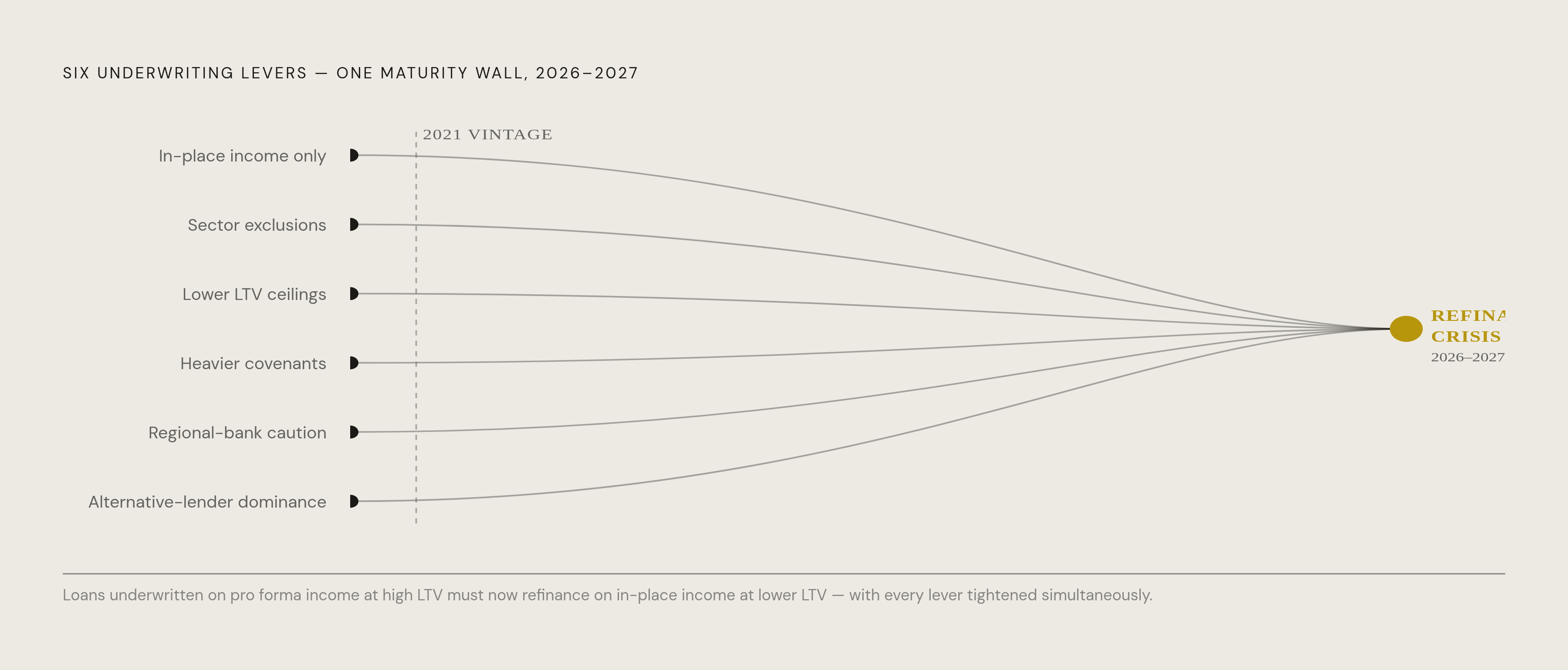
Every change described above eventually arrives at the same reckoning: loans written under the old standards have to be refinanced under the new ones. That collision is the maturity wall, the point where the gap between 2021 underwriting and 2023-2025 underwriting turns from an abstraction into an individual borrower's refinancing crisis.
A large volume of CRE loans originated during the low-rate years are coming due in 2026 and 2027, and the maturity wall has been flagged as a key indicator of potential defaults within regional bank portfolios, especially for loans secured by assets whose values or incomes have slipped since origination. The structural problem beneath those maturities is straightforward to state. A loan underwritten on pro forma income, at a high LTV, with a light covenant package, written for a borrower who expected to refinance into similar terms, now has to refinance into a market that counts only in-place income, allows a lower LTV, and demands a heavier covenant package in return. Every lever covered in this piece, income treatment, sector policy, LTV compression, covenant intensity, the bank-tier divide, the rise of alternative capital, converges on that single refinancing event. For a meaningful share of the loans coming due in 2026 and 2027, that convergence is the entire problem.