Life Company Lending Criteria for Core Commercial Real Estate
Life insurers match long-term liabilities to stable commercial real estate income streams.

Life insurance companies fund commercial mortgages from a different starting point than banks, debt funds, or CMBS conduits, and that starting point shapes every rule they apply to a deal. Banks lend against deposits that can walk out the door on short notice. Debt funds borrow against warehouse lines that need to roll over. Life companies are matching money against obligations that won't come due for twenty or thirty years. A policyholder pays premiums today so a beneficiary gets paid decades from now, and that long horizon needs an asset on the other side of the balance sheet that behaves the same way: steady, long-dated, and boring in the best sense of the word.
Commercial mortgages fit that need about as well as any asset class available. They pay fixed income over long terms, they're secured by real property, and the income stream can be underwritten with real confidence when the building is stabilized and the tenants are paying rent on time. That's the whole logic. It also explains why life companies hold more than $770 billion in CRE debt heading into 2026, the third-largest share of all outstanding CRE debt behind only banks and government-backed agencies. Through 2025, that share grew at a meaningful pace, and in the second quarter life companies actually outgrew both banks and agencies.
Commercial Property Executive noted that amid broad uncertainty across CRE markets, life companies are unusually well positioned, thanks to a mix of flexibility, strong balance sheets, and reliable execution that has made them a popular source of capital in dislocated debt markets. That positioning produces a strange, two-sided posture. Life companies want to put more capital to work, and at the same time they've gotten pickier about where that capital goes. Faron Thompson, executive vice president and executive managing director at Northmarq, put it directly: "There's more of an appetite to put money out and look at a wider variety of opportunities, but there's also a higher level of discrimination for both the types of deals they want to lend to and sponsors they want to do business with". Everything covered from here, property type, market tier, leverage limits, debt yield floors, sponsor vetting, traces back to that same asset-liability mandate. None of it is arbitrary. It's the logical output of an insurer matching a long-term liability to an asset funded without the short-term deposits or warehouse lines that banks and debt funds rely on.
Properties and markets life companies will and won't lend on
Because life companies need income they can underwrite with confidence over a long horizon, they gravitate toward stabilized, income-producing buildings in markets where that income is unlikely to evaporate and easy to refinance when the note comes due. Multifamily that's already leased up, Class A industrial and logistics space, anchored retail with a real sales history, net lease deals backed by credit tenants, and medical or creative office with durable income streams: these are the property types that consistently draw life company capital. CommLoan also lists warehouse and industrial space, mixed-use, self-storage, and top-tier hospitality as eligible, though acceptance on hospitality varies quite a bit from one lender to the next.
Robert Boyd, managing director at New York Life Real Estate Investors, described the underlying test simply: "We have a broad appetite for all kinds of properties but, in the end, it's about having an income that you can underwrite". Property type matters less than the reliability of the cash flow sitting behind it, and low capital intensity going forward.
Location carries its own filter. Most life companies want primary or strong secondary metros, and some won't go past the primary tier at all. A well-run asset in a market nobody's heard of rarely gets a look, no matter how clean the rent roll is. Life companies are matching assets to liabilities that may not come due for 20–30 years, unlike banks funding loans with short-term deposits or debt funds using warehouse lines.
Occupancy is where the filter gets most mechanical. Stabilized assets at 90% occupancy or higher is the standard threshold, and life companies are not, as a rule, transition or value-add lenders. Distressed properties are largely excluded, construction lending is rare and reserved for singular assets, and value-add plays where the income is a projection rather than a fact don't clear the bar. The mandate only works if the income is already there, not promised.
Sector emphasis shifts with the cycle, and 2026 has brought a clear tilt toward industrial. Pacific Life entered the second quarter with expanded industrial and cold storage allocations that hadn't been widely publicized, and the company has been producing some of the most aggressive fixed-rate quotes seen this cycle on logistics assets in the Inland Empire and in Phoenix.
The three underwriting ratios that define the life company box
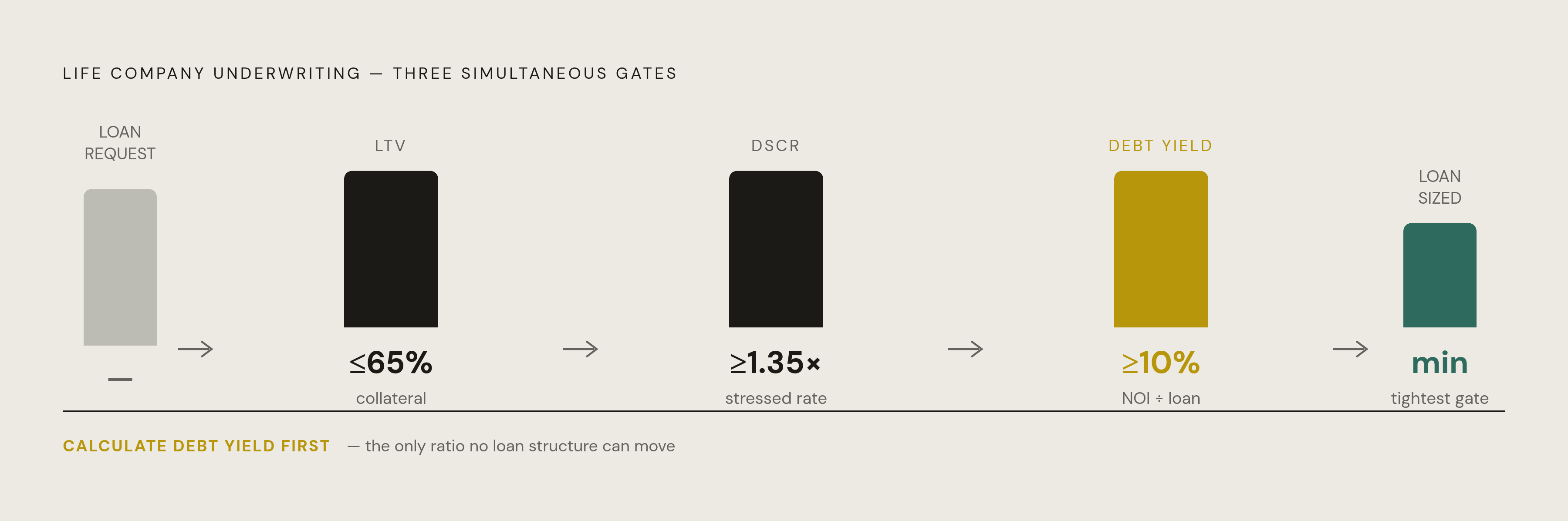
Every life company underwriting file runs on three ratios working together: loan-to-value, debt service coverage, and debt yield. Two of the three can be nudged around through loan structure. The third can't, and that's what makes it decisive on more deals than sponsors expect.
Start with LTV, the collateral test. Life company lending is the most conservative in the market on leverage: maximum LTV typically runs in the low-to-mid-fifty to sixty-five percent range on most commercial property types, with modestly higher limits available for high-quality multifamily or properties with strong anchor tenants. That ceiling compressed further on non-residential collateral through 2026. CommLoan notes that leverage above a certain threshold is virtually unheard of, and even reaching a high LTV requires both borrower and property to be close to pristine. CMBS conduits, by comparison, generally permit somewhat higher leverage on comparable properties, though the gap is often described as slight rather than dramatic. The denominator in that ratio is almost always whichever figure is lower, appraised value or purchase price, so a soft appraisal shrinks the loan immediately, no negotiation involved.
The NAIC's Capital Markets Primer on Commercial Mortgage Loans calls debt coverage ratio "the key metric" for gauging a property's capacity to service its mortgage. Best execution on well-located multifamily in 2026 clustered around in-place DSCR comfortably above the minimum floor lenders require. Life companies typically stress the ratio at an interest rate well above the actual quoted rate, so the coverage they're underwriting to is tighter than what the borrower's real payment would suggest. Many also apply their own adjustments to NOI, standardized vacancy assumptions and management fee assumptions that can differ meaningfully from how the property is actually performing, and this is where life company underwriting diverges most sharply from bank lending.
Debt yield is the one that resists gaming. The formula is plain: NOI divided by the loan amount. Nothing about loan structure moves it. Stretching amortization, adding an interest-only period, or buying down the rate can all flatter a DSCR, but none of them touch debt yield, because it never references the payment at all, only the loan balance against the income the property actually produces. That's the number lenders trust when everything else about a deal can be structured to look better than it is.
Floors move with asset quality and market. A Class A multifamily building in Manhattan might clear underwriting at a debt yield meaningfully lower than what a regional lender would demand on a suburban self-storage portfolio. CommLoan cites a general lender minimum around 10%, with a somewhat lower floor sometimes permitted for standout properties in major markets. Those floors have risen across the board since 2022, and a debt yield that cleared underwriting in a prior cycle may not clear it today. On any deal where debt yield turns out to be the binding constraint, it sets the loan ceiling before LTV even gets a chance to, so sponsors are better off running that number first, before falling for an LTV quote that never gets reached.
All three ratios have to clear at once. A property that sails through LTV but fails debt yield doesn't get a partial approval. It gets resized down to whatever the tightest ratio allows, or it gets declined outright.
Life company loan terms and pricing compared to CMBS
For a sponsor whose deal clears the underwriting box, life company execution carries real structural advantages over CMBS, advantages that compound over a loan term measured in decades rather than years. Those same advantages come bundled with constraints that rule out plenty of otherwise reasonable deals.
On pricing, rates on core collateral in the second quarter of 2026 landed roughly in the mid-fives to low-sixes range, with the best execution, a 10-year term on 30-year amortization against well-located multifamily with strong in-place DSCR, clustering toward the bottom of that band. A large share of life company loans are fully amortizing, so no balloon payment sits waiting at maturity. That's a real reduction in refinance risk compared to CMBS, which typically carries partial amortization and a balloon due at the five, seven, or ten-year mark.
Structural advantages over CMBS extend beyond term and amortization. Both are generally non-recourse with the standard "bad boy" carveouts, though some life company loans add burn-off recourse provisions that expire after a few years and reduce risk on the early end of the term. Because life companies hold these loans on balance sheet instead of pooling and securitizing them, they have far more room to negotiate around a default, a workout, or a modification; a CMBS loan sits inside a trust agreement that constrains the servicer's hands considerably. Earn-outs, additional loan proceeds released once a property hits a defined performance metric, appear regularly in life company deals and rarely in CMBS. Forward commitments are available through life companies and almost never through conduits. Rate locks tend to come earlier too: life company borrowers can often lock at application, while CMBS borrowers typically wait until the loan actually funds.
Prepayment works differently but isn't necessarily friendlier on either side. Life company loans may use step-down premiums, soft step-downs, or yield maintenance, while CMBS relies on defeasance or yield maintenance. Neither structure suits a short hold.
The product itself has broadened at some lenders. New York Life now offers floating-rate and fixed-rate debt, construction financing, and bridge loans, territory that used to belong to banks, layered alongside its traditional long-term fixed-rate programs. Boyd summed up the shift: "We have evolved to be a much more creative and aggressive lender than what might stereotypically come to mind from a life insurance company".
None of this changes the underlying constraint. Life company capital isn't built for short-term strategies, distressed assets, or high-leverage deals, and a sponsor chasing speed or flexibility is better served by a bank or a debt fund. What a life company offers instead is depth of relationship and pricing, on a narrow set of deals that clear its box.
Who is actively lending in 2026
The life company market isn't one uniform pool of capital. Active lenders differ meaningfully by asset type, deal size, and geography, and knowing which lender wants which kind of deal is close to half the work of sourcing a loan.
Commercial Lending Solutions' tracking of closed transactions in the second quarter of 2026 shows several names consistently in the market. MetLife Real Estate was active across deal types. TIAA closed transactions through the quarter. Prudential Mortgage Capital was active across deal types. New York Life Real Estate Investors brought its now-broader product set, floating-rate, construction, bridge, alongside its traditional fixed-rate book. Northwestern Mutual was active across deal types as well. Nationwide and Protective Life were both selectively active on smaller-balance deals concentrated in Sun Belt markets. Pacific Life, as noted above, entered the quarter with expanded industrial and cold storage allocations and was pricing some of the most aggressive fixed-rate quotes of the cycle on logistics assets in the Inland Empire and Phoenix.
Voya Investment Management raised its origination goal for 2026 above where it landed in 2025, and Commercial Property Executive reported the firm increasingly favoring certain asset types as it scales up production. Commercial Property Executive reported in May 2026 that life companies have faced rising competition from banks, debt funds, and CMBS lenders, and that pressure has pushed them to build out programs beyond their traditional permanent-loan book.
Deal size varies by lender rather than by any industry-wide rule. Minimum loan amounts generally start in the low millions, and there's no fixed upper ceiling: some life companies specialize in smaller-balance transactions, while the largest players can underwrite across the full size spectrum.
What life companies require from the borrower
A strong property doesn't carry a weak sponsor across the finish line. Life company underwriting scrutinizes the borrower with the same rigor it applies to the asset, in contrast to CMBS lenders, who weight most of their attention toward the collateral itself.
Credit and net worth sit at the center of that scrutiny. Life companies look for excellent credit and substantial net worth, and this isn't a soft preference tucked into a broader scorecard. It functions as a hard filter: CommLoan notes that borrowers who fall short of these thresholds rarely make it through underwriting at all. Post-close liquidity gets weighed carefully too, particularly on recourse or partial-recourse structures, where the lender cares about what's left in the borrower's accounts after closing costs and reserves are funded.
Sponsor experience is treated as a requirement rather than a nice-to-have. Life companies function as relationship lenders, and a management track record gets underwritten right alongside the balance sheet.
The paperwork reflects all of it. A typical life company file runs three years of tax returns, T12 operating statements, an Excel rent roll, bank statements, copies of leases, a schedule of the borrower's other owned real estate, and an appraisal summary. That documentation load sits noticeably above what a bank typically asks for, and it's the natural consequence of a lender committing to a relationship that, in some cases, will run for twenty-five years or more.