Capital-Sourcing Workflow Tools for Commercial Mortgage Advisors
Automate lender matching, deal packaging, and follow-up to close more deals without hiring.
Commercial mortgage advisory still runs on analyst attention. The work has always been bottlenecked by how many loan packages a single person can read, assemble, and push through a lender's process in a week. In 2026, the tools exist to compress each stage of that work, but most advisory teams have not yet rebuilt their workflows around them. The advisors who do are closing more mandates without proportionally growing headcount.
Why capital-sourcing for commercial mortgage advisors is still a manual bottleneck in 2026
Commercial lending remains deeply underautomated relative to other financial workflows. Lenders still key in data, track covenants on spreadsheets, and assemble credit memos by hand, so the documents an advisor sends out land in a process that is just as manual on the other side. The friction compounds across the entire chain. Deal documents arrive in different formats from every sponsor. An analyst must read, interpret, and re-enter data from offering memorandums, rent rolls, T-12s, and borrower financials before any underwriting can begin. The constraint at every stage is not data availability but analyst attention. A person can only monitor, read, and package so much at once.
The adoption-automation gap tells the rest of the story. AI has spread quickly across commercial real estate, but few processes run fully on their own. The barrier is not the technology itself. It is change management, legacy system integration, and gaps in data and output trust. Advisory firms know the tools exist, but most have not restructured their workflows to capture the gains those tools make possible.
The four capital-sourcing workflow stages where friction concentrates
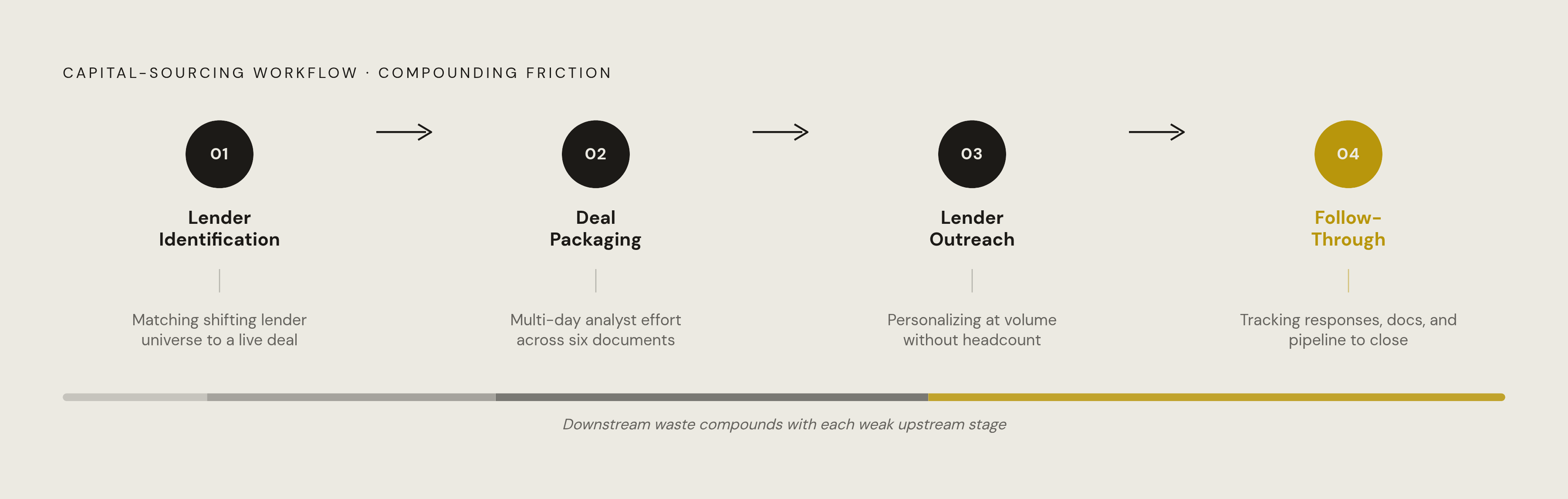
The capital-sourcing workflow is not a single task but a chain of four distinct stages, each with its own characteristic friction point. Understanding them separately is what makes targeted automation possible. The first stage is lender identification: matching a deal's profile to the right capital sources from a large, shifting universe of lenders with different mandates, appetites, and current activity. The second is deal packaging: assembling the loan package into a lender-ready format, spanning the executive summary, sources and uses, T-12 narrative, rent roll commentary, market overview, sponsor bio, and risk register. The third is outreach: personalizing and sequencing lender communications at a volume that a small advisory team cannot sustain manually without dropping quality or coverage. The fourth is follow-through: tracking responses, managing document requests, and maintaining deal-level pipeline visibility through to term sheet and close.
These stages compound one another. A poorly matched lender list wastes the packaging effort that follows it. An underprepared package undermines outreach, because the lender's first substantive impression of the deal is the document itself. Weak follow-through loses term sheets already in motion. An advisor who automates one stage but leaves the others manual captures only a fraction of the available gain.
Lender identification: moving from manual research to continuous signal monitoring
The lender identification problem is not that advisors lack access to lender data. Directories exist, and most advisory firms maintain some version of a contact list. The problem is that no analyst can continuously monitor a shifting lender universe and score it against a specific deal's parameters in real time. Lender appetite shifts constantly. Rates, capital allocations, and product mandates change faster than any list you maintain by hand can track. The right AI tool class for this stage answers a specific question: which lenders are active for this deal, right now? It does not offer a static directory.
Signal monitoring agents apply the logic that already works on the property side. Agents watch intent signals such as permit filings, deed transfers, new liens, mortgage events, and assessed-value shifts continuously across thousands of properties, surfacing owners and capital events before they reach a marketplace. You can point that same logic at lenders to watch how capital moves. An advisor who can see which lenders are actively deploying capital into a given product type, geography, and deal size has a structural advantage over one working from a list built six months ago.
ChatGPT and Claude can help you draft broker introductions and dig up ownership structures from public information. But they are not a lender-matching workflow. They surface no live lender activity data, which is precisely the data that determines whether an outreach effort lands or bounces. The ROI metric at this stage is straightforward: deals reaching the right lender faster, with fewer wasted outreach cycles to lenders whose mandates do not fit. It consumes analyst hours and delays the deal when an outreach cycle goes to the wrong capital source.
Deal packaging: compressing the loan package from days to hours
Deal packaging is the single most time-intensive stage of the capital-sourcing workflow, and it is the one where AI produces the most documented compression. The reason is structural. Assembling a lender-ready loan package is a structured document task, and that is exactly what current AI handles best. The approach is to extract deal facts from raw documents, structure them into a formatted package, run consistency checks, and generate a professional memo. What takes a multi-day analyst effort compresses into hours.
Traceability is the 2026 differentiator. Every number in the package should link back to the page it came from, because institutional lenders and their credit committees increasingly require sourced, audit-defensible deliverables. This is a design choice, not an afterthought. Fifth Dimension, which closed a Series A in May 2026 led by HV Capital with participation from Speedinvest, Seedcamp, Anthemis Group, Prudence, Mercia Ventures, MMC Ventures, and AFG Partners, builds a product called Ellie whose outputs are sourced, cited, and audit-defensible. That design came from institutional LP demand for provenance on AI-generated underwriting work. A number without a source is a liability. A number with a traceable path back to the rent roll is an asset.
Financial spreading is the sub-task where AI has the sharpest edge. Extracting rent roll data, mapping T-12 line items to model rows, and pulling actuals from PDFs are repetitive, error-prone manual tasks that consume enormous analyst time. With the right tool, analysts start from a substantially pre-filled model rather than a blank one. The remaining work is review and validation, not data entry.
The caveat is that template-first spreading tools hit a structural ceiling on tiered K-1 files. It spreads each return on its own, not across documents, so multi-entity consolidation stays with the analyst. Before you commit to a tool, verify how it handles complex entity structures. The compression is real, but it is not uniform across every document type.
Lender outreach: personalizing and sequencing communications at scale
Lender outreach is where advisory firms most visibly sacrifice quality for volume. Personalized, deal-specific lender communications are more effective than blast emails, but crafting them individually at high volume is unsustainable without headcount growth. The result, for most small teams, is a tradeoff: either fewer lenders contacted with higher quality, or more lenders contacted with generic messaging that signals weak preparation. AI drafting tools can spin deal-specific outreach variants from the same deal package, each fitted to a lender's mandate, appetite, and prior relationship. This is scale a two-person team cannot cover manually.
You can use general LLMs to draft first-touch outreach, follow-up sequences, and cover note variants. Claude and ChatGPT write well, and they can structure a deal thesis quickly for LP or lender communication. But purpose-built capital-raise copilots go further. They pull the rent roll, T-12, pro forma, and sponsor track record into a consistent, lender-ready debt request, then generate outreach materials that are internally consistent with the package. That consistency matters. It eliminates the mismatch between what the package says and what the cover note promises, which is exactly the kind of discrepancy that erodes lender confidence before the first call.
The human checkpoint remains essential. An advisor still signs off on every message for accuracy, relationship sensitivity, and do-not-contact compliance. AI handles the drafting and sequencing. It does not make the judgment call on whether to send. The advisor's role shifts from composing to reviewing, which is where the time savings accumulate without surrendering control.
Pipeline follow-through: tracking mandates from first response to term sheet
More mandates are lost in follow-through than at any earlier stage. Missing document requests, stalling lender responses, and an untracked pipeline kill deals that were already moving well. Yet this is the stage most advisory teams automate last. After outreach goes out, the work shifts from creation to tracking. Which lenders responded, what they asked for, what is outstanding, and where the deal stands in each lender's process. At high mandate volume, this tracking collapses into a spreadsheet or an inbox search, and both fail under load. A term sheet expiring unnoticed is the predictable consequence.
AI-powered pipeline tools change the posture from reactive to proactive. They keep an eye on deal status, flag outstanding document requests, and surface stalled lender conversations before they go cold. The advisor sees which deals need attention now, rather than discovering the problem when the lender has already moved on. Portfolio variance monitoring extends the same logic post-close. It continuously compares actual property performance against original pro forma, flagging NOI variance, expense ratio drift, and DSCR compression before the next reporting cycle.
The institutional bar is rising. JLL Falcon compresses portfolio research from weeks to hours using proprietary data, which sets expectations for what advisors should be able to deliver to their clients. The firms capturing the biggest efficiency gains at this stage are those with clean data foundations underneath their tracking tools. Introducing pipeline automation without data hygiene creates new silos rather than resolving the existing ones. The tool is only as good as the data it tracks.
Why point solutions that don't connect create new friction instead of removing it
Automating each capital-sourcing stage with a separate point solution reproduces the fragmentation problem in a new form. A lender list in one tool, a loan package in a second, outreach tracked in a third, and pipeline status in a fourth means an advisor is manually reconciling four systems rather than one deal process. The tools were supposed to remove handoff friction, but data silos between them create the same problem again. The workflow was manual and fragmented. Now it is automated and fragmented, which is not the same as improved.
The strongest objection to full-stack adoption is real and deserves to be taken seriously. Implementation cost, vendor lock-in, and the risk of buying capability a firm lacks the data hygiene to use are legitimate concerns. Firms with messy or inconsistent deal data will not realize the expected ROI from any platform, regardless of how capable the AI is. The answer is sequencing. Start with the single workflow that costs the most analyst time, prove the return, and build from there. A wholesale platform switch on day one is a recipe for abandoned adoption.
There is also a genuine technical reason to prefer purpose-built vertical platforms for the numerical work. General LLMs are strong for narrative drafting and LP communication, but they are not reliable for numerical extraction from financial documents. The hallucination risk in numerical contexts requires validation, which is why platforms with traceable outputs exist. The architectural advantage of a unified platform is that deal data entered at the lender identification stage is available without re-entry at the packaging, outreach, and follow-through stages. That compounds the time savings rather than capping them at the individual tool level.
What separates advisors who capture the automation advantage from those who don't
The advisors who will close more mandates without proportionally growing headcount are not the ones who adopt the most tools. They are the ones who automate in the right sequence, starting with the stage that costs them the most time. The adoption-automation gap is real. AI has spread fast across commercial real estate, but few processes are fully automated, and the barrier is change management and unclear ROI targets, not the technology. The firms that succeed define a specific return before they commit to a tool.
The practical prescription is straightforward. Identify the single workflow stage where the team loses the most hours per mandate, apply the right tool class there first, measure the return, and then extend. For most advisory firms, deal packaging is that stage. It is the most time-intensive, the most format-sensitive, and the most directly connected to lender response quality. A lender who receives a clean, sourced, internally consistent package is more likely to engage seriously with the deal.
Domain specificity matters. AI built by practitioners with direct deal experience, as the CarbonAI founding story illustrates, produces more reliable outputs on CRE-specific document types than generic AI retrofitted to the industry. The document types in this business are not generic. Rent rolls, T-12s, K-1s, and offering memorandums have structural peculiarities that reward training on the actual problems advisors face. The competitive asymmetry is already widening. Advisors deploying purpose-built CRE AI are executing mandates faster, producing more consistent deliverables, and running leaner teams. The window for adopting without disadvantage is narrowing.