Automated Financial Spreading Tools for CRE Loan Packages
Automated tools now handle the data entry that consumes most CRE underwriting hours.
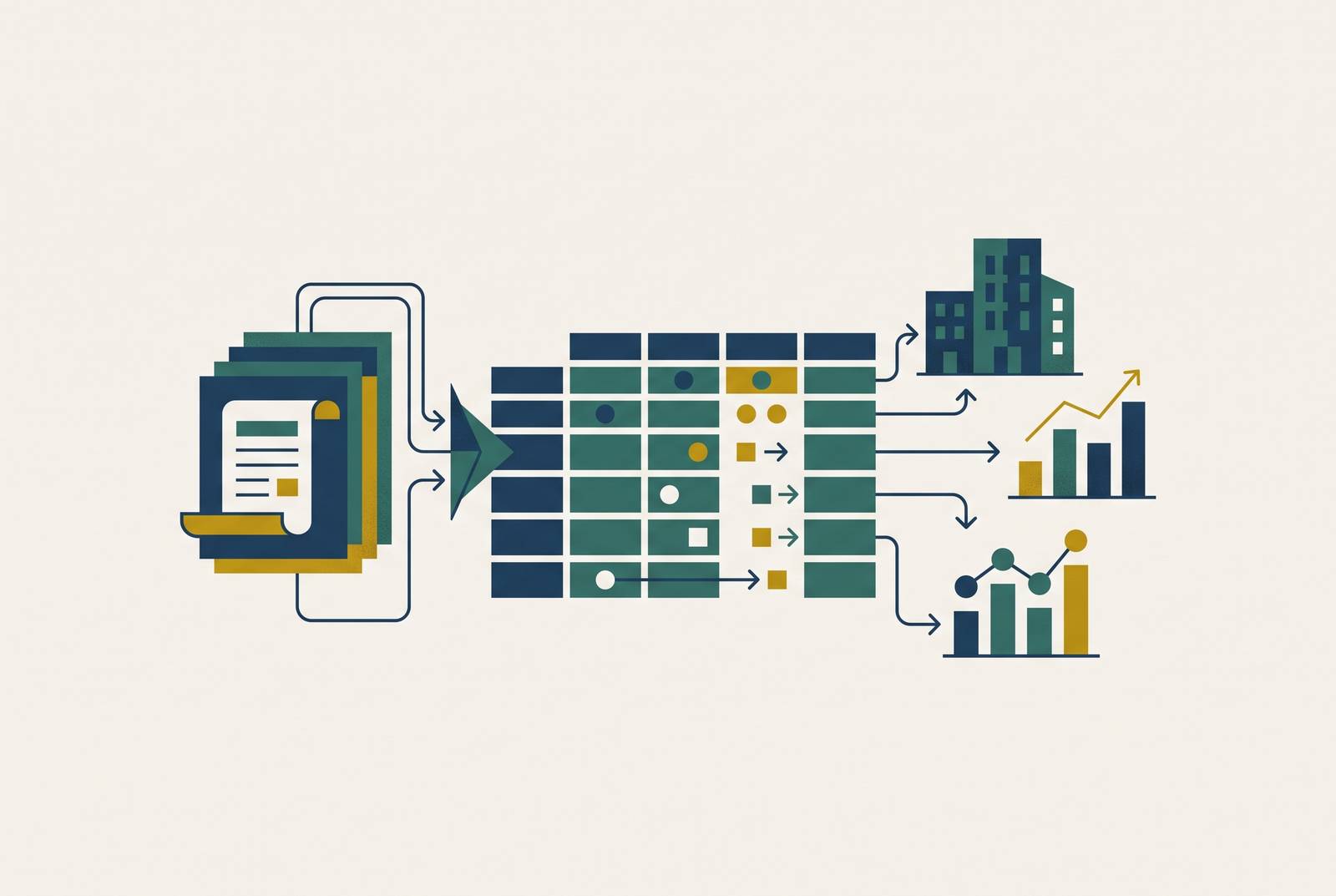
Before an analyst can calculate a single debt service coverage ratio, someone has to read every page of the deal file and turn it into numbers a model can use. That task, not underwriting judgment and not document assembly, consumes the most hours in preparing a commercial real estate loan package. A typical deal file arrives as a stack of PDFs: an offering memorandum, a T-12 operating statement, a rent roll, lease documents, tax returns. None of it comes formatted for a model or a credit memo. An analyst has to read each document, re-key the figures, and reconcile them against one another before a DSCR or a debt yield calculation means anything.
This work is transcription. It draws on the same senior-analyst hours that underwriting judgment requires, but it produces no judgment of its own. Commercial real estate makes the problem worse than it is in general commercial lending. Property-level cash flows, rent rolls, and agency workbooks need interpretation, and generic optical character recognition was never built to supply it, so the manual step runs slower and carries more risk of error than its counterpart in a standard C&I file. A mis-keyed figure on a Schedule K-1 doesn't stay contained to one line. It flows into the DSCR calculation, then into the global cash flow analysis, and from there into whatever recommendation reaches the credit committee. The industry has built increasingly sophisticated underwriting logic on top of a data-entry process that hasn't kept pace, and every hour an analyst spends re-keying a rent roll raises the question of whether the deal should get done.
Three operating layers of CRE spreading software
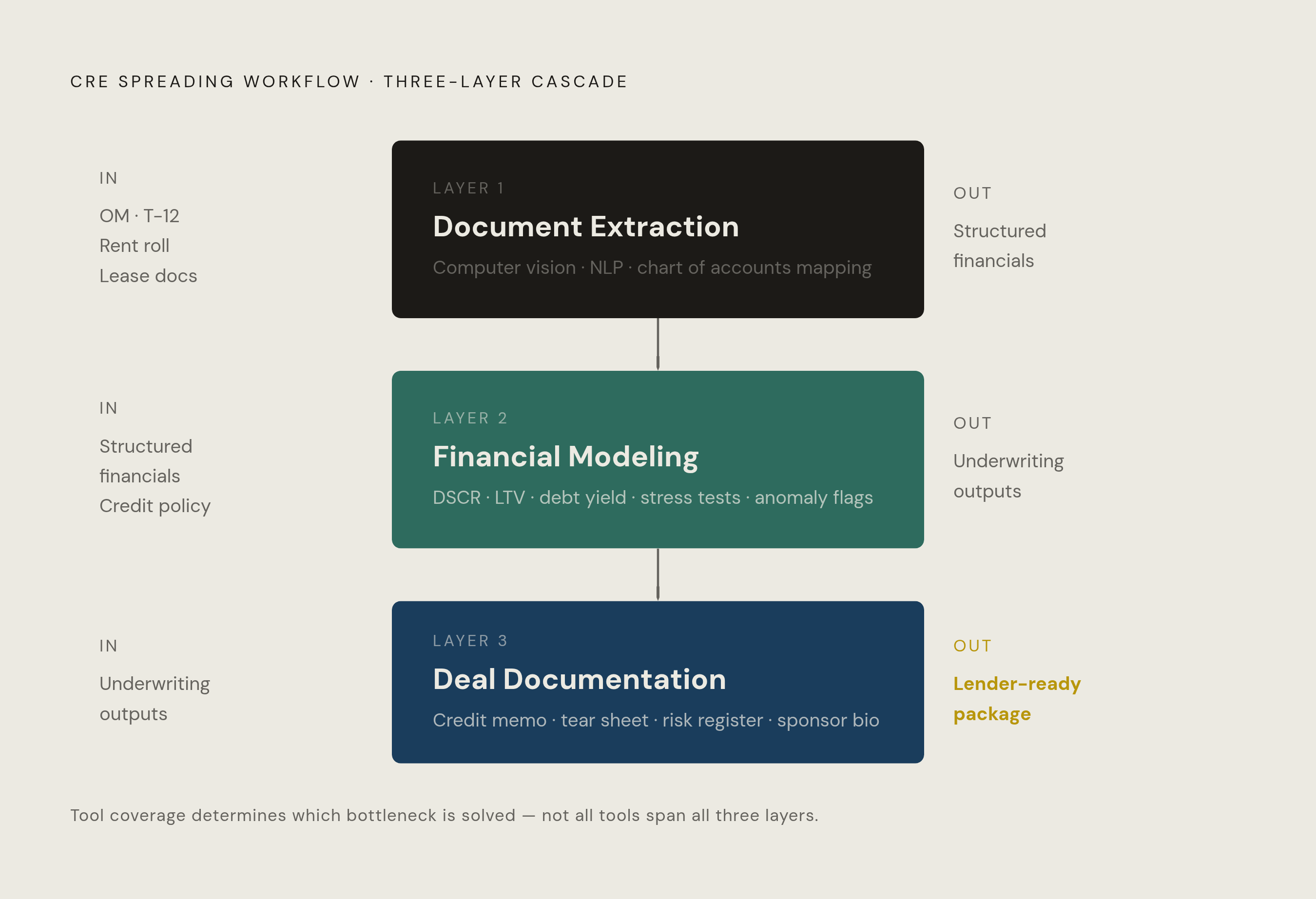
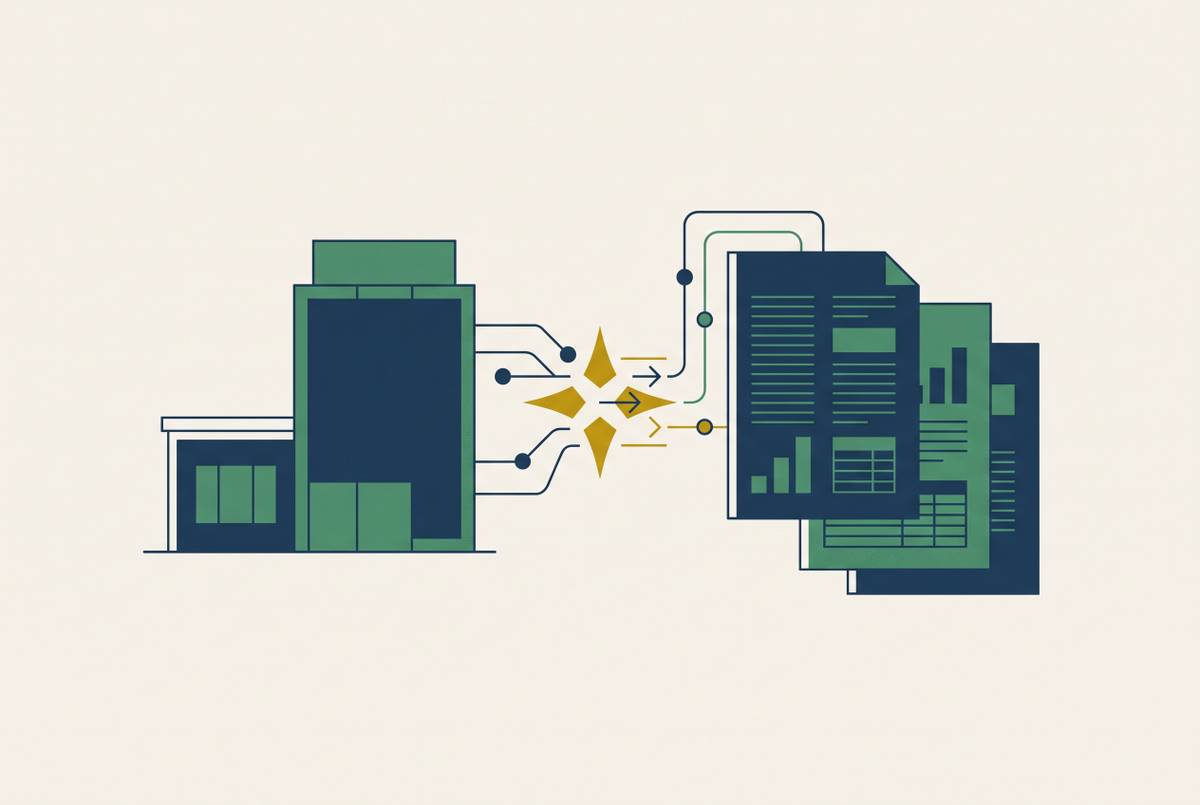
Automated spreading tools address this problem by operating across three layers: document extraction, financial modeling, and deal documentation. Each layer solves a different part of the bottleneck, and a given tool's value depends on which of the three it actually covers.
The first layer, document extraction, ingests the raw PDFs: the OM, the T-12, the rent roll, the lease documents. Computer vision and natural language processing parse handwritten tables, scanned financials, and the irregular formatting that shows up across different brokerages and property managers, then map what they extract to a standardized chart of accounts. Extraction requires interpreting what the numbers mean once they're read, beyond simply reading the page. A rent roll might report "GPR." A T-12 might report "Effective Gross Revenue." An offering memorandum might report "Gross Potential Income." These are related but distinct figures: GPR assumes full occupancy with no vacancy or credit loss, EGR deducts vacancy and credit losses from potential income, and GPI adds ancillary non-rental income back into GPR. A spreading tool has to resolve those distinctions correctly even when the labels vary from one brokerage's template to the next, which is the kind of document intelligence that CRE-specific platforms like Lev, a deal-running AI platform for sponsors and brokers that converts raw property financials and deal documents into lender-ready memos, are built around. Clik.ai's work with Bellwether Enterprise offers a concrete proof point here: the engagement produced a measurable reduction in the time spent processing operating statements and rent rolls, an early signal of what purpose-built CRE extraction delivers once it's running at institutional scale.
The second layer, financial modeling, takes the extracted and normalized data and runs it against credit policy: DSCR, LTV, debt yield, break-even occupancy. This layer also flags anomalies that a manual read might miss under time pressure, concession-inflated gross rents, management fees priced below market, expense ratios that look off relative to comparable properties. Lease amendments that cross-reference clauses from earlier periods get reconciled automatically. Newgen's CRE lending platform embeds stress testing and sensitivity analysis directly into this layer, running scenarios across interest rates, vacancy, and cap rates within the same workflow. What distinguishes CRE-specific modeling from general commercial spreading is the incorporation of property-level data and market comparables alongside the borrower's own financials. General-purpose tools handle the borrower financial statement side competently but don't model property cash flows or apply CRE underwriting logic natively.
The third layer, deal documentation, turns the modeled output into something a lender can act on: a credit memo, an investment tear sheet, a structured data export with every figure cited back to its source. A structured AI workflow can assemble the executive summary, the sources and uses, the T-12 narrative, rent roll commentary, a market overview, a sponsor bio, and a risk register directly from the underlying deal documents, leaving the analyst to review and apply judgment. Lenders across the agency space, life companies, debt funds, and CMBS shops already accept AI-assisted packages on these terms. What they evaluate is accuracy and presentation, not how the package got made.
CRE-specific spreading versus general commercial loan spreading tools
The decision that matters most when selecting a spreading tool is whether it was built for CRE income-producing property analysis or for operating-company financial spreading, because these rest on different analytical frameworks. This reconciliation burden appears only after the deal is already in process.
General commercial spreading tools, designed around C&I lending, SBA products, and operating-company financials, handle borrower financial statements well. They don't model property cash flows, rent rolls, or the ratios specific to CRE underwriting, because that was never the problem they were built to solve. A lender running one of these tools alongside a separate property analysis process ends up performing a reconciliation step on every deal, a step that purpose-built CRE tools remove by design. CRE-specific tools fold property-level data and market comparables into the same analysis as the borrower's financials, which changes what the underwriting framework looks like for income-producing assets rather than simply adding a feature to an existing one.
The document complexity native to CRE compounds the gap. Rent rolls carry individual lease terms that vary unit to unit. T-12s contain non-standard line items, and these differ by property type and management company. Agency workbooks follow their own conventions. Lease amendments reference clauses buried in prior agreements. Extracting meaning from this set of documents requires logic that general-purpose OCR, and general commercial spreading tools built around it, were not designed to handle. Sponsors and brokers assembling a loan package for an income-producing property should judge a tool by whether it reads CRE-native documents correctly, not by whether it can pull figures off a standard tax return.
The tool landscape and the CRE spreading workflow
The spreading tool market isn't one category with several vendors competing inside it. Tools anchor at different points along the three-layer workflow, so if you choose a tool for the wrong layer, the actual bottleneck stays in place.
Some tools specialize narrowly in document extraction, focused on automating the normalization of borrower financial statements, tax returns, and rent rolls, with strength concentrated in source fidelity. Ocrolus operates as a broader document-AI and analytics platform, covering extraction, fraud detection, cash flow analytics, and income analysis rather than sitting as a single narrow extraction layer. Spreading AI maps extracted data to a standardized chart of accounts and links every figure back to the originating document and its exact location, but it doesn't extend into narrative memo drafting.
A second group of platforms covers extraction, spreading, global cash flow analysis, and credit memo generation in one workflow, reducing the handoffs between systems that a single-purpose tool would require. Aloan positions itself as an AI-native commercial underwriting platform that can handle multi-entity reasoning, K-1 tracing, and source-cited credit memos, and it can run either as the commercial loan origination system or alongside one already in place. Accend covers financial statement extraction, global cash flow spreading, and covenant monitoring within a single platform, tracking covenants automatically once underwriting closes, with scheduled tests, due dates, and alerts built into the same system. Newgen's CRE lending platform adds CRE spreading templates built for multiple property types, automated extraction from tax returns and financial statements, stress testing, and AI-led portfolio monitoring. Moody's CreditLens, now positioned as part of Moody's Lending Suite, combines workflow automation with proprietary credit data and benchmarked risk models at a scale suited to large banks.
A third category consists of broader loan origination systems where spreading is one capability among several, not the core offering. Baker Hill, Abrigo, and nCino anchor around origination rather than underwriting speed specifically, and they make sense for an institution whose actual constraint is the absence of a system of record, not the speed of spreading itself.
A fourth category is newer: agentic underwriting platforms that move past extraction into orchestrating the underwriting sequence autonomously, pulling data, running risk models, flagging anomalies, and routing exceptions to human reviewers without manual handoffs between steps. Fifth Dimension raised a $26 million Series A led by HV Capital in May 2026, and that signals institutional confidence is building around this category specifically. The shift from AI functioning as an assistant to AI functioning as an autonomous agent marks where the 2026 tool landscape differs most from what came before it. The question for a lender evaluating these platforms is no longer whether the system can extract data accurately. It's whether the system can orchestrate the full underwriting sequence without losing the judgment layer a human reviewer still needs to apply.
Evaluating a spreading tool for CRE loan packages
Selecting among these tools comes down to four questions, and vendor demos tend to obscure all four of them: what documents the tool actually handles, how it behaves when it isn't sure of an answer, whether it integrates into existing systems or creates a new one, and whether analyst review time actually drops on real files rather than on a vendor's sample set.
Document breadth is the first test. A tool that processes a clean, standardized financial statement without friction says little about how it will perform on a partnership return with tiered K-1s, a rent roll carrying individual lease terms line by line, a T-12 full of non-standard categories, or an agency workbook built to its own conventions. Accuracy on automated spreading tends to hold up well on clean documents and decline on poor scans, handwritten annotations, and unusual formats. A tool that can't flag which fields it's uncertain about is guessing silently, failing to surface the limits of its own read. Vendor demos run on clean sample documents because clean documents make every tool look capable. An 80-page tax return with inconsistent formatting or a rent roll with handwritten notes in the margins is the kind of file that actually shows up in a working pipeline, and it is the real test.
Source fidelity is the second test, and it matters for more than compliance. Every extracted figure should trace back to a specific document, a specific page, and a specific line item. Clik.ai builds section and page citations directly into its extraction workflow, which reflects a principle that applies across the category: speed only has value when it's traceable, since a system that moves data faster without preserving where that data came from has just moved numbers around more quickly.
Workflow integration is the third test. A tool that forces analysts to work inside yet another platform, separate from the loan origination system already in place, adds a layer of friction. Most CRE teams already run several disconnected tools, so they lose hours to duplicate data entry between them. A spreading tool that doesn't integrate into the existing system compounds a problem the institution is already living with. Platforms that combine extraction, modeling, and memo generation into a single workflow cut down the number of handoffs an analyst has to manage. Tools built around a single function require pairing with something else to close the gap.
The fourth test is the only one that produces a real number. Publicly audited accuracy benchmarks across vendors are uncommon, so the practical measure is how much analyst review time an automated spread saves on the institution's own deal documents, not on a vendor's curated demo set. A tool that cuts a five-hour spread down by two hours represents a different return than one that barely moves the number. The only way to know which is the case is to run the tool against the team's actual document types before committing to it.
Automated spreading's effect on the loan package for sponsors and brokers
For sponsors and brokers, automated spreading doesn't deliver underwriting accuracy, because that still rests with the lender's own credit judgment. The advantage is how fast a package can be assembled and how many opportunities can be evaluated before capital gets allocated.
A structured AI workflow can produce the executive summary, the sources and uses, the T-12 operating statement narrative, rent roll commentary, a market overview, a sponsor bio, and a risk register directly from the underlying deal documents, assembling in one pass what used to require drafting section by section. Work that took multiple weeks under a manual process can often finish in a fraction of that time once AI handles the data assembly and the preliminary analysis that used to precede any drafting.
The same shift changes deal screening throughput on the front end. If an analyst reviews an offering memorandum under the old process, they can spend a significant share of the review just extracting figures before reaching a kill decision, hours spent before any actual evaluation of the deal's merits begins. Automated spreading takes that extraction step out of the analyst's hands, so the hours once spent re-keying numbers off a rent roll become hours spent deciding whether the deal is worth pursuing. That reallocation, from transcription toward judgment, is what the three layers of automated spreading were built to produce.