How Debt Originators Should Score an AI Platform Across the Full Deal Lifecycle
Evaluate CRE AI platforms by how seamlessly they connect each workflow stage, not isolated features.

An AI platform built for commercial real estate deal workflows must keep deal data, credit policy, and source evidence intact from intake through post-close monitoring. Debt originators should score that continuity stage by stage, rather than rank platforms by their strongest feature. The best fit is the platform that removes manual work without creating a new bottleneck at the next handoff.
Why evaluating a CRE AI platform feature by feature produces the wrong answer
A strong extraction demo establishes little about what happens when the extracted figures enter an underwriting model. If analysts must rebuild context, reconcile outputs, or transfer assumptions manually, the work has moved. The handoff becomes the new chokepoint. The same problem affects market-research chat interfaces and deal-matching tools that work well on their own but leave the rest of the workflow untouched.
That weakness costs more when volume and underwriting conditions change at the same time. MBA data showed that commercial and multifamily origination volume in Q2 2026 was well above its level a year earlier. The Federal Reserve raised its policy rate in September 2026, which added pressure to re-underwrite files against a moving rate curve. Under those conditions, an untested gap consumes analyst time each time a deal needs another pass.
What the CRE deal lifecycle actually looks like from a debt originator's seat
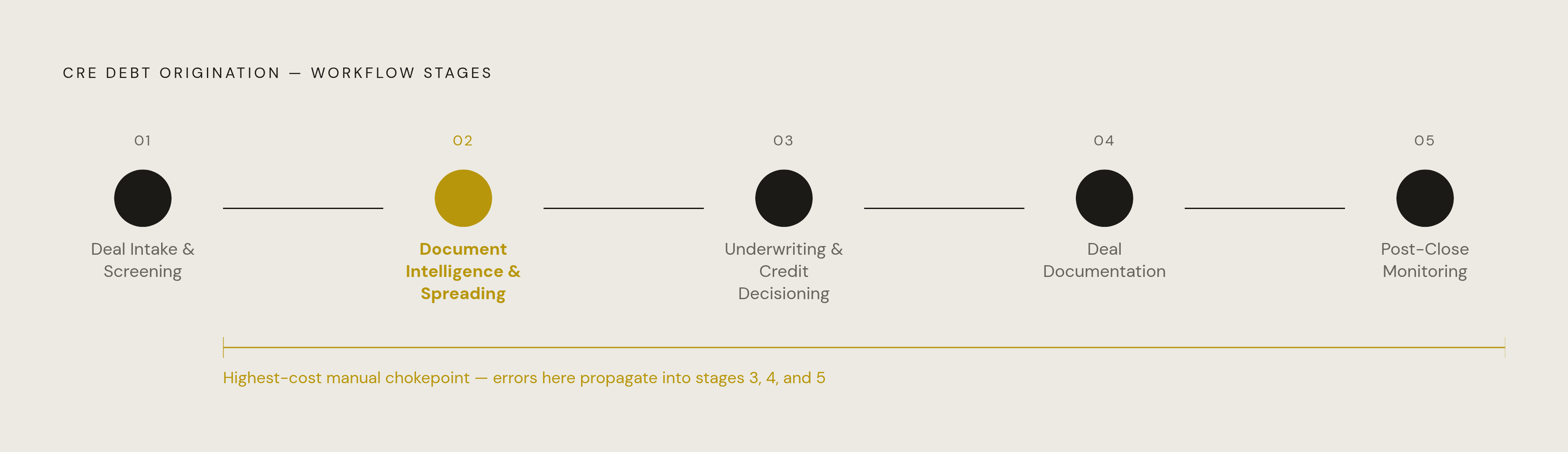
The workflow begins with deal intake and screening, where submissions are assessed against the lender’s credit box and routed for review. Document intelligence and spreading then turn offering memoranda, rent rolls, leases, and T-12s into structured inputs for the underwriting model. Underwriting and credit decisioning apply the lender’s policy, examine risks, and bring the deal to a human lending decision.
Deal documentation follows, translating the analysis into investment memos, loan packages, and offering memoranda that support capital sourcing and deal execution. Post-close monitoring then compares new information with the record and assumptions used at approval. Document-to-model ingestion is the highest-cost manual process for most CRE lending shops, so errors there affect more than spreading. They enter the analysis, documentation, and subsequent surveillance unless someone catches them.
How to score deal intake and screening — speed, credit-box fidelity, and what happens before analyst review
Intake should be scored on the work completed before an analyst opens the file. The vendor should show structured submissions that include property type, loan parameters, and financials, then show how they are screened against the lender’s own criteria. Speed alone is not sufficient credit control. A fast intake process that applies generic rules can produce more packages without improving the quality of the pipeline.
An originator should ask the vendor to demonstrate editable rules for property type, loan size, leverage, DSCR, and debt yield, then show how an exception reaches a named person for clearance. This is especially useful when most inbound submissions fall outside the credit box. Pipeline management deserves a separate assessment of how it tracks deals, conditions, and approvals and connects to existing origination systems.
How to score document intelligence and spreading — extraction accuracy, source citations, and model compatibility
Document intelligence requires the most demanding sample test because clean demonstration files conceal the difficulties of actual deal intake. Originators should supply their own scanned PDFs, multi-format rent rolls, and inconsistent T-12s. The vendor’s curated files are not enough. The evaluation should establish whether every extracted figure links to its source page and document, allowing a reviewer to inspect the evidence without repeating the extraction.
Figures that conflict reveal more in a test than fields that are straightforward. When two documents have different values for the same item, the demonstration should show whether the platform flags the conflict, chooses a value without saying so, or asks a human to resolve it. That behavior determines how much confidence a reviewer can place in the populated model. CarbonAI’s October 2026 funding announcement describes agents that extract and structure information from rent rolls, leases, financial statements, and legal documents, with outputs linked to source documents. Greystone’s co-president identified due diligence collection as a significant, overlooked underwriting bottleneck and cited source-linked output as a reason the tool fit the business.
Source traceability does not eliminate the need for model compatibility. The lender’s Excel model records how the institution evaluates risk. Replacing it can create substantial reconciliation work. The test should therefore include the lender’s existing models and report formats, with attention to whether extracted inputs populate them correctly. When changing rates require another sizing pass, those source-cited inputs should support a rerun without requiring analysts to reconstruct the file.
How to score underwriting and credit decisioning — core metrics, policy grounding, and auditability
Underwriting tests whether the platform understands how the figures relate to one another beyond what extraction alone can show. Originators should require calculations for DSCR, LTV, debt yield, and break-even occupancy against their own credit policy. Screening accuracy does not establish underwriting depth. A platform can reject unsuitable submissions correctly while producing models that need extensive manual correction, so these capabilities require independent scores.
The analytical test should include a rate change that sends the deal back through sizing. The platform should demonstrate a rerun from source-cited inputs, explicit treatment of cash-flow anomalies, lease expirations, and borrower exit strategy gaps, and routing of exceptions to a human. Every assumption should be traceable and auditable. CarbonAI uses “long-horizon agents” to describe systems that complete connected analytical tasks without requiring a new prompt at each step. Its stated division of work places model preparation and assumption documentation with agents while reserving the lending decision for a human. The useful distinction is whether those connected tasks follow the lender’s decision process.
How to score deal documentation — lender-ready output or a draft that creates more work
A polished memo is easy to demonstrate and insufficient to establish production readiness. Documentation should be scored on whether it derives from the uploaded financials, leases, and rent rolls already used in spreading and underwriting. The model must remain the analytical foundation. A document generated separately from a fresh prompt can require reconciliation even when its prose and formatting look complete.
The vendor should demonstrate editable output in the team’s existing formats, preferred branding, and reporting structure. Reviewers should also be able to trace claims in the text to the figures that support them without rebuilding the analysis. CarbonAI describes memo drafting within the workflow that extracts documents and populates the underwriting model, making the memo downstream of that work. External enrichment requires its own scrutiny, however. When a tool adds marketplace data to deal files, it should make clear which figures come from that data and which are source-document inputs, and leave gaps visible even when the text reads smoothly.
How to score post-close monitoring — protecting the book rather than stopping at origination
Post-close monitoring tests whether the platform keeps useful context after the deal is complete. Before closing, the lender evaluates a prospective investment. After closing, the question changes to whether performance, documents, or obligations have changed in ways that require attention. A platform that stops at origination leaves this work outside its workflow and fails the full-deal test for an originator managing a loan book.
The demonstration should establish whether monitoring runs continuously or only when requested, and whether it uses the same underlying data and document record as origination. It should also show quarterly surveillance reports in the team’s preferred format and risk alerts routed to a named person. Passive availability is not the same as escalation. CarbonAI describes continuous monitoring that aims to flag risks before the next manual quarterly review and keeps surveillance linked to origination records. That description is not a guarantee of real-time coverage of every event, so evaluation should distinguish the stated monitoring design from broader assumptions about coverage.
The scoring criteria that apply across all five stages — data quality, compliance readiness, and security
Data quality, compliance readiness, and security are deployment gates. Workflow performance cannot compensate for failure in these areas. The data test is whether the platform helps turn inconsistent deal files into structured loan and property records or assumes that work is already complete. Portfolio analytics depend on the foundation created upstream. Analysis grounded in the market also calls for checking transaction history, comparable deals, and current market metrics instead of taking outputs from generic or stale sources at face value.
Compliance requires more than an activity log. Freddie Mac Multifamily’s AI and machine-learning requirements took effect July 1, 2026, making them a specific evaluation point for originators servicing agency-eligible loans. The FDIC, another federal banking regulator, and Federal Reserve released revised interagency model-risk guidance on April 17, 2026. Against the applicable requirements, the platform should demonstrate a why-trail linking decisions to the relevant policy version and source evidence at field level. Extracted figures and automated credit-workflow decisions must remain auditable.
Security must be tested with equal specificity. CarbonAI’s published posture provides a reference checklist of role-based permissions, single sign-on, encrypted U.S. hosting, and a policy against using customer content to train or fine-tune models. Those controls are evaluation criteria. Before moving toward deployment, an originator should check whether a candidate has the required access restrictions, hosts data in the right jurisdiction, and sets clear limits on how it uses customer data.
Which AI tools are actually built for CRE deals rather than generic workflows
The distinction is architectural. A general-purpose assistant may summarize a rent roll without establishing whether rental income matches lease terms, how expenses are treated, or which assumptions drive cash flow. Those connections require CRE-specific credit logic. The full-lifecycle test therefore examines document pipelines, credit-policy engines, audit infrastructure, and continuity between tasks alongside language quality.
A general AI foundation can be part of a lending system, but it is not the finished system. Building production-ready CRE document processing, policy enforcement, and audit infrastructure takes substantial engineering time while the manual workflow remains in place. Purpose-built architecture addresses that integration burden directly. Its practical advantage is strongest when it accommodates the lender’s templates, credit criteria, and reporting formats. A vendor that claims end-to-end coverage still needs to show how it works at every stage, including capital-sourcing documentation and post-close surveillance.
The adoption gap that makes the scoring framework urgent — pilots are not deployments
Deloitte’s 2027 Commercial Real Estate Outlook, published September 24, 2026, drew on a June–July 2026 survey of commercial real estate owners and investment companies. The report found that the vast majority of respondents remained in research or piloting, while only a small fraction had integrated AI solutions. A little more than half reported incremental operational gains. Those findings distinguish early benefits from enterprise deployment rather than establish that a successful demonstration becomes a dependable operating workflow.
Data readiness helps explain the difficulty of that transition. Only a small share of CRE firms have enough clean, structured data that they can access for AI workflows, so expanding use in production can reveal weaknesses that a narrow pilot avoids. Start with one bottleneck, measure performance before and after, and retain a named person accountable for every number in a credit memo. Lifecycle scoring extends that accountability to the surrounding handoffs. It gives a pilot a deployment test beyond whether its strongest feature saves time.
Putting the scoring rubric to work — a stage-by-stage evaluation in practice
An originator should start the evaluation with real inbound submissions, including deals outside the credit box, and check what the platform catches before an analyst steps in. The next test should use the firm’s scanned PDFs, inconsistent T-12s, and multi-format rent rolls to establish extraction quality and source traceability. The underwriting test should then introduce a rate change that shifts whether DSCR or debt yield is the binding constraint. Manual reconstruction counts against the workflow score. The documentation test should establish whether the resulting memo or loan package follows the model or requires reconciliation with it.
The final stage should demonstrate how a rent-roll shortfall or lease expiration on an existing loan becomes an alert to a named person. In parallel, the originator should request audit-trail documentation, assess the applicable Freddie Mac requirements, and establish the security architecture. Strong stages must not conceal weak ones. A nine in extraction and a three in monitoring do not make a seven overall when monitoring becomes the next bottleneck. Keeping stage scores separate makes the remaining manual work visible before purchase, giving the originator a defensible basis for choosing a platform that fits the whole deal.