Tech Stack Decisions for a Growing CRE Capital Markets Practice
Unified platforms beat fragmented stacks by eliminating handoffs that grow with deal volume.

An AI platform built for commercial real estate deal workflows links document extraction, underwriting, lender matching, and deal documentation so they use the same deal data and produce outputs that can be traced to their sources. For a growing CRE capital markets practice, the right stack is built workflow by workflow, beginning where manual handoffs consume the most analyst time. The choice between a unified platform and specialized tools turns on data continuity.
Why volume growth and AI adoption are arriving at the same time in CRE capital markets
Rising origination volume and accelerating AI adoption make 2026 a specific decision point for CRE capital markets practices. As of 2026, 88% of CRE investors had started piloting AI, placing most somewhere on the adoption curve. Yet adoption is not the same as dependable production. REdirect Consulting’s 2026 strategy describes firms that are still learning how to make experiments work reliably in their day-to-day business. That gap separates access to technology from the ability to absorb more work.
Headcount alone cannot absorb the increase in volume. Practices also need productivity gains from the processes through which deals move. As teams with better tools cut back on repeated work, teams without those tools still have the same work to do by hand for each new transaction. Practices therefore urgently need to decide which part of the deal process needs to change first, before choosing which AI tool to buy.
Why most growing practices end up with a fragmented stack instead of a coherent one
Growing practices often buy tools to fix the bottlenecks they can see. A CRM addresses pipeline tracking, a modeling tool supports underwriting, and a document tool helps produce offering memoranda. Each purchase can make sense on its own. But without a governing view of how information moves between them, these local improvements create a fragmented stack. The practice acquires more capabilities while leaving analysts responsible for connecting them.
That connection becomes difficult when the same property or deal appears under different labels across a model, a CRM, and a PDF rent roll. Before the information can be used together, someone must reconcile the identities and resolve inconsistencies. AI does not remove that prerequisite for reliable analysis. Disconnected records constrain what any tool can do with the broader deal context.
The objection that existing tools already work is valid but incomplete. A tool can do its own job well and still leave work to be done by hand at the next stage. Analysts make up for this by re-entering figures, reformatting outputs, or checking whether versions agree. This work sits between the subscriptions. As deal flow increases, those handoffs consume the capacity that the purchases were intended to release.
The framework for making stack decisions — start with the workflow, not the category
To address that fragmentation, a practice should evaluate each workflow against three tests. The first is effort: the analyst time consumed by repetitive steps at the stage’s actual volume and frequency. The second is quality, including the errors introduced under time pressure and whether outputs remain traceable to source documents. The third is continuity, meaning whether the result feeds the next stage directly or requires another human handoff. These tests show costs that are missed when tools are compared by their features.
The evaluation should also distinguish AI from governed logic. Exact calculations, structured reporting, and rules-based matching are better served by deterministic processes. AI earns its place in unstructured document analysis, pattern recognition, and first-draft generation. A workflow built for the job uses these capabilities together and gives language models the tasks they suit. A person must still approve any output used to make a decision with serious consequences.
Most firms are still exploring or implementing AI selectively, so the framework should identify a practical next move. Screening and underwriting usually provide the first test because they absorb substantial manual effort. Lender matching then tests how quickly the work reaches capital sources that fit the deal, while documentation tests whether the facts that were checked make it into the final package.
Deal screening and underwriting — where fragmentation creates the earliest and largest drag
Underwriting exposes the cost of fragmented inputs early. Analysts read offering memoranda, T-12s, and rent rolls, extract figures, and enter them into financial models. The work is repetitive but requires close attention, making it both a substantial time sink and an error-prone handoff. With rising volume, rebuilding each model from source documents places a direct constraint on screening capacity. The bottleneck precedes the investment judgment itself.
AI extraction changes the starting point for that judgment. A tool can read the documents, extract their figures, and produce a first-pass model for the team to refine. But speed alone is insufficient for an investment committee package. Every number should link to the source page from which it came, allowing the analyst to examine the evidence. Traceability makes verification part of the workflow.
ARGUS Enterprise illustrates why this is a layered decision rather than a search for one tool to perform every task. It is a common language of CRE finance across North America, Europe, and Asia Pacific, supporting valuation outputs and investment committee packages that lenders recognize. It is not a document extraction tool. A purpose-built extraction layer can support pre-screening and data ingestion before a defined handoff to ARGUS for valuation. To be worth adopting, that handoff must remove manual entry and still let the practitioner check the inputs.
Lender matching and capital sourcing — where manual relationship management becomes a speed liability
A completed underwriting package does not eliminate the next bottleneck. Manually surveying lenders against a deal’s parameters can still consume days before productive conversations begin. AI-assisted matching can compress that search to minutes by reading lender credit boxes against property type, geography, loan size, and leverage. The immediate benefit is a narrower, more relevant field. It reduces exploratory work before the first call.
The matching workflow should use the same deal facts established during underwriting. Otherwise, the practice must reconstruct the transaction for a separate sourcing tool, introducing another reconciliation step. When a package reaches a lender already aligned with its stated criteria, intake requires less back-and-forth over basic fit. A shortlist disconnected from the underlying deal data solves only part of the problem.
Relationships remain central to securing the right financing. Matching complements them by directing attention toward lenders whose criteria fit the transaction, rather than replacing the conversations required to close. The broker’s value shifts from knowing who to call toward knowing how to close with the right lender, faster.
Deal documentation and the offering memorandum — where slow output loses deals already won
Documentation can return time costs to a process that has already removed them elsewhere. Offering memoranda, loan packages, and investment memos draw on information extracted and reviewed during underwriting. Yet a disconnected document workflow requires analysts to assemble those facts again, often while reconciling summary figures with supporting material. The underlying analysis is complete, but production remains manual. A deal with a suitable capital source can still stall at this stage.
Connected document generation allows extracted deal facts to populate structured templates. AI can help with drafting and formatting, while governed calculations and consistency checks help produce numbers that can be trusted. The practitioner then focuses on strategy, positioning, and narrative. Broker opinions of value, offering memorandum drafts, owner outreach lists, and deal-specific market summaries are particularly suitable repeatable tasks. Their value compounds when they draw on the same reviewed information.
This is also an extension of lender matching. A clean package with consistent figures and traceable assumptions is a functional input to the lender’s own AI extraction layer. Good matching establishes likely fit. Structured documentation helps the lender process the supporting evidence. The quality of documentation should therefore be part of capital markets strategy as well as a marketing choice.
When should a CRE practice use a unified AI platform versus best-of-breed tools?
The answer depends on the cost of preserving data continuity. A specialized tool can be the stronger choice when a workflow is genuinely isolated, receives clean inputs from a governed source, and has no complex downstream dependencies. Lease abstraction feeding a standalone reporting system can fit that pattern. Specialization has a clear role in such cases. There is little to gain from moving a task that stands on its own into a broader platform just to have everything in one place.
Screening, underwriting, documentation, and lender matching benefit from a consistent data model and automatic handoffs because the same facts support each activity. A unified platform need not outperform every specialist feature to create more value across that sequence. Its advantage is the reconciliation and re-entry it removes. Those costs are easy to miss in a per-tool return calculation but visible in total analyst hours.
A practice assembling best-of-breed tools should therefore evaluate the connections as carefully as the components. The extraction-to-valuation handoff can justify separate tools when each has a defined role and the transfer is controlled. Either architecture still needs a governing answer for how the same property, deal, or entity is identified across systems. Without that foundation, adding AI does not make the stack coherent.
Governance and human oversight as non-negotiable stack requirements, not afterthoughts
Data continuity improves efficiency, but it does not establish trustworthiness on its own. Large commercial real estate transactions involve substantial financial and legal consequences, making unverifiable outputs a liability. The strategy states that AI does not replace sound processes, reliable data, controls, or human judgment. Outputs used to make financial, legal, or operating decisions should be checked against their sources.
For procurement, that means documented approved tools and data security standards before deployment. Policies should state which tools can be given deal-sensitive information, including rent rolls, tax returns, and borrower financials. There should be clear human review checkpoints wherever AI output is used to make a financial or legal decision. Traceability is also a procurement requirement. A fast output is useful only if the reviewer can examine its basis.
Policies that only prohibit activity can push motivated employees toward harder-to-detect workarounds, leaving the practice with less visibility into how sensitive work is performed. Approved tools, clear rules on who can access them, and stated duties for review give teams a way to work within the controls.
How a growing practice sequences the stack build without over-investing early
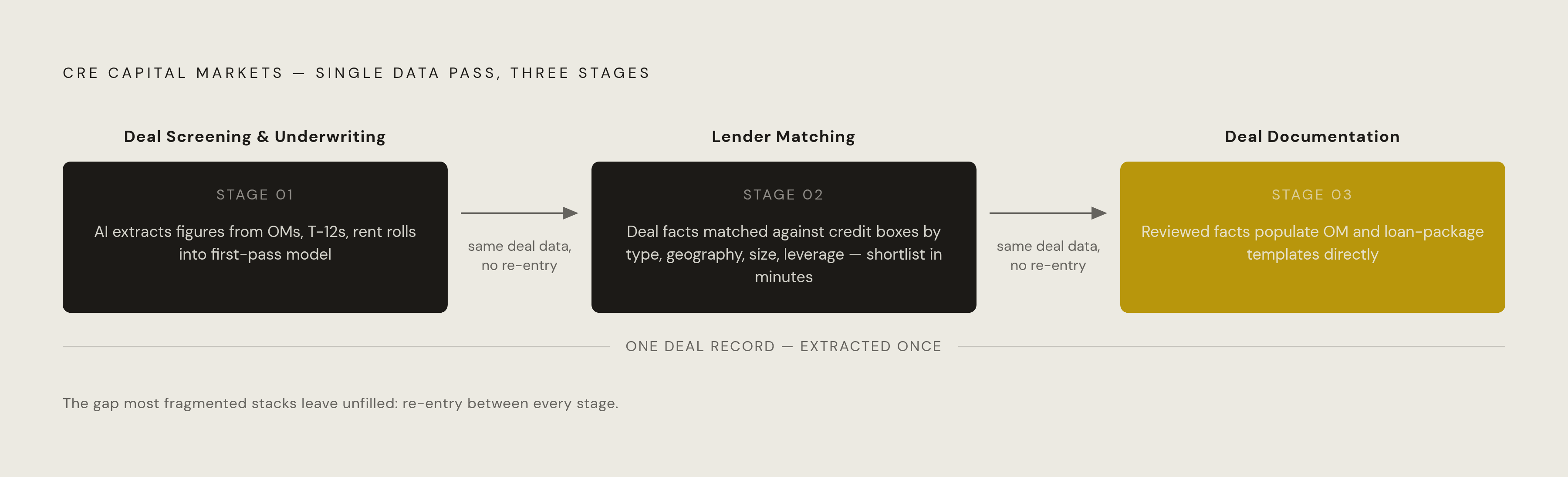
Responsible adoption begins with a bounded workflow whose performance can be judged. A growing practice should identify the one or two stages with the highest volume, the most repetitive manual steps, and the clearest output standard. For most capital markets teams, underwriting extraction is the first candidate, followed by lender matching and then documentation. That sequence addresses internal effort before external sourcing speed and downstream production. It does not require solving the whole stack at once.
The strategy distinguishes a compelling demonstration from a solution that connects to the right systems, respects access controls, and produces reliable outputs within the real process. A workflow that fails those tests is not ready to become the foundation for adjacent stages. A successful one provides a controlled starting point. The next investment should build on that connection and keep new automation linked to the work already in place.
Purpose-built tools are now accessible to practices that previously would have needed enterprise budgets, so growing teams need not wait for enterprise scale. The destination is a practice where deal data enters once at screening, moves through underwriting and matching without re-entry, and leaves as a lender-ready package. Every figure remains traceable, and every required human review checkpoint is documented. Analysts spend less time transporting information and more time judging the transaction it describes.