Financial Spreading for CRE Underwriting From Raw Operating Statements
Automated spreading converts messy borrower documents into standardized credit data.
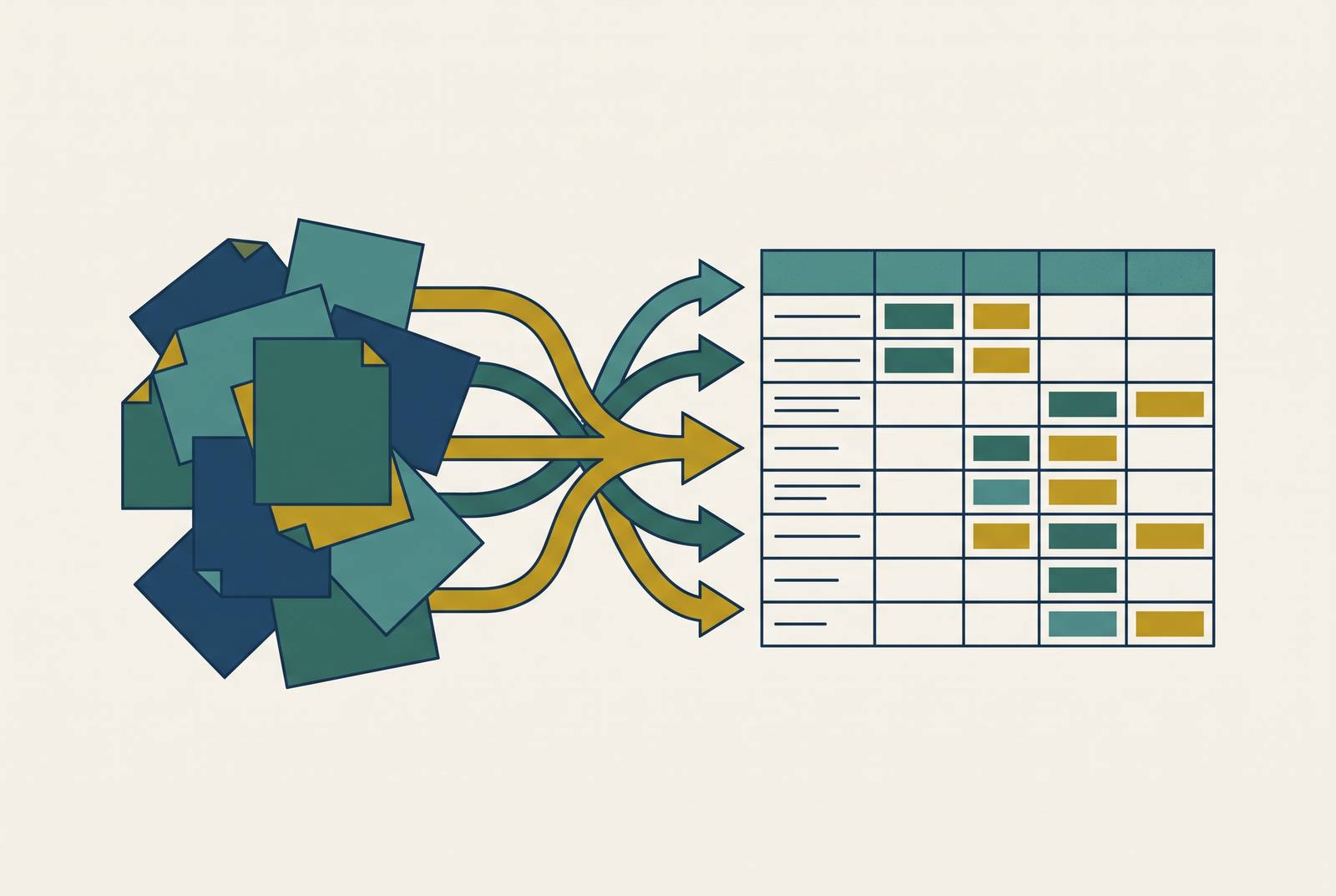
Financial spreading is the conversion of raw operating statements, rent rolls, T-12s, and borrower financials into standardized, decision-ready credit data that underwriters can actually use. The output of good spreading is practical and specific: a standardized income statement, a balance sheet, a cash-flow view, borrower trends, add-backs, key ratios, and the inputs that feed DSCR. Spreading isn't the credit decision itself, but everything that has to happen before an underwriter can make that decision with confidence. A single CRE file may contain three years of tax returns, T-12 operating statements, an Excel rent roll, bank statements, leases, a borrower schedule of real estate owned, and a scanned appraisal summary, and none of it arrives in a standard format. Two borrowers with nearly identical revenue can demand wildly different preparation effort: one submits clean, accountant-prepared statements, while the other hands over scanned tax returns, partial bank statements, and an interim Excel file built around custom line items. The credit risk between those two borrowers might be comparable, but the labor required to get each file into usable shape is not. Rent rolls, T-12s, operating statements, appraisals, and agency workbooks each carry their own structure, their own exceptions, and their own review logic, and that specificity is why general-purpose OCR tools consistently fail on CRE documents in ways they don't on more generic business records.
The manual spreading workflow, step by step
Manual spreading doesn't fail because analysts lack the skill to do it. It fails because so much of that skill goes to low-value handling work, and that imbalance worsens as deal volume climbs. The typical sequence runs through document collection, data entry, line-item mapping, exception handling, footnote review, tax schedule interpretation, and quality control, and each of those steps introduces its own chance for delay or error. Analysts sort PDFs, Excel files, scans, and tax schedules by hand, decide manually where each borrower-specific line item belongs, and check totals, periods, formulas, and copied values one at a time. Every handoff along the way, whether it's a PDF routed by email, a T-12 rekeyed into a spreadsheet, or a rent roll rebuilt from scratch for a new reporting cycle, adds another point where delay, inconsistency, or a simple input error can enter the file. The effects compound downstream in the credit department: slower time-to-decision, credit files that don't match each other in structure or quality, higher operating costs, and less analyst time left over for actual risk analysis. A useful test for any credit shop is this: if analysts spend more hours preparing numbers than they spend challenging the assumptions behind those numbers, manual spreading is capping underwriting capacity. At an institutional acquisition team working through a heavy deal pipeline, a senior analyst can spend most of the available time on data entry and model construction before ever reaching a judgment call on a single offering memorandum, and that time loss adds up across every deal that follows.
The manual bottleneck and the current volume environment
The binding constraint on deploying capital in the current CRE market is the operational capacity to underwrite deals quickly, accurately, and at scale. A recent survey of bank loan officers found that banks reported generally unchanged CRE lending standards overall, with large banks reporting some easing and smaller banks reporting some tightening, even as loan demand strengthened. Institutions facing that combination need more throughput without loosening controls and without expanding headcount at the same pace volume is rising. Fragmented workflows, the kind built on PDFs routed by email, T-12s rekeyed into spreadsheets, and rent rolls rebuilt for every reporting cycle, aren't simply slow. They introduce inconsistency and error risk at the exact point where lenders most need their inputs to be reliable. A lender that takes weeks to produce a term sheet because pipeline data is scattered across formats and inboxes signals operational weakness to the borrower on the other side of the table, and speed at origination has become part of go-to-market strategy. Lenders that move from first look to term sheet with speed and precision tend to close more deals, often because the speed itself gives borrowers more confidence in the process. That competitive pressure is what pushes the conversation toward automation.
Automated financial spreading: from document ingestion to credit-ready output
AI-powered financial spreading differs from basic OCR in a fundamental way: it classifies financial line items, aligns reporting periods, reconciles totals, flags anomalies, and prepares outputs built for credit analysis, rather than simply reading characters off a scanned page. The workflow runs in a consistent sequence. Borrower financial statements, tax returns, bank statements, PDFs, Excel files, and scans enter the system across whatever format they originally arrived in, and the platform extracts and classifies that content, mapping borrower-specific line items into the lender's own standard financial categories. From there, the system reconciles periods, totals, and missing values, flagging anomalies for an analyst to review. The system outputs standardized statements, ratios, cash-flow views, and DSCR inputs, ready to move into underwriting. Analysts still validate exceptions, and they carry the work forward into the lender's existing credit process. The distinction that matters here is that automation removes low-value handling work, not credit judgment: AI doesn't replace an underwriter's analysis, it clears the path so analysts spend more time testing assumptions and less time moving numbers between files. Integration matters too, because AI spreading needs to work alongside a lender's existing loan origination system, not force a wholesale system replacement. Clik.ai, for instance, operates as a single infrastructure layer for CRE and commercial banking operations, automating the spreading of property and loan documents into production-ready outputs, including Excel-based financial models, rather than functioning as a narrow point solution that handles one step and leaves the rest to manual work. For regulated lenders, human review remains essential regardless of how good the automation gets: analysts need to validate extracted data, review assumptions, inspect source references, and explain how a number moved from the borrower's original document into the credit model. A well-built workflow delivers speed, but it doesn't turn the credit file into a black box.
The CRE-specific metrics spreading must produce
A DSCR calculation is only as reliable as the assumptions built into it, and the same property can produce a materially different result depending on how net operating income gets normalized. You need every adjustment behind that number to be visible and traceable, so it isn't buried inside an analyst's personal spreadsheet. CRE underwriting software should calculate net operating income, DSCR, LTV, debt yield, occupancy, expense ratio, break-even occupancy, global cash flow, and borrower liquidity, and it should expose the inputs behind each figure, not just the final ratio. The adjustments that normalize NOI, vacancy allowance, one-time or non-recurring expenses, replacement reserves, real estate taxes and insurance, management fee adjustments, amortization changes, and interest rate stress tested at current market rates against the borrower's requested rate, all need to be explicitly controlled and auditable. In an uncontrolled spreadsheet environment, NOI adjustments get added back without any standard audit trail, reserves get omitted or applied inconsistently from one deal to the next, and interest rate stress assumptions end up depending on which model version or which analyst happened to build the file. A policy-driven software approach changes that picture: adjustments tie back to source documents and defined policy rules, reserve treatment stays visible and repeatable across property types, stress assumptions can be configured and flagged automatically when they fall outside policy, and a reviewer sees the calculation, the underlying assumptions, and the source references together in one place. Credit teams benefit when they define institution-specific thresholds so the software flags exceptions consistently, instead of depending on each analyst to remember every detail of policy from memory. The stakes rise further in multi-tranche structures, where senior debt is constrained by LTV, DSCR, and debt yield simultaneously and mezzanine or preferred equity sits layered on top. In that structure, NOI flows through every constraint at once, so standardized, traceable inputs matter even more to getting the capital stack right.
Fraud and data-quality checks that good spreading platforms build into the workflow
The strongest spreading platforms don't stop at extraction and normalization. They compare facts across the full document package, and they surface items that deserve underwriter review before credit analysis even begins. Consider a rent roll that shows strong occupancy and healthy expected collections: if bank statement deposits don't align with that picture over the same period, the variance appears in automated review rather than waiting for an analyst to manually inspect every transaction line. Good systems are built to catch a specific set of document-level red flags, including altered PDFs, missing pages, inconsistent entity names, sudden occupancy jumps, unsupported expense reductions, and lease totals that don't match the operating statements submitted alongside them. AI-driven bank statement analysis can compare deposits, cash flow patterns, and borrower-provided schedules against each other in a fraction of the time it would take an analyst to perform the same cross-check by hand. None of these checks make the final credit decision on their own. What they do is hand the underwriter a cleaner fact base, which makes the eventual recommendation easier to explain and defend in front of a credit committee. For regulated lenders, auditability isn't optional: reviewers need to trace any spread value back to the specific source page, schedule, or cell it came from, and automation that can't support that kind of trace introduces a different category of risk than the one it was meant to remove.
The credit memo stage when spreading is done right
When spreading produces structured, traceable outputs, the credit memo stops requiring a separate research effort and becomes largely a documentation step, with a lender-branded memo generated directly from the spread data, sources and assumptions already attached. At minimum, a CRE credit memo needs to present deal structure, NOI, DSCR, LTV, debt yield, key risk factors, and the underwriter's recommendation, all stated in the language a credit committee expects to see. Manual credit memo preparation typically takes multiple hours for a standard commercial deal, and it takes considerably longer for complex multi-entity or CRE transactions, and that time accrues across every deal moving through the pipeline at once. When the memo is generated straight from the spread data, the calculations, assumptions, and source references arrive already embedded in the document, so reviewers can trace a number back to its origin. Approval routing through the institution's review chain can follow immediately once outputs sit in the lender's standard format, skipping the manual reformatting step that otherwise delays the handoff. The quality of the memo is downstream of the quality of the spread: if the spread itself is wrong, the memo built on top of it is wrong too, regardless of how clean the final document looks. The same baseline data that produces the credit memo can also support covenant monitoring after close. Spreading quality shapes not just origination speed but the ongoing management of the portfolio.
Spreading discipline benefits brokers and sponsors
The discipline described above isn't exclusive to lenders. Sponsors and brokers who prepare and present their own financials with the same rigor gain a measurable advantage in how quickly and confidently a lender can underwrite their deal. A well-structured financial package, with normalized NOI, visible adjustments, and consistent period alignment, effectively accelerates the lender's own spreading process and cuts down the back-and-forth that otherwise delays a term sheet. A lender's spreading tool works fastest and most accurately when its input documents are consistent and complete, so sponsors who anticipate what a lender needs to spread, clean T-12s, organized rent rolls, clear expense schedules, compress their own deal timelines in the process. Brokers assembling loan packages and offering memoranda face a parallel opportunity: AI tools that extract deal facts from raw documents, such as rent rolls and operating statements, and structure them into a formatted package cut down the hours otherwise spent on manual reformatting and calculation checking. Lev, for example, builds tools aimed at this side of the transaction, giving sponsors and brokers a way to generate structured financing packages and deal documentation without rebuilding that structure by hand for every submission. A broker who delivers a loan package that maps cleanly to a lender's credit template is doing more than saving the lender a few hours of work. That clean mapping signals operational credibility, and it lowers the perceived risk of the deal before an underwriter has read a single line item. If sponsors and brokers build this discipline into their process early, they carry structurally lower overhead on every deal they bring to market, and that lets them move faster whenever a market window opens.
The shift from automated spreading to agentic underwriting workflows
The spreading step that once consumed hours of analyst time is turning into one automated node inside a coordinated, multi-step underwriting workflow, and CRE professionals who understand how that underlying process works will be better positioned to evaluate these systems as they mature. Earlier generations of AI tools handled individual steps in isolation, while agentic AI frameworks now coordinate entire sequences at once, pulling market data, running comps, normalizing NOI, stress-testing the model, flagging risks, drafting the credit memo, and routing exceptions, all without the manual handoffs that used to separate each step. That shift is already visible at the institutional level, where major enterprise CRE platforms are embedding autonomous agent features directly into their software, moving from AI that assists with a single task toward AI that orchestrates an entire deal lifecycle. For individual firms, understanding what spreading is, what it must produce, and where it tends to fail is the foundation for evaluating any AI underwriting platform with real judgment, because the quality of every downstream step depends directly on the quality of the spreading inputs feeding it. Firms that treat spreading as a commodity step and focus only on the credit decision at the end will be slower to catch the errors that propagate forward from bad inputs, and slower to capture the productivity gains that good inputs make possible. The conviction behind platforms like Clik.ai and Lev, that commercial real estate deserves purpose-built AI rather than generic tools retrofitted from other industries, gets validated precisely at the spreading layer, where CRE document types demand domain-specific logic that horizontal platforms aren't built to provide reliably. Spreading quality determines underwriting quality, and everything the industry is building toward now, agentic or otherwise, rests on that fact.