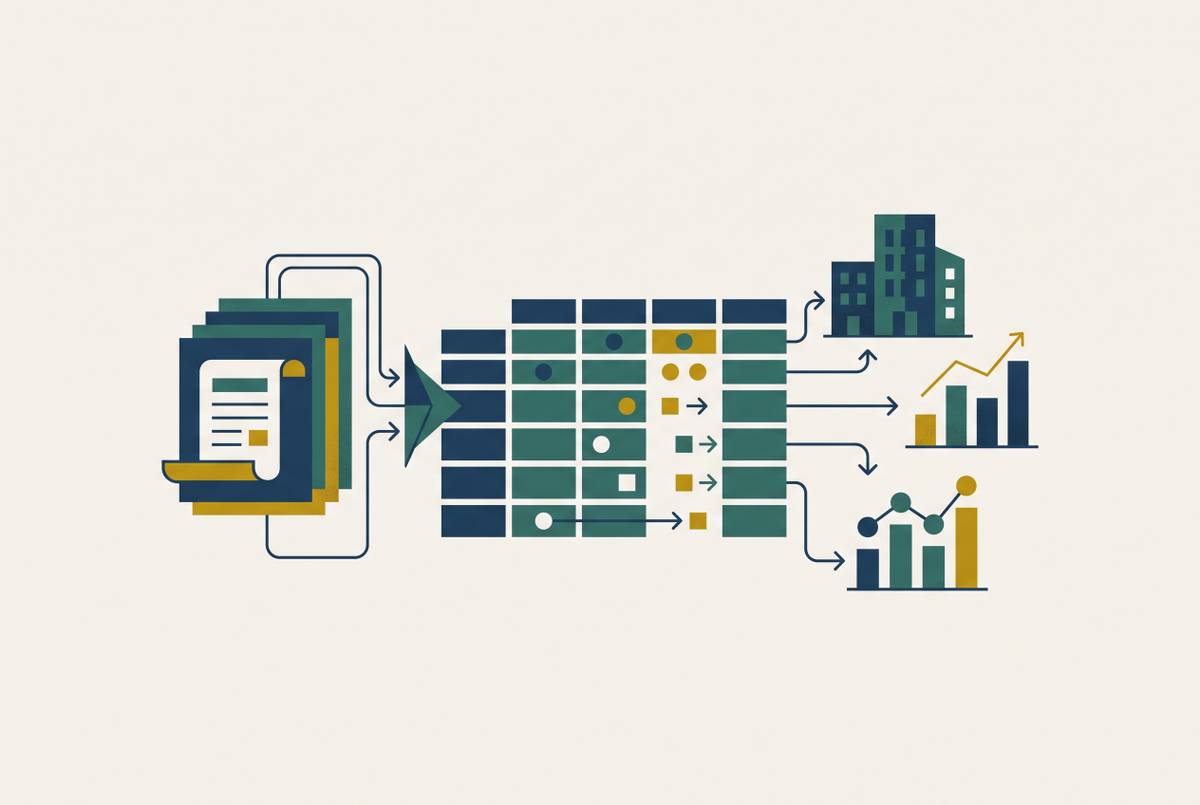
Rent Roll and Operating Statement Automation Platforms Benchmarked Against Institutional CRE Deal Volume
Three CRE automation platforms tested on institutional deal complexity and extraction accuracy.

PRODA, Radix Underwriting, and Fifth Dimension automate different parts of CRE financial spreading, from rent roll normalization to multifamily pro formas and investment screening. The right institutional benchmark is extraction accuracy, full-package throughput, and cross-document reconciliation, tested against the firm’s own documents.
Why institutional deal volume exposes the limits of standard automation tools
An institutional acquisition package can contain an 85-page rent roll exported from Yardi, a trailing-12-month operating statement mapped to a proprietary chart of accounts, multiple lease abstracts, an appraisal, environmental reports, and guarantor financials. These arrive together and need reconciliation before the deadline. PRODA’s official blog describes an 85-page Yardi PDF for which an outsourced processor billed 20 hours of manual processing time.
The harder task is connecting the documents. Does the rent roll support the T-12, and does the appraisal assume a rent level the property has never achieved? Guarantor schedules also raise the question of whether leverage sits outside the property-level financials. Meanwhile, borrower spreadsheets use inconsistent columns, operating statements use bespoke expense categories, and offering memoranda vary by market, asset class, and vintage. Institutional volume therefore tests more than reading speed. It tests whether an automation workflow can keep the meaning intact across formats that conflict while several deals compete for attention.
What extraction accuracy, throughput, and cross-document reconciliation actually mean as benchmarks
Extraction accuracy means pulling the correct number from an unstructured document and tracing it to a specific source page and table. The test needs to cover format variability because clean PDFs, scanned documents, non-English formats, and broker-specific exports each ask different things of the tool. The test also changes with asset class coverage, since multifamily rent rolls differ from office lease abstracts and industrial operating statements.
Throughput means processing the full financial package in parallel and sustaining that pace across concurrent deals. Cross-document reconciliation means detecting disagreement between documents, including mismatched revenue totals, conflicting assumptions, and inconsistent entity names. It is distinct from checking whether individual fields were extracted correctly. Where the data goes also affects throughput, because the underwriting handoff is still unfinished if someone has to move the data into Excel by hand.
The three-layer architecture that separates document extraction platforms from underwriting platforms
Layer 1 is document extraction, which converts rent rolls, T-12s, OMs, and leases into structured data without itself performing financial modeling. Layer 2 is financial modeling, which generates or populates DCF pro formas, sizes debt, and models waterfalls. ARGUS Enterprise is the institutional standard for commercial real estate valuation and financial modeling, while Radix Underwriting combines extraction with structured multifamily modeling. These layers solve different problems. Deal management systems track the pipeline and should not be treated as substitutes for either.
Layer 3 is institutional knowledge, which draws on a firm’s deal history to build a proprietary comp database from cap rates, operating expense ratios, and debt terms. It is the least mature layer. Most acquisition teams need extraction to feed data into a modeling environment, either through separate products or through an integrated workflow. Accuracy and throughput govern the extraction benchmark, while formula integrity and deal-structure depth govern the modeling benchmark. Comparing both on one undifferentiated scorecard obscures where each platform contributes and where another system remains necessary.
How PRODA performs against the institutional benchmark
PRODA provides the most documented institutional-scale extraction baseline among these profiles, with named clients including large institutional real estate firms. Its core function is ingesting rent roll files in different formats and mapping them to a unified data model. The 800-point data model runs hundreds of automated validation checks against each file, flagging errors. This gives the accuracy benchmark an operational mechanism. PRODA is backed by JLL Spark, ING Ventures, Blackstone Innovations Investments, and Concrete VC, although backing does not establish processing performance.
It is best suited to reports from joint venture partners and third-party property managers whose files differ in format, language, and market convention. Normalization is the central job in that workflow. But within-file validation does not show that a tool handles package-wide reconciliation, and PRODA does not claim to offer financial modeling or deal management. The downstream handoff still needs its own test. Clik.ai’s Bellwether Enterprise case study documents integration of 90+ life company, CMBS, and agency underwriting models into lender upstream systems, illustrating the integration requirement.
How Radix Underwriting (formerly redIQ) performs against the institutional benchmark
Radix Underwriting is the platform formerly known as redIQ. Radix’s official product page calls it “the next chapter of redIQ,” with the rebrand ongoing as of 2026 following the August 2024 acquisition. Its distinction is the connection between extraction and modeling. Radix standardizes rent rolls and T-12s against a custom chart of accounts and feeds the data into a structured multifamily pro forma, so it handles the transfer that a pure extraction tool leaves to another system.
That integration raises the standard for a successful test. Correctly extracted fields are necessary, but the output must also be a pro forma the underwriter can support without rebuilding the inputs. The accuracy test therefore extends into account mapping, while the throughput test ends after the model has usable data. Multifamily specificity is both a strength and a boundary. A team underwriting office, industrial, and multifamily assets still needs a different extraction tool for the non-multifamily deals, so it should test Radix’s integrated workflow on the deals it is built to handle.
How Fifth Dimension's agent-based approach performs against the institutional benchmark
Fifth Dimension’s agent, Ellie, extends automation from extraction into screening. It ingests opportunities, normalizes T-12 and rent roll data, benchmarks them against the firm’s investment criteria, and returns a go/no-go recommendation. Ellie also drafts investment committee memos covering the deal summary, market overview, sponsor analysis, underwriting walk through, and risk register. Each section is cited back to source files. That citation trail makes the draft verifiable, but the recommendation introduces a judgment test beyond whether the source numbers were read correctly.
The benchmark becomes whether the investment thesis can be encoded well enough for the recommendation to withstand review. Nuanced qualitative criteria or frequently shifting mandates can require substantial human rework. Fifth Dimension announced a Series A led by HV Capital on May 11, 2026, with participation from Prudence, Mercia, MMC, and AFG, and continued support from Speedinvest, Seedcamp, and Anthemis. That funding is relevant to platform longevity, with institutional throughput requiring separate evidence. Its deployment history is earlier than PRODA’s or Radix’s, and the supplied sources do not document named case studies at large institutional real estate clients.
How general-purpose AI tools (Claude, ChatGPT) perform against the institutional benchmark
That role has strict rules for sources and review. These tools can accelerate an initial reading without constituting a complete financial spreading system. The distinction becomes clear when the analyst moves from summarizing a document to producing normalized, verified inputs for an underwriting model.
In the ad hoc general-model workflow considered here, native cross-document reconciliation, chart-of-accounts normalization, and automated validation checks are absent. Structured output also needs manual intermediation before it flows into the team’s Excel model. Page-and-table attribution requires the analyst to construct the citation trail rather than rely on an established extraction workflow, which can erase much of the throughput gain at institutional volume. The affirmative case for purpose-built CRE tools is this reduction in repeated verification and transfer work.
The cross-document reconciliation gap that separates adequate tools from institutional-grade ones
Cross-document reconciliation should be the first evaluator question because correct extraction can faithfully reproduce inconsistent information. A seller may adjust the T-12 without updating the rent roll, while an appraisal may assume rent the property has never achieved. Contingent liabilities can also be spread across guarantor tax returns and entity schedules. None of these conflicts requires an extraction error. A system can read every document accurately and still leave the central diligence problem unresolved.
Entity resolution is part of that problem. Recognizing that “ABC Holdings LLC,” “ABC Holdings,” and “ABC” refer to the same tenant or guarantor enables comparisons that literal name matching can miss. This capability has become functional in production systems, but implementation varies significantly across platforms. The evaluator’s first question should therefore be whether the system flags disagreement between documents or silently resolves it. A large validation model, an integrated pro forma, and a cited memo each show a different capability, so each alone leaves that question open.
Which software fits a CRE team's financial spreading workflow and deal type?
For large portfolio owners, PRODA fits the need to normalize data reported by joint venture partners and third-party managers across languages and markets. For multifamily acquisition teams, Radix fits the need to connect standardized rent rolls and T-12s directly to a structured pro forma. The deciding distinction is where work accumulates. Sponsors and brokers evaluating these categories need to separate a reporting-format bottleneck from a modeling handoff, rather than assume the broadest feature set will serve both equally well.
Fifth Dimension’s architecture suits investment firms that have machine-readable investment criteria and need screening and first-draft IC memos. Lending creates a wider document requirement. Aloan addresses community and regional bank CRE teams that need rent rolls, operating statements, sponsor tax returns, guarantor financials, and appraisals in a single source-cited underwriting package. Enterprise lenders testing that broader workflow also need to check whether a tool covers the full file or handles rent roll extraction alone. Across these use cases, whether data lands in existing Excel models, a proprietary interface, or a purpose-built CRE environment changes implementation cost and output auditability.
How to build a stress-test before signing an annual contract
The practical evaluation should use a real package from the firm’s pipeline. For the format test, provide the messiest rent roll the team regularly receives, whether a borrower spreadsheet, scanned broker PDF, or Yardi export with non-standard headers. Measure extraction accuracy against ground truth that has been checked by hand. Then submit the full package, including the OM, T-12, rent roll, lease abstracts, appraisal, environmental report, and guarantor financials. Measuring end-to-end processing time across concurrent deals exposes throughput limits that isolated document speed does not capture.
The reconciliation test should add a known variance in effective gross revenue between the rent roll and T-12 on purpose. Record whether the system flags it, where the flag appears, and whether it points to a specific source page. Auditability needs its own test. Open the extraction output and establish whether every field can be traced to its source page and table. An output without that trail is not a dependable basis for investment committee review.
Finally, require validated data to flow into the existing Excel model or approved modeling environment without anyone having to enter it again by hand. For modeling tools, open the output workbook and inspect cells for live formulas referencing other cells and for hardcoded numbers. These requirements can form the vendor’s acceptance test before an annual commitment. The analyst remains accountable for the final recommendation. Automation can compress extraction, normalization, and first-pass reconciliation, but data quality validation, market judgment, and model integrity remain analyst responsibilities.