Benchmarking AI Offering Memorandum Generators Against Institutional Capital Markets Standards
AI-generated offering memoranda still need institutional verification before lenders will fund.

IntellCRE and the A.CRE Offering Memorandum Creator Assistant can generate commercial real estate offering memoranda from supplied property information, but automated production does not make an OM lender-ready. For automated CRE offering memorandum and loan memo generation, the institutional benchmark is traceable figures, defensible market evidence, validated sizing, and appropriate governance. Speed and visual polish are useful only after those requirements are met.
What institutional capital markets actually require in an offering memorandum
An institutional package begins with a one-to-two-page executive summary covering the loan request, property overview, capital stack, business plan, exit strategy, and sponsor credentials. The lender needs to understand the deal before opening the attachments. Beyond that summary, debt service coverage, loan-to-value, and debt yield must be tested independently, with the binding constraint setting maximum proceeds. A submission without those tests can consume weeks of underwriting on a deal that will not pencil.
The sponsor is also part of the underwriting. Institutional-grade reporting, controls, and governance are filters rather than background information, and platforms without them can be excluded before their numbers receive consideration. Conservative leverage, a capital stack that is clearly laid out, downside protection that is clear, and a professional underwriting framework help a deal pass institutional underwriting. The narrative still has a precise job, which is to explain the transaction without outrunning its evidence. By that standard, an offering memorandum is ultimately a data-integrity document.
Why 2026 is a harder environment for OM submissions than prior cycles
CRE debt markets in 2026 have more capital to lend, but tighter underwriting standards make them more selective. Banks, CMBS, and private credit outlets have applied materially tougher standards in response to higher-for-longer rates, mounting maturities, and closer scrutiny of sponsorship quality. Asset quality and execution strategy, rather than deal volume, determine outcomes. In that environment, a weakly supported submission is competing against packages built to withstand more demanding review.
Institutional LPs increasingly judge managers by their reporting infrastructure as well as their returns, so well-run underwriting operations give managers another way to stand out when raising funds. Consistent, defensible documentation across deals builds a transparency track record, raising the standard for the platform behind the sponsor as well as for each submitted document. A credible OM therefore has to reflect repeatable controls for assembling transaction materials.
How AI OM tools actually work, and what they are optimizing for
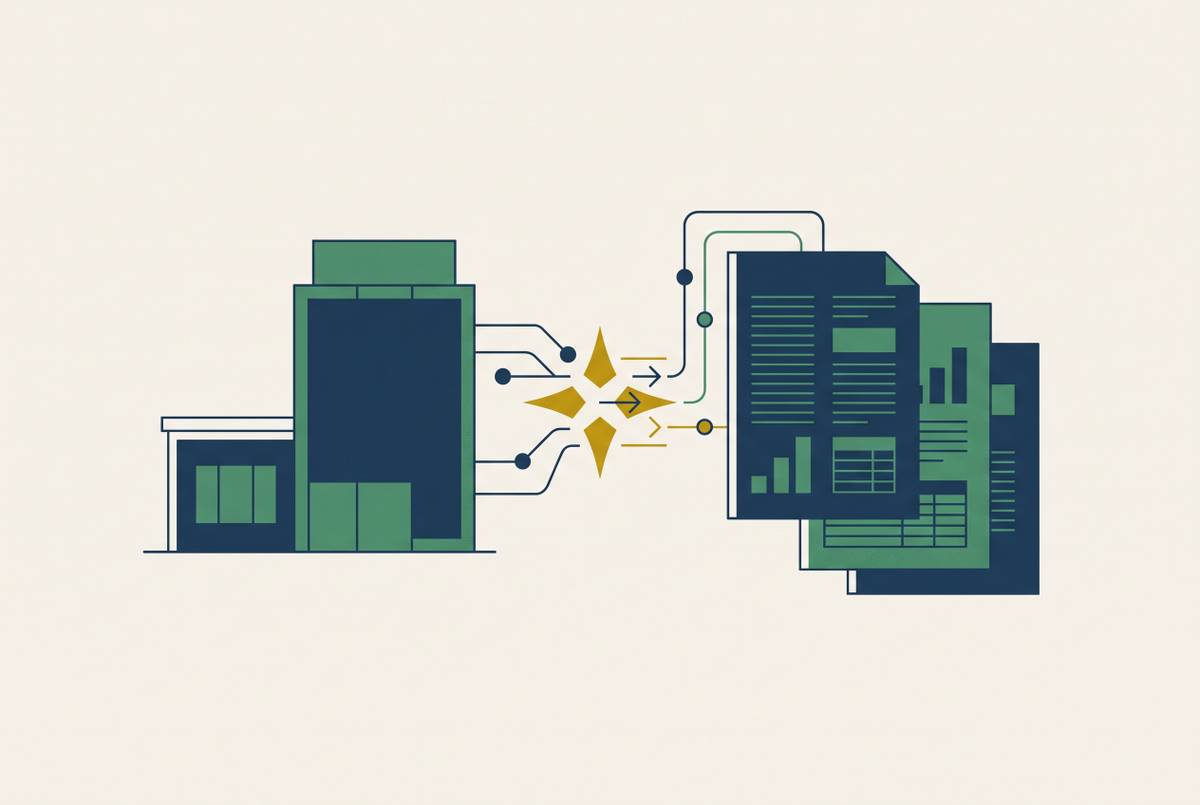
Document intelligence extracts structured information from rent rolls, T-12s, and deal files, while intermediate stages may calculate ratios, reconcile documents, or retrieve supporting context. A large language model then turns the processed data into narrative sections. Where a generator fills missing inputs with industry norms, it substitutes general assumptions for absent property-specific facts. The writing may look complete even when the evidence behind it has gaps.
IntellCRE illustrates a marketing-oriented implementation of this workflow. It generates OMs, BOVs, brochures, listing websites, and flipbooks from uploaded rent rolls, T-12s, and a user’s own Excel model, with a stated focus on brand consistency and same-day turnaround. This production goal differs from establishing whether every number can withstand underwriting verification.
Adventures in CRE’s Fall 2026 edition describes five layers of the CRE AI stack, namely harness, model, connectors, knowledge, and you. Its scope is broader than institutional packages. Tools including Claude for Excel, ChatGPT for Excel, Endex, and Shortcut AI bring AI into spreadsheets, while Green Street, MSCI Real Assets, Yardi Matrix, ATTOM, and Regrid publish MCP servers connecting licensed data to Claude or ChatGPT. Moody’s also publishes MCP servers. These developments move AI closer to underwriting inputs, but an OM generator alone does not cover the whole workflow.
Where the A.CRE tool meets institutional requirements and where it does not
The A.CRE Offering Memorandum Creator Assistant produces a recognizable institutional document sequence, including a cover page, table of contents, executive summary, financial summary, and market overview. That structure has genuine first-draft and training value. The tool is designed for education and professional practice, and its documentation acknowledges that accuracy improves when specific information is supplied.
The decisive limitation is how it handles gaps. When specific case study inputs are missing, the assistant uses industry norms and assumptions to fill in details. It can also generate a table of hypothetical comparable sales when explicitly asked. Such a table can serve an educational scenario, but it cannot substitute for market-supported, verifiable comparables in an institutional submission.
The assistant originally required a ChatGPT Plus paid membership, although OpenAI has since made existing GPTs available to all signed-in users. Access to a drafting assistant, however, is not equivalent to an enterprise underwriting platform. For a live submission, structural completeness must be separated from the evidentiary quality of the content placed within that structure.
The hallucination problem and why it is structurally worse in OM production than in other AI use cases
Hallucination in OM production can affect financial figures, comp citations, and sponsor representations, which are among the first fields institutional underwriters verify. A wrong NOI or DSCR can change a sizing decision. A false representation may change whether a deal appears financeable, even when the surrounding narrative remains coherent and professional.
Errors can also propagate from supporting documents into projections. A fabricated exclusivity clause or an incorrect CAM reconciliation formula in a lease abstract could affect downstream NOI projections and cap rate calculations. An unsupported comparable can also look sound until someone else checks the transaction. An explicitly requested hypothetical comp is not inherently a hallucination, but presenting it as actual market evidence creates the same verification gap. The lender then becomes the mechanism for finding an error that should have been addressed before submission.
Reliability consequently depends on more than model capability. Experimental evaluation using adversarial critique architecture reduced hallucination rates to 3.8% and increased decision accuracy while reserving all binding decisions for humans. That finding backs the use of architectural controls but leaves open how reliable OM generators are as a whole. Without validation built for the task, flaws in how data is ingested can hurt the output, whichever model writes the prose.
What extraction-first tools do differently, and why that architecture is closer to what lenders need
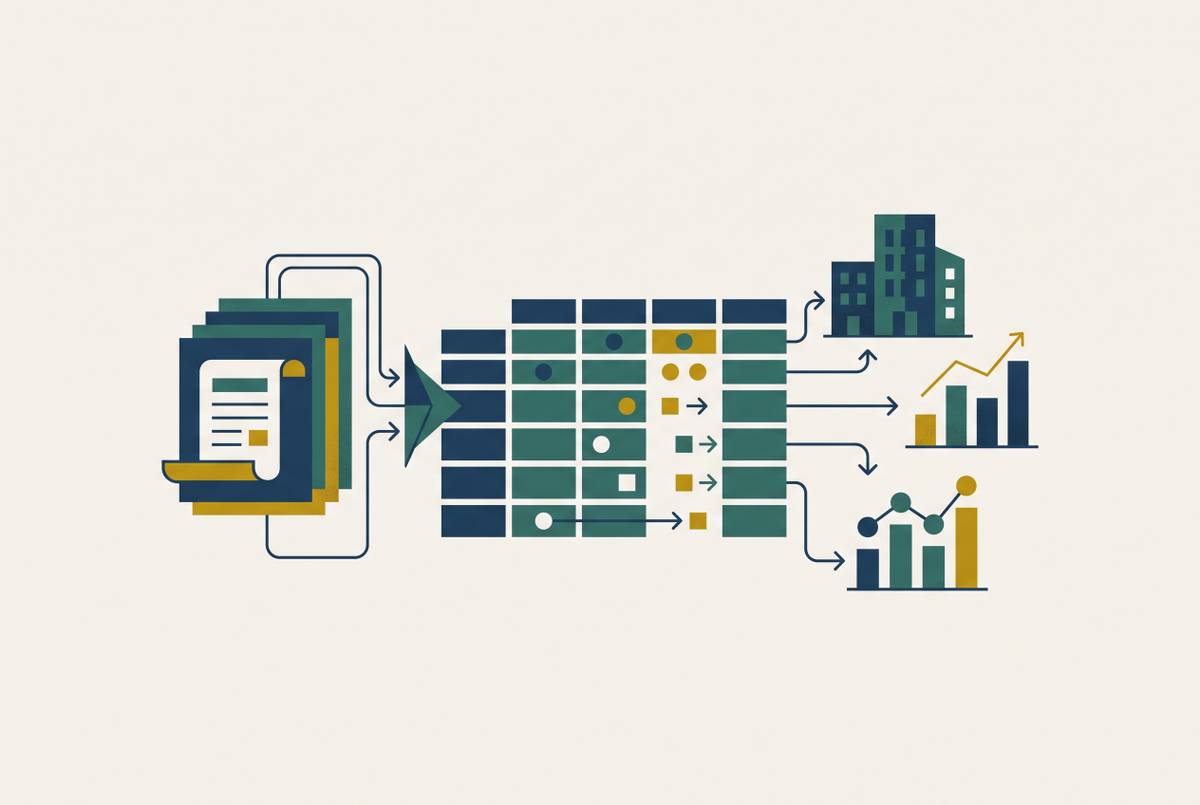
Extraction-first tools begin by ingesting supporting documents, including rent rolls, T-12s, and existing deal files, then map structured information into underwriting models while preserving source attribution. This can reduce model population time by many hours per deal. More importantly, it supports the underwriter’s primary verification task of tracing a figure back to the document that supports it. Missing evidence remains a data problem rather than becoming an invitation to generate an answer.
The practical distinction is the provenance chain. In lease abstraction, a useful test is whether the user can click from an output number to the sentence in the source document. OM figures need to be traceable in the same way, with references to the source pages or cells that support them.
IntellCRE partly supports this approach by accepting a user’s own Excel underwriting model, allowing document production to start with sponsor-controlled figures. That route is strongest when the sponsor has already validated the model. The product also offers AI-generated estimated expenses, market rents, and exit cap rate predictions when the user has not supplied the data. Bringing a validated model into document production supports institutional review in a way that generating missing figures from assumptions does not.
What a purpose-built CRE AI platform adds that point solutions cannot
Extraction establishes where a number came from, but it does not by itself establish whether the transaction works. A purpose-built platform brings source data, the logic for each workflow, and document generation together on one foundation. Its validation layer can check figures against the independent sizing constraints before the package is sent. That shifts error detection earlier in the process. A document generator without that connection can produce polished prose around figures that have not passed the lender’s tests.
Market evidence needs the same connection to production. A platform grounded in live CRE data can populate comparable sections with sourced transactions. The Fall 2026 shift toward agents that carry out multi-step deal workflows favors systems that take work from ingestion through document production to capital matching without passing it between disconnected tools.
Governance must also cover the whole shared environment. Rent rolls, T-12s, sponsor financials, and lender communications contain sensitive information, making enterprise-grade security and controls essential. Putting everything in one interface does not by itself provide those protections. The institutional advantage depends on the platform actually supplying the data foundation, validation logic, and governance that a drafting point solution does not provide.
The "human in the loop" safeguard and why it is insufficient without the right data foundation
Human review is the strongest safeguard against treating an AI draft as a finished institutional submission. A reviewer can challenge conclusions, identify inconsistencies, and retain authority over the final decision. That responsibility should remain with the human reviewer. The reviewer receives an output with potentially limited visibility into the inference that produced it. A plausible figure derived from missing, stale, or fabricated evidence may not reveal its weakness on the page.
Surface review and source verification are distinct, necessary tasks in human review, and the former cannot substitute for the latter. Incomplete or inconsistent property data can produce confident but wrong outputs, leaving the reviewer to reconstruct their evidentiary basis. When sources are hard to reach, the time saved on drafting can be lost to the work of checking each claim.
The sound operational pattern is AI for the first draft and a human for the final call, backed by documented quality control. Its effectiveness depends on how the draft was built. A sourced draft lets the reviewer test the transaction and its presentation, while an assumption-filled draft transfers the burden of discovering unsupported inputs to that reviewer.
A practical framework for evaluating any AI OM tool against institutional standards
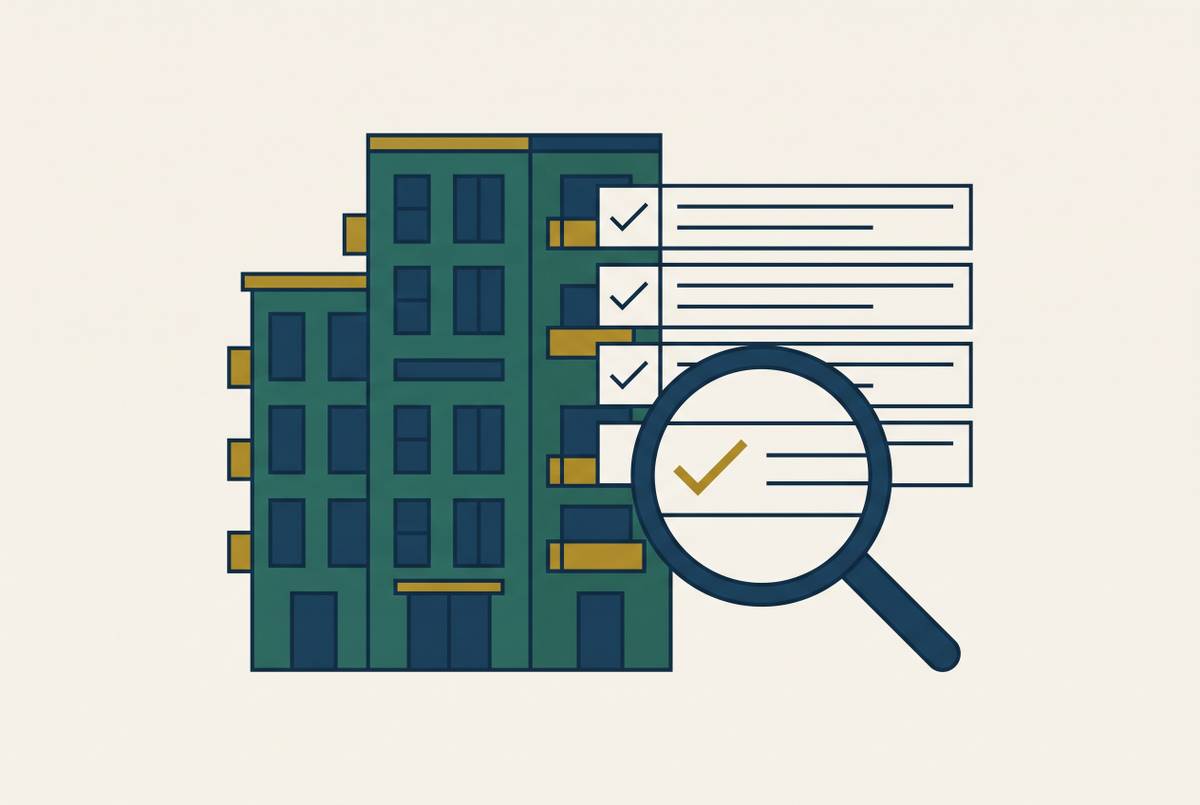
Sponsors and brokers should judge tools by four criteria, starting with figure-level traceability. Can every generated figure be traced to a named source document with a page or cell reference? Missing inputs filled with industry norms do not pass that test as documented property facts. The second criterion is sizing validation before submission against DSCR, LTV, and debt yield by property type. A visually complete document is not a substitute for tested proceeds.
The third criterion concerns market evidence and currency. Comparable data needs scrutiny of where it comes from and whether it is current, with real-time, sourced comps from licensed providers as the institutional standard. Hypothetical sales and static comparables present different problems from hallucinated transactions, but neither satisfies that requirement. The fourth criterion is enterprise-grade security and governance appropriate for rent rolls, sponsor financials, and capital stack details. A GPT wrapper without suitable access controls is not appropriate for live deal data.
The A.CRE assistant offers structured drafting for education and professional practice, while IntellCRE offers marketing production with a sponsor-model input option. Neither capability alone establishes that all four institutional tests are met. Extraction-first and unified CRE platforms are architecturally closest to the requirement when they connect sourced inputs, validation, and controlled document production. Firms adopting any tool should document how numbers are verified, so the resulting OM or loan memo is defensible without asking an institutional reviewer to trust the interface.